



Bury October 7 and Blame the Kaplan Protestors: How the Israeli Right Plans to Win the Next Election
Right-wing strategists share their campaign plans, goals and means: Smashing the ‘anyone but Bibi’ camp by calling for national unity – under Netanyahu; Appealing to the mainstream right, even while saying contradictory things to placate the base; Thwarting the establishment of a state commission of inquiry by delegitimizing the Supreme Court; and removing the Haredi draft law from the agenda by blaming the left. These are just some of the tactics revealed
Right-wing strategists share their campaign plans, goals and means: Smashing the ‘anyone but Bibi’ camp by calling for national unity – under Netanyahu; Appealing to the mainstream right, even while saying contradictory things to placate the base; Thwarting the establishment of a state commission of inquiry by delegitimizing the Supreme Court; and removing the Haredi draft law from the agenda by blaming the left. These are just some of the tactics revealed
Right-wing strategists share their campaign plans, goals and means: Smashing the ‘anyone but Bibi’ camp by calling for national unity – under Netanyahu; Appealing to the mainstream right, even while saying contradictory things to placate the base; Thwarting the establishment of a state commission of inquiry by delegitimizing the Supreme Court; and removing the Haredi draft law from the agenda by blaming the left. These are just some of the tactics revealed
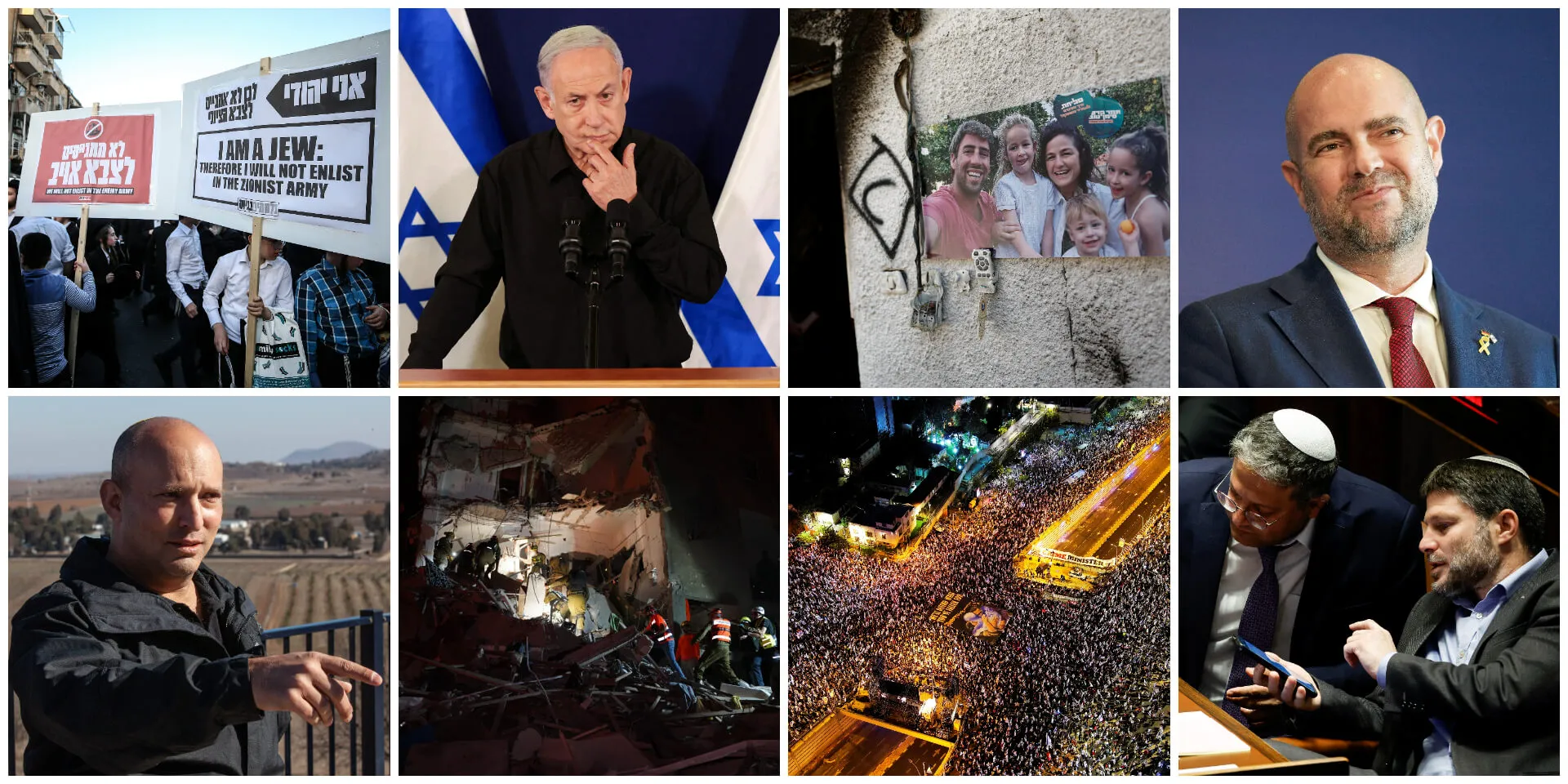
Clockwise from top left: An ultra-Orthodox protest against the draft; Prime Minister Netanyahu in October 2023; the Siman-Tov family, who were murdered on October 7; Knesset speaker Ohana; Ministers Smotrich and Ben-Gvir; a protest on Kaplan Street in April 2023; an Iranian ballistic missile strike in June 2025; and former Prime Minister Bennett. Credit: Reuters

Chen Shalita
November 6, 2025

Summary


Listen to a Dynamic Summary of the Article
Created using NotebookLM AI tool
Irrespective of whether the next Knesset election takes place as scheduled, in October 2026, or whether it is brought forward by a few months, Israel is entering an election year that will force the government of Prime Minister Benjamin Netanyahu to go to the polls on the back of the gravest dereliction of duty in the country’s history – the October 7 massacre – alongside the many ramifications of the attack, the subsequent failings and the promises that remain unkept. The list of these failures is extensive: from promises of “total victory” to two years of war which ended with Hamas still in control of the Gaza Strip; from a standing army and reserve force that is buckling under the burden to the ultra-Orthodox, who remain steadfast in their refusal to serve in the military; from promises to bolster governance that ended with a sharp rise in the crime and a promise to impose Israeli sovereignty over the West Bank, which was nixed by U.S. President Donald Trump. Meanwhile, Israel finds itself increasingly isolated by the international community and its very participation in sporting and cultural events is now in doubt. Not to mention the erosion, caused by the aggressive judicial overhaul, of public trust in the legal system and institutions of the state.
The prime minister and the ruling coalition are already working from a campaign mindset. It is still important to examine the engineering of public perception and the campaigns that will likely target right-wing voters, in the hope of strengthening the loyalty of the base and bringing disillusioned voters back into the fold.
Shomrim has spoken to strategic advisors who worked in the past with right-wing parties and who may well do so again in the next election, as well as prominent right-leaning media personalities, in order to gauge the mood of the moment and to understand what goals the right will set itself. For example: dismantling the “Anyone but Bibi” camp by arguing that politicians who claim to want to rehabilitate and rebuild Israeli society cannot engage in boycotts. Or dealing with the two most challenging issues from the coalition’s perspective: the ultra-Orthodox draft exemption law and the pre-October 7 policy of seeing Hamas as an asset, which led to political and diplomatic stagnation, to arrogance and, ultimately, to the October 7 disaster. When it comes to the current government’s achievements in other areas – what Netanyahu calls “Life itself” – well, it’s almost a good thing there was a war.
According to Tzuriel Sharon, the CEO of political polling and public opinion research firm Direct Polls, “life itself won’t be relevant in the next election. So what if the cost of living has gone up? The coalition will just say that there was a wartime economy. Everything moved to the sidelines over the past two years. Nobody is listening to anything that isn’t linked to the war. And it’s not as if the public would have been up for it even if there had not been a war. Unlike municipal elections, a national election is not really a judgment on what the government has done. People vote in accordance with their identity and their tribal ties, not based on achievements.”
1.
The goal: Smash the ‘anyone but Bibi’ camp
The means: Talk about unity
“There are three to eight seats in the center that will drop from “Anyone but Bibi” to “Preferably not Bibi”
For Netanyahu’s Likud party, smashing the “Anyone but Bibi” camp is the only way to bring back votes to the coalition parties, which – according to a poll conducted by Mano Geva for Channel 12 News over the weekend, is projected to win just 51 of the 120 Knesset seats. Members of the “Kaplan Force”, which has been demonstrating against the Netanyahu government, will be portrayed as “a millstone around the neck of the Zionist Left.” As Shimon Riklin, a commentator and presenter on Channel 14, tells Shomrim: “There are Zionist and moral leftist who are settlers, who contribute to the development of the country. They are wonderful people, but they are being held captive by the Kaplan Force, which has led them all to doom.”
Is Netanyahu, who recently uttered a few words of lip service in favor of unity, the right person to be the “presenter” for this concept? “It’s true that he’s not the ideal person to be talking about unity and that new actors can garner greater trust on that issue,” says Sharon. “Netanyahu is talking about unity because he recognizes there is a desire among the people for unity – but that unity can take off far beyond what people imagine. Netanyahu will ensure that talking about unity in the upcoming election campaign will be akin to saying “I’m done with the “Anyone but Bibi” camp. I’m in favor unity with Netanyahu at the helm.”
Who decides? Bibi?
“From what we see, the battle over who will be prime minister has almost certainly been decided,” says Sharon, whose company conducts opinion polls for i24 News. “The real battle will be over the composition of the next coalition and it’s important to note that the new players – like Yoaz Hendel [who now heads The Reservists party] – are not talking about boycotting Netanyahu.”
Hendel is a rightist and his party also isn’t projected to pass the electoral threshold. He can hardly afford to be picky.
“There are between three and eight seats in the center of the political map who will move from the “Anyone but Bibi” camp to the “Preferably not Bibi” camp. They would be happy to see him leave the political stage, but, if that were not to happen, they would not rule out joining his coalition. And I am talking about Gantz and the more right wing parts of Bennett’s party. We’re not talking about huge numbers of votes, but it’s something that needs to be noted.”

One person who very much has noted this is strategic adviser Shlomo Filber – a former partner of Sharon – who declined to be interviewed for this article but recently published on social media an account of a conversation with a friend whom he met for coffee. The whole anecdote can bee seen as a trial balloon for efforts to win back people from the religious-Zionist mainstream who have become disillusioned with Netanyahu and who have aligned themselves with Bennett and Gantz. The friend – “bourgeois and educated,” according to Filber – “firmly declared until recently that he didn’t vote and wouldn’t vote for Netanyahu. This morning, he joyfully announced that he, his wife and his children decided that this time they will vote for Netanyahu. The reason: He’s not perfect, but he was shocked by the lack of gratitude from the Hostages and Missing Families Forum, the media and the families [of the hostages].”
Nehemia Gershuni-Aylho, a data analyst and a prominent voice in the right-wing ecosystem on X, is not surprised. “How many more elections will it take before you realize that there are some people who are more interested in screwing over leftists than helping the right? People on the right are capable of saying that they don’t believe a single word that Bibi says, that he’s problematic, that he’s hedonistic and that he’s willing to give the ultra-Orthodox an exemption from military service – just because he’d sell everything to remain in power – but the crazy hatred of him on the left will make us vote for him again.”
What may be true for disillusioned one-time Netanyahu voters is not necessarily true of leaders of the parties that will compete against him in the election. “Bennett won’t rule out [a coalition with] Netanyahu,” says Eyal Arad, a former advisor to both Likud and Kadima. “He will simply say, “We will establish a national unity government under my leadership” – and that’s a scenario Netanyahu won’t agree to. But as far as Bennett is concerned, this would be a government based on the “Alliance of those who Serve”– and if Likud is willing to serve, they’re in.”
Asked whether Bennett could nonetheless agree to be part in a coalition headed by Netanyahu, thus taking with him the votes of center-left Israelis who made a strategic choice to vote for him to replace Netanyahu, Roni Rimon – from public relations and consultancy firm Rimon-Cohen – has this to say: “Bennett is running a campaign to replace Netanyahu and you ask me whether I’m convinced that he would refuse to sit in the same coalition as him? There is a difference between what you say during the campaign and what you say after Election Day. The only person who I genuinely believe when they say they will never sit with Netanyahu is Avigdor Lieberman. As for all the rest, I believe that [after the election] their absolute boycott of Netanyahu will be relaxed, even if they vow otherwise during the campaign.”

It is possible, of course, that it is just wishful thinking on the part of the right that the boycott of Netanyahu will be eased. Arad believes that “what you’re hearing is Bibi’s primary strategic campaign: that he is irreplaceable, that no one can do what he does, no one could have conducted a war on eight fronts the way that he did.”
What about reading out an apology to Qatar that was written for him by the United States?
“He will market that as a sophisticated and planned move and that things are not as they seem. Bibi will give speeches about national unity, because he believes that’s what the voters who abandoned him want. If he were also to take the trouble to do things that bring people together, he might yet have a chance of winning them back – but the flood of legislation that the government submitted at the start of the Knesset’s winter session last week, which continues to dismantle Israeli society by reintroducing the judicial overhaul, does anything but foster national unity. And if, after the Likud primaries, those same divisive figures who are currently prominent on the list are elected to the top spots, the whole issue of unity will be dead and buried.”
2.
The goal: Win over the mainstream right
The means: Doublespeak
“Ohana will deal with the Deep State and the reform; Netanyahu will market peace and unity.”
Perhaps surprisingly, the prevalent view among right-wing commentators is that the judicial overhaul – which made a tempestuous comeback at the opening of the Knesset’s winter session – will not play a starring role in the coalition parties’ campaigns. At first glance, one could be forgiven for thinking that this was nothing more than gaslighting. After all, the legislative moves by the coalition put the judicial overhaul back front and center of the public agenda. However, most of the people interviewed for this article see it more as an effort to appeal to Likud members and not an election campaign.

“The [judicial] reform will not be at the center of the Likud campaign,” insists Eitan Zeliger, CEO and partner at Zeliger Shomron Communications and one of the founders of the Fourth Quarter social movement. “It may help to shore up the support of part of the base, but it doesn’t increase the voter pool. In the end, on Election Day you want to get the vote of people who were considering abandoning you or joining you – and these are the people who think that it’s time for the Netanyahu trial to end, either because it’s gone on too long or because it was tenuous from the outset, but don’t want this to be done through legislation that allows the defense minister to determine when there are court hearings. [As proposed currently by the Liked C.S] That’s not their style.”
And what about those people who actively want to attack the judicial system?
“In any case, they will vote for one of the coalition parties,” says Sharon. “But forget about that. Apart from a nod and a wink to Likud members ahead of the primaries, no one cares about the board of directors of the government companies overseen by Dudi Amsalem. It’s dust in the wind. Today it’s a headline, but tomorrow no one remembers.”
Riklin also insists that “the judicial reform is old news, a non-issue, uninteresting.” This could be because stirring up that particular hornets’ nest could go against the idea of unity and efforts to shape Netanyahu as a statesmanlike figure who even recognized Yitzhak Amit as chief justice. “Amit is the president of the Supreme Court and that is a fact,” Netanyahu said at the Knesset’s opening session after President Isaac Herzog had raged over Knesset Speaker Amir Ohana refusing to acknowledge Amit as head of the Supreme Court and by not addressing him with his full title.

“We will continue to see efforts to differentiate between Netanyahu and Ohana in the future,” says one strategic advisor who has worked with several right-wing parties. “Ohana will deal with the Deep State and the judicial reform, while Netanyahu will market peace and unity, in an effort to portray himself as the “responsible adult” in the run-up to the election. The in-depth research that I see is also available to Netanyahu and it shows that the struggle against the Deep State is actually winning back floating voters.”
So, will the Likud campaign jump between two contradictory options?
“What’s amazing is how the media falls for it every time. After all, where do all these leaks about Supreme Court President Yitzhak Amit and Attorney General Gali Baharav-Miara not being invited to Trump’s speech in the Knesset come from? And news items about pardons and MKs turning up to Bibi’s trial? The Likud leaks them because it serves its interests with the base. And, at the same time, the media gravely discusses every slight allusion to unity and a move toward the political center – even though Netanyahu can’t move to the center if he has Ben-Gvir and Smotrich flanking him from the right.”
3.
The goal: Bury the October 7 attack
The means: Blaming the “Kaplan Force” and the protest movement against the judicial overhaul for the massacre and promising peace
“In a year from now, the war won’t be such a big story – certainly not on the right or in Likud”
The potential peace accords that Likud is promising, along with efforts to change the name of the October 7 war [in the end of October 2025, the cabinet voted to change the official name of the war from ‘Swords of Iron to the ‘War of Revival’ C.S], will play a large part of the campaign – even if nothing comes of them in practice. “According to the ‘big opportunity’ campaign,” Arad explains, “even if the peace accords do not come to fruition, Netanyahu will say that they are just around the corner – exactly as he did with victory in Gaza.” The goal is to find another way of burying October 7, given that even the longest war in Israel’s history did not dull the memory of the massacre and the demands for a state commission of inquiry. Moreover, the goals for which the war dragged on not only cost the lives of hostages and soldiers – they were not even accomplished. Hamas is still around and still very much armed, which is far from the image of “total victory” that Netanyahu promised and which was adopted wholeheartedly by his supporters.

“The big challenge facing the right during the campaign is dealing with the massive failure of October 6 and 7,” says Zelinger, “because from October 8 onwards, there was a different approach. The right believes that, since October 8, the security conduct of the government has been exemplary. Unlike the judicial reform and the draft law, where some right-wingers do not like what the government is doing, on security matters they trust their leaders, especially in light of the results.”
But the results are a long way from “total victory.”
“So, it may not be 100 percent, but did we get to 80 percent? Right-wingers are also exhausted by the war and understand that, in the end, it’s a choice between alternatives. They do not think that Yair Lapid would have secured a better deal on the ground from the IDF’s perspective. And yes, the right also judges things by who does them and not the action itself. That is the cardinal sin of both sides in identity politics and it is obvious that Netanyahu is taking advantage of the fact that people are more forgiving of him than of Bennett or Lapid, had they agreed to this cease-fire deal. Right-wing voters give Netanyahu credit for the successes in Lebanon and Iran and assume that he knows what he’s doing this time, too.”
Rimon agrees what the ramifications of the failure will be on the opposition. “Likud will argue that the opposition tried to hold the government back,” he says, “and that our security situation would have been much worse had Netanyahu listened to them – never mind had they been in power – and that victory was total compared to what could have happened had Lapid been prime minister. An election campaign is not exactly the place for historical accuracy. The re-election of the Trump administration will also be turned into the natural extension of United States’ cooperating in the bombing of Iran. Yet again, our great friend supported us – and only we could make that happen.”
The peace campaign, it seems, had become the new refuge. All it takes is to hear Riklin declare that “in a year from now, the war won’t be such a big story – certainly not on the right or in Likud. We will be facing a future with as many peace agreements as possible. It’s vital to make peace with Indonesia, the fourth most populous country in the world. Not to mention the holy grail, which is Saudi Arabia.”

It’s not like Israelis woke up every morning praying for peace with Indonesia.
“Okay, but the market reacts to it. If there are foreign investments here because of a peace deal and the economy grows dramatically, that would be an asset for Netanyahu’s campaign.”
Netanyahu declared in September that Israel would become “super Sparta” because of the ever-increasing international isolation we are facing.
“I’m not sure you understood the analogy with Sparta. He meant that it is possible that we will have to start manufacturing our own weapons, because we cannot know what kind of administration will be elected in the United States in the future. But Netanyahu is as Athens as they come. Sometimes, he’s too Athens for the right. Accusing Netanyahu of being ‘super Sparta’ is a joke.”
So, the fact that the election will be held in October next year – around the time of the anniversary of October 7 – doesn’t threaten him?
“Netanyahu will not bring the election forward. It will take place on October 26. From the moment that the living hostages returned home, that date no longer threatens the right. On the contrary: it has become a problem for the left.”
In what way?
“I also used to think – when I really didn’t know anything – that Netanyahu should resign. I even met with him at the start of the war and asked him about it. I haven’t thought that way for a long time. The whole of the right now thinks that the Kaplan Force was responsible for October 7, not the prime minister, who wasn’t told anything. In the weeks and months before the election, the issue of insider treason will also make massive waves. I have to get answers about that.”
If you were to support a state commission of inquiry, you would get answers.
“And let the cat guard the cream? [We should] let Yitzhak Amit, who opens up the Supreme Court to hear petitions from Palestinians, determine who is on that commission?”
4.
The goal: Preventing a state commission of inquiry
The means: Delegitimizing the Supreme Court and the chief justice
“The worry is that the commission would publish an interim report before the election, placing serious blame on Netanyahu.”
The delegitimization of Chief Justice Amit and the judicial system is nothing new. “The strategy is to throw as much mud as possible as much of the time and hope that something sticks,” says one right-wing media advisor. “The main goal of the current delegitimization is to prevent Amit from appointing a state commission of inquiry – and it’s working. There is already talk that he won’t be the only one to appoint members and that his deputy, Noam Sohlberg, will also participate.”

“The worry on the right,” Gershuni-Aylho explains, “is that the commission could publish an interim report before the election, which would place serious blame on Netanyahu. And, incidentally, for the average rightist, the commission could decide that Netanyahu is totally at fault, but it’s up to one headed by Yosef Elron, not Yitzhak Amit to decide that.”
Does the average rightist also keep close tabs on their judicial philosophies?
“No, but they have learned that there are people who would be delighted at the opportunity to oust Netanyahu and to absolve the Brothers in Arms movement of all responsibility.”
Netanyahu’s own criminal trial will be harder to address as part of the campaign than a state commission of inquiry. “The right has always been supportive of its leaders,” says Sharon. “They know that Netanyahu hasn’t slept at night for the past two years and has been engaged in world-changing events – just like Churchill did – so to drag him into court to ask about peanuts? His voters are no longer interested in the trial, but they could use it to portray him as a martyr.”
5.
The goal: Getting the Haredi draft off the agenda
The means: Accuse the opposition of not really wanting ultra-Orthodox soldiers
“This is the issue that causes Netanyahu most damage. The draft law is driving voters away.”
One issue that is occupying voters’ thoughts in Netanyahu’s camp and is seen as the one thing that could cause Netanyahu a lot of damage is the draft law. “To our delight, the opposition isn’t dealing with it enough. It should be bringing people out to demonstrate,” says one well-known rightist, “because that is the issue that can do most damage to Netanyahu. The draft law is driving voters away from the coalition to the opposition. In contrast, October 7 has left most people with the same positions they held beforehand.”
Zeliger agrees: “The issue that will prove most challenging to the rights’ election campaign is the ultra-Orthodox draft. Netanyahu will try to evade the issue because it splits his voters into for and against. They also know that with a different government that could have got a better outcome, with more ultra-Orthodox men joining the army.”
.webp)
The anger of the mainstream voters from the national-religious camp, who carried a large share of the burden in the standing army and the reserves, is also being felt in recent opinion polls, in which Smotrich – the national-religious leader who was overly tolerant of ultra-Orthodox draft evasion – does not cross the electoral threshold. “He will argue that, as finance minister, he helped the reservists by giving them financial benefits,” Sharon says.
If we once again let Riklin be our guide to the rightist zeitgeist, here, too, “Lapid and the Supreme Court are to blame, because petitions to the courts have added a bullying element to this whole struggle and prevented genuine integration.” A more sophisticated response to the draft campaign is proposed by Arad. “Bibi will say that he has introduced a draft law that will lead to the recruitment of 50 percent of the ultra-Orthodox. That’s not 100 percent, because 100 percent would mean civil war and that won’t happen. Even with 50 percent, it’s still a historic law. The leftists, with all their talk, recruited far fewer Haredim. They also don’t really want the ultra-Orthodox in the army. Let’s see how they will respond when there’s an ultra-Orthodox chief of staff. They won’t even accept David Zini and Ofer Winter. They are using the draft law just to bring down a legitimate right-wing government.”
6.
The goal: Steering clear of the electoral threshold
The means: Promising West Bank sovereignty despite Trump and mergers between the borderline parties
“Smotrich will keep on talking about sovereignty in Judea and Samaria, to stop terrorists in Toyotas from marauding through Netanya”
According to well-place people, Ofer Winter, the former Minister of Defense’s military secretary and a leading public figure in the religious-zionist community, will play a starring role in the election – in many different contexts. Some believe that Netanyahu will force him to join up with Smotrich to prevent the right-wing bloc from losing valuable votes, if Smotrich’s Religious Zionist Party remains perilously close to the threshold. Sharon believes that “if we face a situation in which Ben-Gvir and Smotrich are running on separate tickets, and there’s a worry that one of the parties won’t get over the threshold – especially given that even five seats is a major risk for Netanyahu – he will summon them both to his office and tell them exactly what they have to do.”
Zeliger adds: “Smotrich will have to refresh his list of candidates. The elders of that tribe – or the young guard – will tell him so.”
What is he offering his voters? Let’s say that resettling Gaza was a dream for just a handful of people; even annexing Judea and Samaria, which is something especially important to that bloc, has become a distant possibility on his watch
“People in niche parties are looking for a home. They want to vote for people close to them. Why do people vote for Meretz? Because of their amazing achievements? Because it offers them a small and highly ideological village to anyone for whom that is important. Smotrich offers the same thing. At the moment, he’s in a bad place. He’s got Ben-Gvir on one side and, on the other, the religious mainstream, for some of whom voting for a religious party is not a priority.”

Another advisor adds a sarcastic sidenote: “Trump may have told us what to do, but not what campaign to run. Smotrich will keep on talking about sovereignty over Judea and Samaria, to prevent terrorists in Toyotas from marauding through Netanya – as happened in Sderot on October 7.” Riklin, for his part, comes to Smotrich’s defense. “Thanks to him, Judea and Samaria is undergoing a massive overhaul. He’s done wonders. He doesn’t care about the annexation; he cares about the demographic balance. So the United States won’t let us annex, but it will let us do what we want on the ground and some wonderful things are happening in Judea and Samaria. Not everything can be discussed in public.”
Apart from wanting the death penalty for terrorists, what ticket will Ben-Gvir run on?
“The life-saving distribution of firearms to civilians, rapid response teams that he set up and the threat of repeats of October 7 coming from Judea and Samaria.”
What about the hostages who said they were tortured in captivity because of him?
“He’ll say that people made fun of him and called him the pita-bread minister – and now terrorists are afraid to go back to prison because of him. All of these squabbles about how much food terrorists get just adds to his credit.”
7.
The goal: Preventing a new right-wing party from emerging
The means: Reserved spots at the top of the Likud list
“Netanyahu prefers his party to be big over an initiative that he can’t control”
How would a new right-wing party be received? “You remember when Gantz formed a party and Netanyahu said that he doesn’t interfere in how the left divides up it’s votes?” says Sharon. “Well, now Netanyahu’s view on a new party will depend on the polls. If a new party takes votes from the center, then he’ll allow it to exist because it serves his interests. If it leads to a split among right-wing votes, he’ll do everything in his power to thwart it from coming into being.”
Even if it would definitely cross the electoral threshold?
“Even so. They will reserve all of the top spots on the list just to ensure that Likud doesn’t shrink. Netanyahu prefers his party to be big over an initiative that he can’t control. But if that new party can steal two or three votes from the center, like people who vote for the Reservists party, Gantz or Lieberman – or from Bennett on the right – I wouldn’t rule out Netanyahu giving his full backing to a new party.”
Gershuni-Aylho adds: “Likud will run a campaign that will eat up the votes from the Reservists – who are rightists in any case – and it will win over the religious right by convincing hard-core local council leaders from Judea and Samaria to run in the Likud primaries. What will be fascinating will be to see whether a well-known rightist dares to run a campaign along the lines of “Thank you, Bibi, we’ll take it from here” – bringing impartiality and new blood.”
.webp)
Like Lapid once did and like Ehud Olmert originally said to Teddy Kollek in the Jerusalem mayoral elections
“It would have worked for Bennett if he hadn’t brought the Arabs into his previous government.”
The very fact that many advisors have been contemplating an update to the campaign that Olmert ran – “We love you Teddy, but we’re voting for Olmert” – with Netanyahu, who is older now than Kollek was at the time, as the elder statesman, is something that should worry the prime minister. Arad believes that such a campaign could work for Bennett, “who will say that new blood is needed and that Netanyahu is old, tired and has been in office for too long – and also that Bibi cannot unite everyone around him like Bennett could.”
“The more people attack Netanyahu, the more people will close ranks around him,” Zeliger says. “In any case, people are not easily moved from their voting habits, certainly not when they are being told they were idiots all those years and that they voted the wrong way. A gentler system could work. A campaign which says, ‘Thanks for everything, Bibi, but it’s time to go home’ could bring people together.”