


Haredi Leadership to Dropout Yeshivas: You Must Meet the IDF Quota
Last month, Shomrim published a financial analysis showing that, while the end of state funding has affected every yeshiva in Israel, it poses an existential threat to drop-out yeshivas, which have been unable to find alternative sources of income. Demands by the heads of these yeshivas to get a share of emergency money raised by various foundations led to a discussion at which, for the first time, the Haredi leadership intimated that it prefers to meet the quota using drop-out students than to endanger the elite yeshivas. The Haredi street is already rife with accusations: ‘They’re trying to dismantle the drop-out yeshivas, so they’ll have someone to draft.’ A Shomrim follow-up
Last month, Shomrim published a financial analysis showing that, while the end of state funding has affected every yeshiva in Israel, it poses an existential threat to drop-out yeshivas, which have been unable to find alternative sources of income. Demands by the heads of these yeshivas to get a share of emergency money raised by various foundations led to a discussion at which, for the first time, the Haredi leadership intimated that it prefers to meet the quota using drop-out students than to endanger the elite yeshivas. The Haredi street is already rife with accusations: ‘They’re trying to dismantle the drop-out yeshivas, so they’ll have someone to draft.’ A Shomrim follow-up
Last month, Shomrim published a financial analysis showing that, while the end of state funding has affected every yeshiva in Israel, it poses an existential threat to drop-out yeshivas, which have been unable to find alternative sources of income. Demands by the heads of these yeshivas to get a share of emergency money raised by various foundations led to a discussion at which, for the first time, the Haredi leadership intimated that it prefers to meet the quota using drop-out students than to endanger the elite yeshivas. The Haredi street is already rife with accusations: ‘They’re trying to dismantle the drop-out yeshivas, so they’ll have someone to draft.’ A Shomrim follow-up
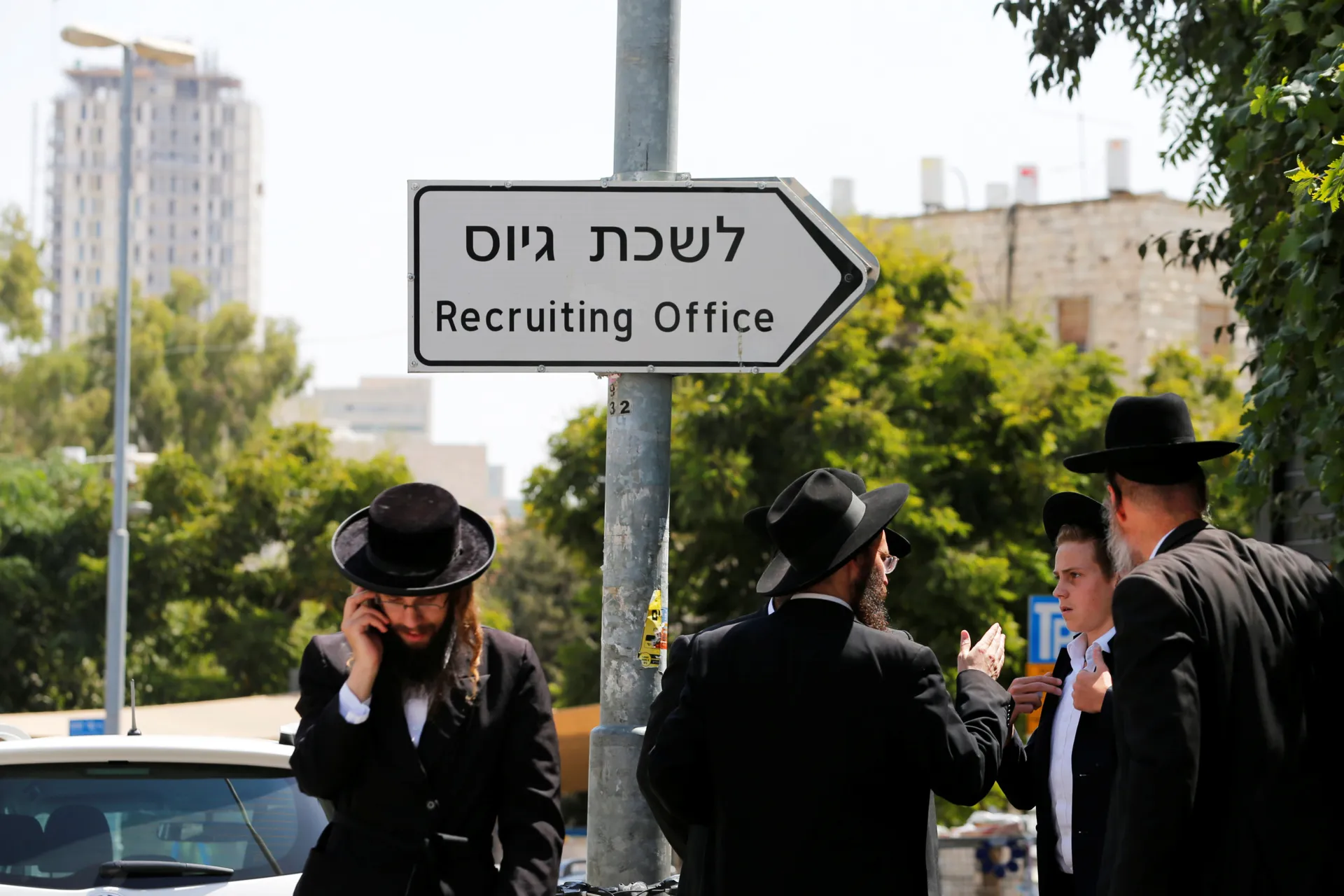
Haredim near the sign of the recruitment office in Jerusalem. The people photographed are not related to the article. Archive photo: Reuters

Lir Spiriton
December 31, 2025

Summary


Listen to a Dynamic Summary of the Article
Created using NotebookLM AI tool
Last week, the independent media group Pargod published an article which shook Israel’s ultra-Orthodox community to the core. According to Pargod, a hugely popular outlet which has more than 200,000 followers on various platforms, including Telegram and WhatsApp, “the rabbis” – a somewhat vague phrase which usually refers to the rabbis who control the ultra-Orthodox political parties – have sent a message to the heads of the so-called “drop-out yeshivas,” intimating that they will be called upon to provide the quota of Haredi draftees into the IDF. This comes at a time when the Knesset is advancing a bill to grant ultra-Orthodox men exemption from military service, as well as the financial difficulties facing these yeshivas, in which an estimated one-third of all ultra-Orthodox yeshiva students study, ever since the High Court of Justice halted funding.
To the secular reader, the equation that forms the basis of the report may seem simple, but, from the perspective of an ultra-Orthodox reader, many other messages are contained between the lines. The most important of them is that, despite the stated and vehement opposition of the rabbinical leadership to the recruitment of any ultra-Orthodox young man – yeshiva student or drop-out – in practice, they have decided that it would be best to end the crisis and secure the resumption of state funding, which would allow them to safeguard the future of the elite and intermediate yeshivas. This is something they are willing to do even if it means the enlistment of drop-outs, with all that this means for the Haredi ideology. The fact that there are so many young ultra-Orthodox men who have dropped out of yeshiva makes the decision a particularly bitter pill to swallow for almost every member of the Haredi community.
So great was the drama following the report that Pargod soon issued an “update,” signed simply by “ITK,” or “in the know.” The update clarified that no new decision has been made about IDF recruitment and that the report was, in fact, about budgetary issues related to the drop-out yeshivas and the fact that wealthy benefactors prefer to donate money to larger yeshivas. ITK went on to add that the criteria for the distribution of money raised in lieu of government funding (via the World of Torah Foundation) were particularly stringent and that any yeshiva which did not meet them would be disqualified.
It is worth noting that Pargod has not hesitated in the past to go after sacred cows in the Haredi world and that publishing a clarification of this kind is something of a rarity. As an aside, it’s also worth mentioning that, from a Haredi perspective, the follow-up article did nothing to change the bottom line, since, without state funding or a significant influx of money from elsewhere, drop-out yeshivas will not survive.
In November, Shomrim and Mako published an analysis of the financial reports of several ultra-Orthodox yeshivas and the difficulties the Haredi community is facing when it comes to funding them. According to that report, elite and intermediate yeshivas will survive the freezing of state support by independent fundraising, money they receive from the World of Torah Foundation and by increasing tuition fees. In contrast, drop-out yeshivas – which provide a framework for those students who, for whatever reason, find it hard to study Torah and who are “at-risk” of abandoning the Haredi lifestyle entirely – find it hard to locate alternative sources of funding, since Torah study is secondary for man of them and students at some even have jobs. Given the Haredi ideology, donors prefer that their money goes to “prodigies” and not to what are colloquially referred to as “shababnikim.”
The alternative – raising tuition fees – is not an option for drop-out yeshivas, since they already charge far more than standard yeshivas, in some cases several thousand shekels a month, which places a huge burden on the vast majority of ultra-Orthodox families. The analysis also mentioned the almost inevitable assessment from many quarters that, because of financial difficulties, students at drop-out yeshivas would be the first to be dispatched to the IDF.
.webp)
The message: Maybe this way they’ll leave the Haredim alone
In a conversation with Shomrim, a source who is well placed in the world of yeshivas, says that the background to Pargod’s publication was a long process which ended recently in failure when the heads of some of the drop-out yeshivas made it known that they had not received any of the money raised for yeshivas. According to the source, this happened during a kind of round table event convened to discuss the matter; it was also attended by various officials connected with the World of Torah Foundation, who the source says he recognized as representatives of some of the most important ultra-Orthodox rabbis.
According to the source, the message implicit in the answers that were given on the budgetary matter is that if the ultra-Orthodox public does indeed need to meet the draft quota – as the draft law making its way through parliament stipulates – the rabbis prefer that the drop-out yeshivas provide the students. “The bottom line is that they told them they don’t really need these yeshivas and maybe this way they’ll leave the Haredi alone on the draft issue,” he adds.
The source goes on to say that one interesting possibility that has been raised is relocating the drop-out yeshivas to places where there are security needs, which would justify their existence from the perspective of the general public. The northern border is one such possible location. “They told them to go to the Jordanian border, the northern border, and reopen the yeshivas there in the same model as the hesder yeshivas, and let the students protect the border. They said they would accept this and give them funding.”
While it is possible that some of the above has been exaggerated in the telling, there is still a major shift in the position espoused thus far by the rabbinical leadership, which has rejected any ultra-Orthodox draft out of hand. The change is in line with the proposed draft-exemption legislation, which the ultra-Orthodox parties are keen to pass in the coming weeks. According to the bill, the quota for ultra-Orthodox recruits to the IDF over the next two years will be between 4,800 and 5,700, although everyone involved knows that these are merely the opening numbers, which will increase by the time the bill reaches its third and final reading. The young yeshiva ultra-Orthodox men who eventually turn up at the IDF recruitment centers will come, it seems, from the drop-out yeshivas.
The source goes on to argue that it will not end there. The heads of these yeshivas tried to argue that their students are not fit for military service and even used phrases like “wretched” and “unfortunate” to describe them; they have also spoken about mental health issues and the importance of the existing frameworks for the well-being of these young men. “They were told that it makes no difference and that the army itself will grant them an exemption,” he explains, adding that, in his opinion, the leaders of the Haredi community believe that, at the current time, there is no chance of passing a blanket exemption for all Haredim and that they will have to meet a certain quota in order to “calm the secular and the National Religious public a little. A kind of painkiller until the storm passes.”
In previous reports by Shomrim about the Haredi draft issue, we asked yeshiva students from all backgrounds about the possibility that they could be drafted – and they ridiculed the idea. The report by Pargod has shattered – at least on the fringes – that confidence. For example, one Modern Haredi student who was enrolled at a drop-out yeshiva says that rumors have been going around his yeshiva about financial difficulties. “They said that the World of Torah Foundation is in difficulty and looking for places to cut funding and, at the same time, in the Knesset, they’re going to commit to a quota [of recruits],” he says angrily. “They want to sacrifice people, but who would want to fill that quota? So, they’re trying to cut funding to weaker yeshivas, in the hope that they will collapse and the students there will have no choice but to go to the army.”