



Israeli Court Rules Against Use of ‘Smart Cameras’ to Enforce Parking Violations
Only the Knesset can authorize the use of license plate recognition (LPR) technology in Israel. Yet a court case from December 2025 revealed that local authorities, which use the technology widely, never received such authorization. The attorney general has also confirmed that LPR cameras - which have generated hundreds of millions of shekels in traffic fines for municipalities - were installed without legal authority. So what happens now? The Tel Aviv Municipality is unlikely to stop using the cameras to issue fines, and neither are other local authorities - at least until the High Court intervenes. A Shomrim investigation, also published on N12.
Only the Knesset can authorize the use of license plate recognition (LPR) technology in Israel. Yet a court case from December 2025 revealed that local authorities, which use the technology widely, never received such authorization. The attorney general has also confirmed that LPR cameras - which have generated hundreds of millions of shekels in traffic fines for municipalities - were installed without legal authority. So what happens now? The Tel Aviv Municipality is unlikely to stop using the cameras to issue fines, and neither are other local authorities - at least until the High Court intervenes. A Shomrim investigation, also published on N12.
Only the Knesset can authorize the use of license plate recognition (LPR) technology in Israel. Yet a court case from December 2025 revealed that local authorities, which use the technology widely, never received such authorization. The attorney general has also confirmed that LPR cameras - which have generated hundreds of millions of shekels in traffic fines for municipalities - were installed without legal authority. So what happens now? The Tel Aviv Municipality is unlikely to stop using the cameras to issue fines, and neither are other local authorities - at least until the High Court intervenes. A Shomrim investigation, also published on N12.
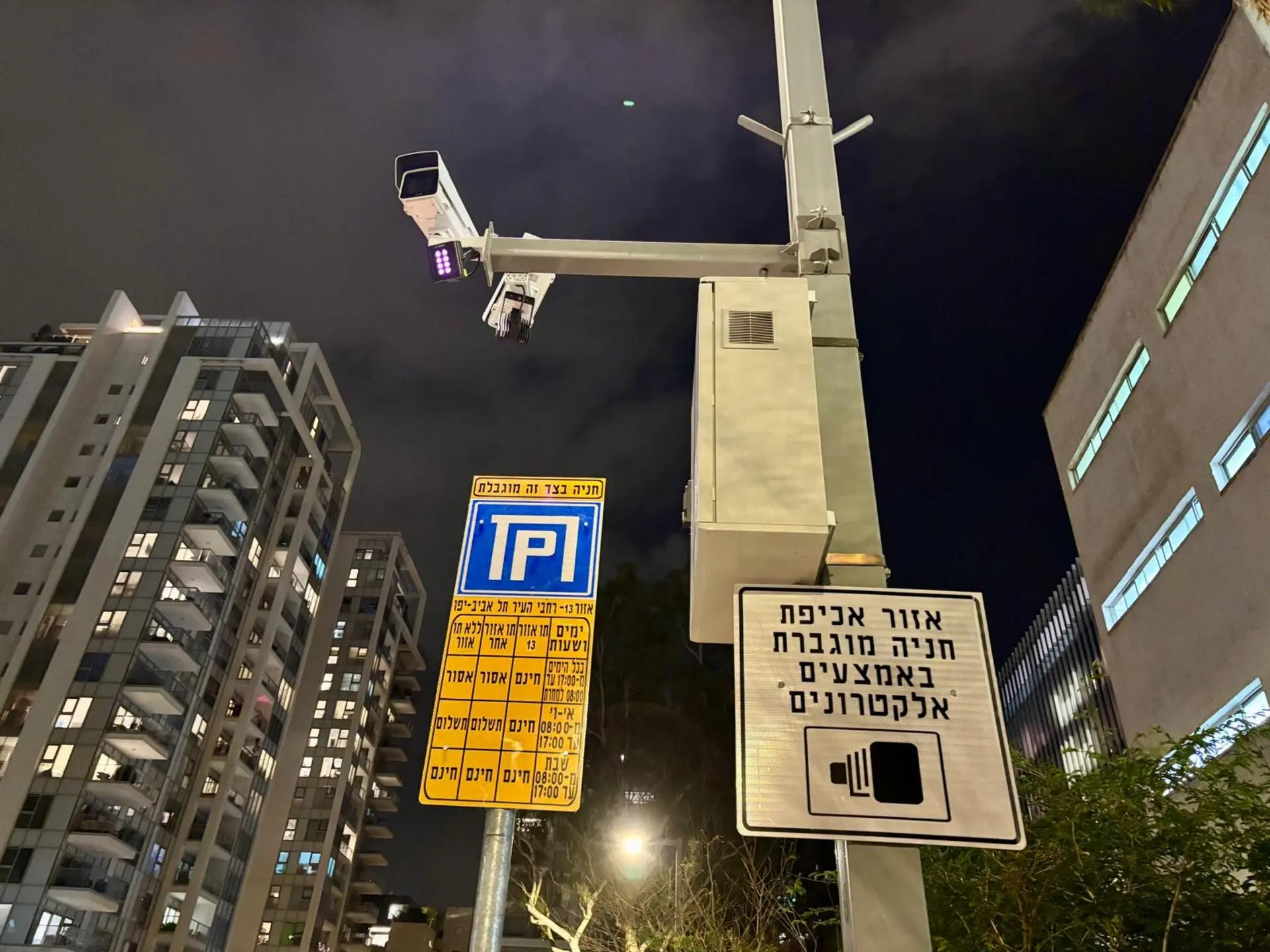
Parking enforcement camera, Tel Aviv. Photo: Shomrim

Rachely Edri-Hulata
January 13, 2026

Summary


Listen to a Dynamic Summary of the Article
Created using NotebookLM AI tool
Late December last year, an Israeli court issued a precedent-setting ruling that managed to pass entirely below the public radar. The decision by the Tel Aviv District Court, (Court for Administrative Law), will have dramatic and far-reaching consequences for two areas of public life between which, at first glance, there appears to be no overlap: the right to privacy in public spaces and the right of local councils to implement parking regulations using digital and electronic means. While the first point is admittedly harder to unpack, it will have a significant impact on the future of ‘smart’ cameras in the public sphere. The second calls into question the hundreds of millions of shekels in cumulative revenue collected by local authorities using this kind of technology. One can get a sense of the figures involved from Tel Aviv Municipality’s own data. According to a Knesset report, the city’s total revenue from parking enforcement – comprising both manual ticketing and digital systems – hit 282 million shekels [$92 million] in 2023.
Shomrim asked Tel Aviv Municipality for its response to the court ruling. A spokesperson confirmed that the city has no intention of ending its use of the digital and electronic means mentioned in the ruling. And it seems inevitable that other authorities will also opt to ignore the ruling – at least until outraged civilians take the matter to the country’s highest court. Tel Aviv Municipality’s full response appears below.
Police and toll roads – yes; municipalities – no
The legal battle over municipal smart cameras began when an Israeli company called Safer Place sued the Ramat Gan Municipality. The dispute focused on a city tender that required automated cameras featuring, among other tools, License Plate Recognition (LPR) technology.
Midway through the proceedings, the Ramat Gan Municipality notified the court that it was withdrawing the tender. Despite this, Judge Kobi Vardi of the Tel Aviv District Court opted to issue a ruling anyway, characterizing the decision as a matter of principle.
LPR cameras are smart cameras that combine imaging capabilities with advanced algorithms to automatically identify vehicle license plate numbers. The technology allows whoever deployed the camera to continuously monitor vehicles passing through the camera’s field of vision, to cross reference that information with databases and to identify traffic violations – without the need for human intervention.
Many local authorities in Israel have started using this kind of technology in recent years, for a wide variety of applications, including parking and standing enforcement, noise violations, managing access to public parking lots and other municipal purposes. Use of LPR technology saves millions of shekels in salaries, makes enforcement far more effective and ensures that fines are issued in a speedy manner. At the same time, it also raises far-reaching questions about the extent of official surveillance of civilians, the use of external databases for cross referencing – as well as privacy violations. Nonetheless, many Israeli councils and municipalities opted for the massive deployment of these cameras – and the boost in income from enforcement became a catalyst for others to jump on the bandwagon.
The legal position regarding use of these cameras appears to be fairly clear-cut. While the Knesset has given permission to various bodies to use sophisticated surveillance systems, it only did so with specific legislation – such as the law allowing police to operate its Eagle Eye LPR program or the payment system on the Route 6 toll road. In contrast, local authorities have not been given explicit legal authorization to use this technology.
%20-%20%D7%A7%D7%A8%D7%93%D7%99%D7%98_%20%D7%A9%D7%9C%D7%95%D7%9E%D7%99%20%D7%99%D7%95%D7%A1%D7%A3%20(1).webp)
The categorical statement that local authorities do not have the right to use these methods is a result of a ruling by the High Court of Justice from 2017. According to the ruling, the protections established in the Privacy Law require explicit legal authorization, whereas “auxiliary authority” cannot serve as an empowering source for an infringement on privacy, which is a constitutional right anchored in the Basic Law on Human Dignity and Liberty.
It’s worth noting that the use of regular video cameras, as opposed to automated technology that collects data from a variety of sources, such as LPR, which have also been deployed throughout cities, does not constitute an infringement of privacy and therefore does not require explicit authorization.
At the hearing in Tel Aviv in December, the position of the Privacy Protection Authority was also presented to the court. In its legal opinion, the authority wrote that the use of LPR technology requires special and specific authorization and that authority granted by power of municipal bylaws cannot be seen as an alternative.

Tel Aviv issues around 800,000 parking fines a year, from which it raises 282 million shekels [$92 million]. How much of that comes from fines issued by LPR cameras? Since City Hall refuses to divulge that information, Shomrim has submitted a freedom of information request in order to force it to do so.
What happens next?
The court has ruled unequivocally that local authorities lack the authorization to use LPR cameras for the purpose of enforcing parking violations and as long as such authorization is not regulated through primary legislation, the use of this technology is illegal. This means that many authorities in Israel are effectively collecting data, conducting enforcement and issuing fines without constitutional authority. Although the ruling related specifically to parking enforcement, it opens the door to a broader discussion about privacy violations in the public sphere thanks to the deployment of technologies which continue to develop at a dizzying pace.
The technology currently available allows for the creation of massive databases showing the location and movement of vehicles and people in the public sphere – in a systematic and ongoing way. For example, License Plate Recognition technology gives authorities the practical capability to track an individual’s travel habits, what places they visit and how long they spend at any given location. The December ruling determines that such violations of privacy cannot be carried out simply for the sake of administrative convenience or even for more efficient enforcement. It placed responsibility on the state to either pass legislation on the matter or to issue local authorities with clear guidelines and instructions.
The court’s decision to characterize its decision as a matter of principle creates a complex problem for the local authorities on two levels. The first problem is the significant likely loss of income. Tel Aviv, for example, issues around 800,000 parking fines a year, from which it raises 282 million shekels [$92 million]. How much of that comes from fines issued by LPR cameras? Since City Hall refuses to divulge that information, Shomrim has submitted a freedom of information request in order to force it to do so.
The second problem relates to the fact that this technology has been in widespread use for several years. What about fines that were issued and paid? It’s a safe bet that no local authority will rush to give up on such a lucrative source of income or to reimburse money it raised through illicit fines – notwithstanding the District Court’s unequivocal ruling.
In response, Tel Aviv municipality said: “The municipality enforces parking violations in accordance with the law, including the Interior Ministry’s guidelines on the matter, and it is permitted to use cameras for this purpose. Regarding the enforcement of parking violations in the city, there has been no change in the legal situation and the municipality will continue to enforce according to the provisions of the law.”

Follow up:
Tel Aviv Uses ‘Smart’ Cameras to Issue Hundreds of Thousands of Parking Fines, Ignoring Court Order and Privacy Concerns
In response to Tel Aviv municipality’s claim, that the technology it uses is “fundamentally different” to the license plate recognition (LPR) system that the court ruling referred to, Shomrim analyzed a series of internal municipal documents, the contents of which are being revealed here for the first time. According to these documents, Tel Aviv has ordered and operated LPR systems for at least the past 11 years – even if it has added various layers to them over the years which it claims have mitigated any violations of privacy. In fact, the very fact that Tel Aviv asked to add these features raises the possibility that it was aware of the legally problematic nature of operating automated systems without Knesset approval and was looking for ways to sidestep the issue.
In addition to revealing that Tel Aviv operated these systems, the documents raise questions about the process by which the external company that operates them was selected. It turns out that the municipality did not publish a single tender for the system during the 11 years it has been operating. Instead, the municipality has issued three RFIs – Requests for Information – during this period. An RFI is usually a preliminary stage to a tender. It replaces the tender only if the number of applicants is limited or if it becomes clear that the applicants cannot provide a solution. Although no fewer than seven companies responded to some of the RFIs for automated cameras, no tender was ever issued and, instead, the same company was selected on all three occasions.
“If this is how they conduct themselves, it’s a scandal,” says one official connected to local authorities. “It is absurd that no tender was issued for more than a decade – especially when the income raised appears to exceed half a billion shekels ($161 million).”
Shomrim has submitted a long list of questions to Tel Aviv Municipality on this issue, but City Hall’s response answered only some of them – arguing again that since the technology was fundamentally different, the District Court ruling does not apply to it and that it will continue to use the smart cameras for parking and other enforcement.
In order to examine this claim – and given that Tel Aviv Municipality was unwilling to explain exactly what constitutes “fundamentally different technology” – Shomrim went looking for the tenders that the company which operates the system won. However, as already mentioned, there were no such tenders. Instead, we located the RFIs that the municipality issues, in which it presented candidate companies from the field with various questions about their capabilities. The goal of RFIs of this kind, according to municipal officials, is to obtain a preliminary understanding of the various market players and their capabilities. RFIs are usually followed by a tender.
The first such RFI was issued in 2015, but Shomrim was unable to find a copy of it. According to the minutes of the Tenders Committee that was asked to approve the winning company without a tender, it appears that five companies responded to the RFI, but a representative of City Hall told the committee that only a company called Safer Place had met all the criteria. The representative also heaped praise on the company, bragging that the courts had not overturned a single one of the 30,000 fines issued by the company up to that time.
One of the key arguments put forward by Tel Aviv Municipality – as well as by other local authorities which use the system – is that it is not fully automated, since a city official has to approve each fine. However, this argument is entirely irrelevant to the legal ruling regarding the technology itself.
Both the state’s position and the court ruling make it clear: the violation of privacy stems from the very deployment and use of LPR cameras, the automatic use of databases and the creation of new and independent databases – not on whether the process ends with a human pressing a button. This is exactly the difference between a regular video camera and a system with smart recognition capabilities.
Even before the ruling late last year, the Israeli Law, Information and Technology Authority (ILITA) – which later became the Privacy Protection Authority – issued an instruction back in 2012 on this very matter. According to instruction 4/2012, any video surveillance system which uses license plate recognition falls under the definition of a database according to the Protection of Privacy Law. Since these systems enable individual identification, data storage and the ability to search and retrieve information based on identifying parameters, they constitute an infringement on privacy even if some of the data is subsequently deleted or if human involvement is required.
In its response to Shomrim’s questions Tel Aviv Municipality opted not to answer the very specific questions it was asked and did not specify which technology it is actually using.
The full response from Tel Aviv Municipality: “The engagement with Safer Place was entered into in accordance with the legal provisions governing tender exemptions for a sole source provider. Following a professional evaluation conducted by municipal experts, which included a Request for Information (RFI) process to survey existing market solutions, it was determined that the system provided by Safer Place is the only one possessing the requisite technological capabilities. The findings of this assessment and the corresponding legal opinion were presented to the Municipality’s Tenders Committee, which adopted the recommendation to designate the company as a sole source provider.
“Regarding the use of cameras, the technology employed by the municipal enforcement department differs fundamentally from the LPR technology addressed in the opinions of the Deputy Attorney General and the District Court. Consequently, the operations of the municipal enforcement department comply with all legal requirements and shall continue as normal.”
Read the full follow-up here.