


No Leaders, No Solutions: How Ultra-Orthodox Society Found Itself at an Impasse
An already deepening crisis has been further intensified by the freezing of the draft law amid the war with Iran. Tens of thousands of yeshiva students are now officially classified as deserters, funding has been cut, and a fragmented leadership is struggling to respond, all While Haredi society itself undergoes profound change
An already deepening crisis has been further intensified by the freezing of the draft law amid the war with Iran. Tens of thousands of yeshiva students are now officially classified as deserters, funding has been cut, and a fragmented leadership is struggling to respond, all While Haredi society itself undergoes profound change
An already deepening crisis has been further intensified by the freezing of the draft law amid the war with Iran. Tens of thousands of yeshiva students are now officially classified as deserters, funding has been cut, and a fragmented leadership is struggling to respond, all While Haredi society itself undergoes profound change
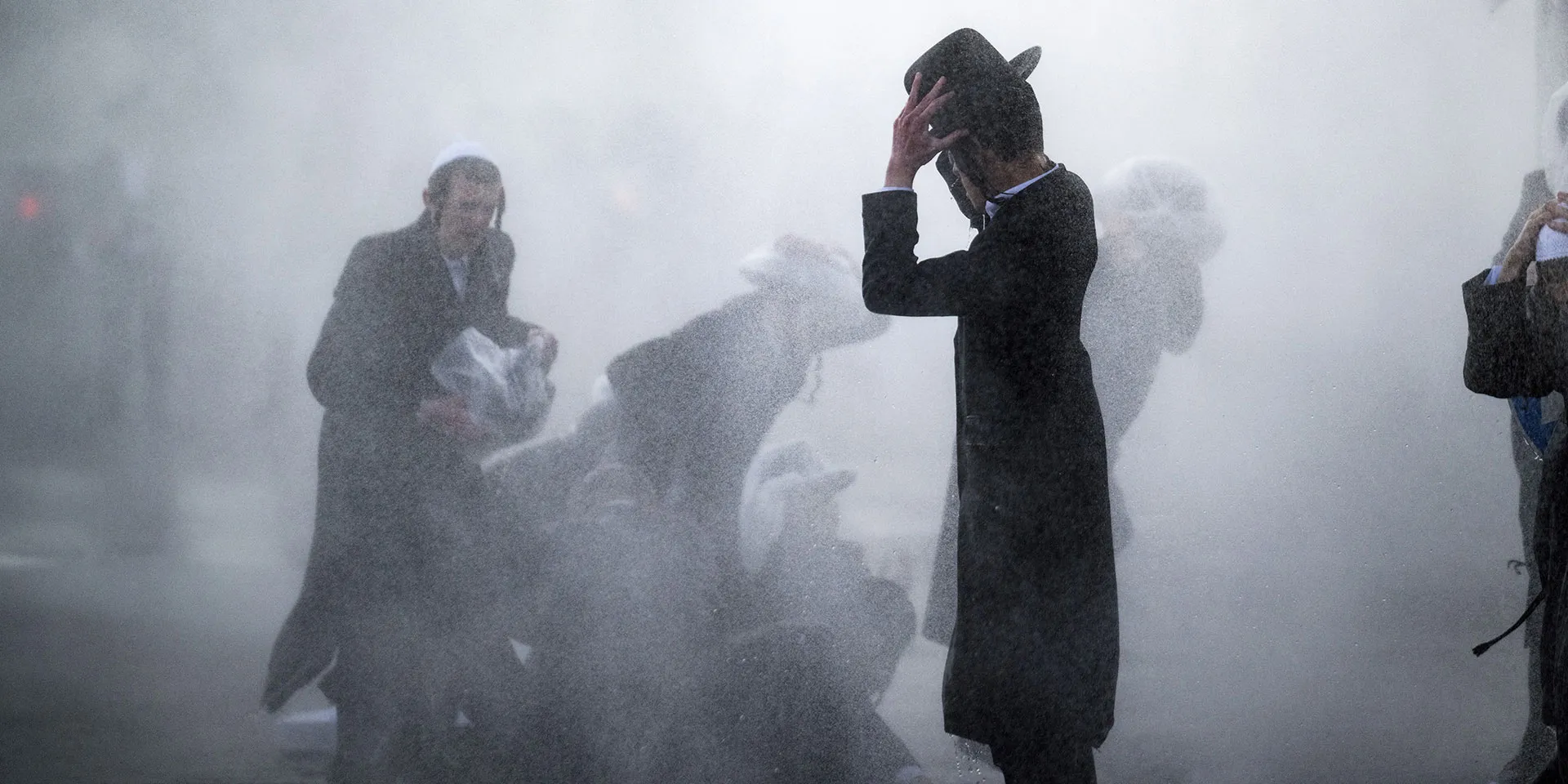
An ultra-Orthodox protest against the draft in Jerusalem, last week. Photo: Reuters

Lir Spiriton
March 29, 2026

Summary


Listen to a Dynamic Summary of the Article
Created using NotebookLM AI tool
The most recent round of fighting between Israel and Iran came at a time when leaders of the ultra-Orthodox parties were engaged in prolonged discussions over the ultra-Orthodox military service bill – and while internal pressure was starting to build. As soon as the war broke out, the Knesset’s Foreign Affairs and Defense Committee curtailed its discussions and it later appeared that the bill is dead and buried. Or, in the words of Minister of Finance Bezalel Smotrich, “we are putting to one side controversial issues, which are not suitable for times of war.”
However, the decision to put the issue to one side not only fails to serve the interests of the Haredi public, but also increases internal pressure on the leadership. Two years into the conscription crisis, it is evident to everyone that failure to reach an agreement means that tens of thousands of yeshiva students will remain deserters, will not get state support to pay for daycare centers for their children and will mean less state funding for the yeshivas – a shortfall that will be covered by raising the tuition paid by parents. It was perhaps with all this in mind that Prime Minister Benjamin Netanyahu declared that the draft exemption law will be back on the agenda soon, notwithstanding the “10 red flags” that IDF chief of staff Eyal Zamir waved recently, when telling the security cabinet that the army “is going to collapse in on itself.”
The conscription crisis is a manifestation of a much broader crisis. In recent years, the leaders of the ultra-Orthodox sector – political and rabbinical alike – have been unable to provide answers or solutions to some of the most fundamental issues facing Haredi society. Chief among them is the issue of teaching the core curriculum in Haredi schools. For years, the Ministry of Education turned a blind eye to these schools’ refusal to teach core subjects, but a series of High Court rulings earlier this year put the matter firmly back into the headlines. At the same time, Haredi society itself is undergoing changes, with greater exposure to broader Israeli society and increasing diversity within the community itself.
All of this effectively means the leaders of the ultra-Orthodox community are facing what is arguably their most challenging period since the state's founding. Given the prevalent sentiment among the Haredi public and based on expert opinion, it appears doubtful that, in its current shape, the leadership can provide any response to these crises.
How did the Haredi leadership become such a fragmented and indecisive force?
The ultra-Orthodox public expects clear solutions from a leadership headed by rabbis and their emissaries – the politicians – but so far, at least, there are no results. Leaks from the various rabbinical courts reveal a deep lack of consensus between the Haredi streams, as well as internal chaos accompanied by empty threats to quit Netanyahu’s ruling coalition or that there will be mass migration.
“There’s a problem here, a leadership crisis,” says former Shas Knesset member Haim Amsalem. “When there’s no unified leadership, it’s hard to make decisions that are acceptable to broad segments of the public. For example, Rabbi Ovadia Yosef is no longer with us. He was a character who could make decisions; the public knew that he had decided and that was the end of it. He said yes or he said no. Today, everything is a lot less clear.”
.webp)
Amsalem argues that the lack of proper leadership is one of the reasons for the loss of resolve on issues such as the draft, and that it is what pushed Sephardic Haredim to imitate the more radical Ashkenazim. He cited comments earlier this year by Rabbi Yitzhak Yosef – the former Sephardi Chief Rabbi of Israel and a member of Shas’ rabbinic leadership council – as an example of the change in tone from the Sephardi Haredi leadership. During a weekly Torah lecture, Yosef said that he has instructed his grandson to rip up his draft paper and throw the pieces in the toilet – which he did.
Aaron Rabinowitz, Haaretz’s ultra-Orthodox affairs correspondent, is a lot more forthright. He believes that the ultra-Orthodox leaders “behave in this way because they’re a bunch of cowards. In the past, they had more room to operate. In the past, the leadership had more power to launch daring moves.
“Ultra-Orthodox society is experiencing a severe leadership crisis. You just need to look at the divisions within Haredi society to understand. Take Agudat Yisrael, the Hassidic faction in United Torah Judaism, for example. It’s not that there was some kind of wonderful unity within the party for all these years, but it has never been this bad. We see how they vote against one another in the Knesset. It’s blatant. They are operating like entirely separate entities – and it’s a very real manifestation of the crisis, not something that is happening behind the scenes,” he adds.
Rabinowitz also says that, “even with the Degel Hatorah, the Lithuanian faction, the infighting has been unprecedented. They’re no longer even bothering to conceal it. There are open confrontations which have a practical impact on the decision-making process. One of the reasons that the draft exemption law has not been advanced is power struggles and ego battles between the rabbinical courts.”
The “courts” that Rabinowitz refers to are the Lithuanian rabbinical families that lead Degel Hatorah – Rabbi Moshe Hillel Hirsch and Rabbi Dov Lando – who are trying to maintain a façade of unity. According to Rabinowitz, one of the points at which the draft exemption law got stuck, which was externally described as a delay in a rabbinical decision, was actually a petty power struggle: Hirsch’s court made a decision, Lando’s was offended and refused to answer phone calls from Knesset members for some 10 days, until the decision was no longer relevant.
Shas, too, has been beset by disarray and Rabinowitz compares what is happening there to events in the Ashkenazi parties. “Once there was a leaked audio tape of Rabbi Ovadia speaking harshly about Aryeh Dery and it caused an earthquake. Today, within the rabbinic leadership council itself, the knives are openly drawn. The leadership is in tumult. And the moment you no longer have stable leadership, every rabbi does whatever he wants.”
According to Rabinowitz, there are political solutions available, but the leaders refuse to implement them. “The Haredim made a mistake by continuing to support Netanyahu,” he says. “They are paying a very heavy price for it. If I were in their shoes, I would move over to the left and tell them: Give me what I want and I’ll give you what you want. That’s how politics works. When it comes to the game of politics, they are the worst players imaginable.”
It’s worth noting that the internal Haredi volatility surrounding these issues is also reflected in the difficulty obtaining a response from the Haredi parties. Shomrim’s requests to interview Haredi Knesset members were either declined or ignored.
So why doesn’t someone say something?
In light of this situation, it is perhaps not unreasonable to wonder why the Haredi public itself does not protest against the leaders. While the pressure is intense, the average ultra-Orthodox citizen would be reluctant to disrespect the rabbis and would not speak out against them. This means that the politicians become an outlet for public anger, since it is permissible to speak out against politicians. Indeed, there has been harsh public criticism of ultra-Orthodox politicians, primarily in private conversations, however, rather than on public platforms. Some of the critics argue that political leadership is misrepresenting the situation to the rabbinical leadership. Others say that the rabbis are well aware of what is going on, but are cynically taking advantage of the politicians.
Menachem Toker, a popular Haredi broadcaster, was asked why there is not enough open criticism of some parts of the ultra-Orthodox political leadership. “The public understands what’s going on, but will never say anything because ‘you shall do according to all that they instruct you.’ I also do what they tell me, but the greatest failure lies with the Haredi parties.I do not accept the argument that the attorney general is at fault because the politicians had enough time to deal with the issue before she was even appointed and after that, too.
“They are not presenting solutions, such as military service adapted to the ultra-Orthodox lifestyle, volunteer courses or any other idea, with the approval of the great Torah scholars. But that didn’t happen. It has to be said: if a yeshiva student who wants to study Torah in the Land of Israel runs the risk of being arrested during the term of the government – then they have failed. And I am not expressing my own opinion here, just what I keep hearing all the time.”
In the WhatsApp forum he manages, Toker conducted a survey to gauge the mood among the ultra-Orthodox public. While it was not a representative sample of the Haredi population, of course, it can still provide some insight into the public mood. A total of 2,000 people took part in the survey, of whom 65 percent said that they voted in the past for United Torah Judaism but would not do so again. Toker, incidentally, believes that these are mainly from the Modern Haredi sector.
“Some of the representatives need to be replaced,” Toker believes. “They no longer represent the majority of the Haredi sector. A lot of the Haredi sector today is made up of working, open and modern Haredim, who are involved and integrated – but still Haredi. They want to remain Haredi but there are many types and genres within the Haredi sector.”
Rabinowitz agrees that the Haredi political leadership finds itself at a difficult moment. “I don’t think that anyone believes that the situation is solvable,” he says. He argues that the Haredim are interested in any kind of draft law, because “this year, either way, there will be an election and they cannot fight an election without something to take to their public. Otherwise, their voters will ask ‘What did you do for four years in the government? In the Knesset?’ Their voters are captive, but it’s a delicate game. In the end, you go to synagogue and your neighbor or friend asks you: ‘What did you achieve?’ And what does he tell him? Even if the audience is captive, there is a difference between having 80 percent or 90 percent turnout; they are fighting for every vote. You have to work hard with them, you have to make promises, you have to be a politician.”
What have the changes done to Haredi society?
This leadership vacuum is not just an abstract concept, however. It affects people’s lives. “A young man who wants to go out and get a job – cannot. That path is not open to him. He has the army and he finds himself struggling with his studies,” Rabinowitz explains. “There is no clear path to integration, so they work without paying taxes or they don’t work at all – and ultra-Orthodox society is becoming poorer and poorer. It all revolves around who’s running the political show.”
Rabinowitz is indirectly referring to the internal changes that Haredi society is undergoing. The coronavirus pandemic and the shutdowns led to a massive uptake in internet access and an acceleration of the process whereby the modernist fringes of Haredi society expanded. In turn, this leads to greater leniency – however slow and almost invisible – in the inner circles. “There are some people who want a good life. They vote for Haredi parties and, at the same time, often act like non-religious people. They do not integrate like the Haredim, they want to enjoy the best of both worlds,” Rabinowitz explains. “The public has changed, the people close to the rabbis have changed and the leaders have changed. We are now in the next generation.”
Alongside them, there are also “ideological” modern Haredi, who remain Haredim throughout their whole lives – not just for external consumption. According to Rabinowitz’s explanation, they want to combine Halacha with integration in Israeli society. From the perspective of the Haredi political establishment and its rabbis, the modern Haredim pose a greater threat, since they not only introduce foreign ideas into the Haredi community but also challenge the leadership’s authority regarding the question of who is Haredi. The blind obedience that was taken for granted for decades is no longer a given.
“Both groups,” he adds, “see integration into Israeli society as something that is not terrible. It’s hard to know how many people there are among these groups, but their numbers are growing. It’s a very dramatic change.”
The internal processes in ultra-Orthodox society are eroding the authority of the leadership which, until now, was unchallenged. What is still hidden from view in the political arena may now erupt, as the crisis over the draft law and core curriculum give the leadership a challenge it is far from certain of passing.