


“If You Come Back - We’ll Kill You”: Settler Violence Crosses Over Into Palestinian-Controlled Parts of the West Bank
Testimonies from the ground, official documents, and a High Court petition reveal a surge in violence and land seizures by Israeli settlers in areas under Palestinian Authority control. “It wasn’t like this before - this year has been the worst,” says a resident of Sinjil, where settlers have invaded agricultural land and private property. A Shomrim report
Testimonies from the ground, official documents, and a High Court petition reveal a surge in violence and land seizures by Israeli settlers in areas under Palestinian Authority control. “It wasn’t like this before - this year has been the worst,” says a resident of Sinjil, where settlers have invaded agricultural land and private property. A Shomrim report
Testimonies from the ground, official documents, and a High Court petition reveal a surge in violence and land seizures by Israeli settlers in areas under Palestinian Authority control. “It wasn’t like this before - this year has been the worst,” says a resident of Sinjil, where settlers have invaded agricultural land and private property. A Shomrim report
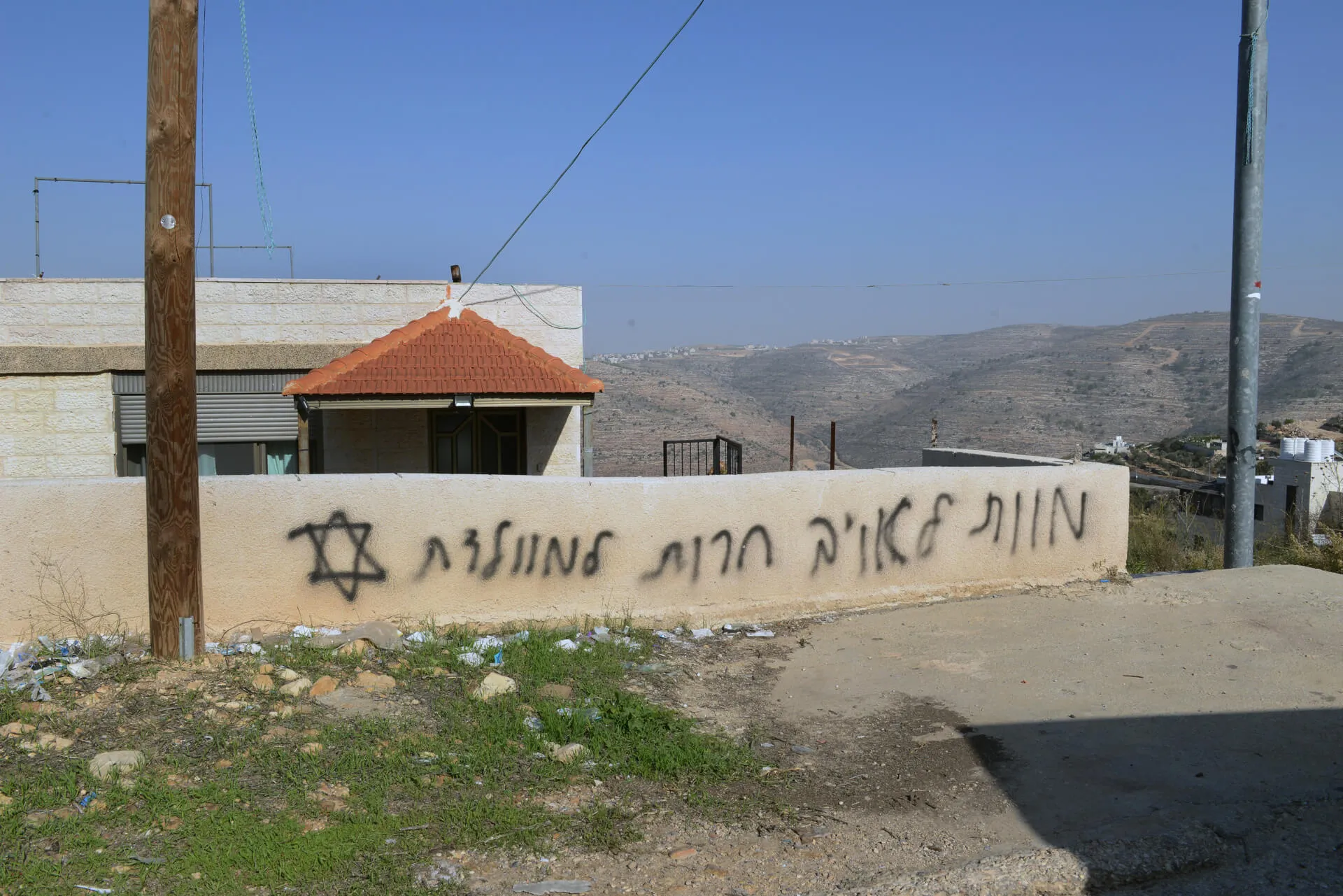
"Death to the enemy, freedom to the homeland." A graffiti sprayed on a house in the Palestinian village of Atarah, December 2025. Photo: Eyal Izhar

Daniel Dolev
January 7, 2026

Summary


Listen to a Dynamic Summary of the Article
Created using NotebookLM AI tool
Sixty-year-old Ibrahim Shabana speaks fluent Hebrew and has a tendency to talk at length about the many years he worked in restaurants in Jerusalem. He hosted us on the roof of his home in the West Bank village of Sinjil, located between Nablus and Ramallah, on a warm, sunny morning in early December. In sharp contrast to the pastoral surroundings, what Ibrahim has to say is bleak.
“Do you see those olive trees over there?” he asks, pointing to a plot of land on the outskirts of the village, not far from the last homes. “I own seven dunams of land next to them. I planted them and when I went there, a soldier told me, ‘If you come back here – I’ll kill you.’ Last year, during the plowing season, my brother went there, but soldiers and settlers told him to leave immediately or they would kill him. It didn’t used to be like this. Two or three years ago, we could go there. Until the war. This year has been the worst.”
Shabana’s testimony, taken along with additional witness reports and evidence collected by Shomrim, point to a very clear trend: if, in recent years, Israeli settlers focused their attention on uprooting shepherding communities from their land in Area C of the West Bank, their violence is now also being directed toward Palestinians in Area B, which is under the civilian control of the Palestinian Authority – and sometimes even in Area A, which is under full PA control and which Israelis are banned by law from entering. And judging by comments from some of those settlers, it appears evident that this is a planned move.
.webp)
In the southern section of Sinjil, which has a total population of around 4,000, is Al-Batin, an agricultural area with several homes. The mayor of Sinjil, Dr. Mutaz Tawafsha, can only see the area from afar since settler violence has made it dangerous to even get close. He says that settlers took over the land during the summer and set up an outpost there, after invading the Palestinian homes. He explains that residents can’t get to their houses or to the adjacent agricultural land, which is split between Areas A and B.
Unusually, the testimonies of Palestinian residents have been backed up by Israeli authorities. The houses which the Israeli settlers invaded belong to residents of the adjacent village. In August, residents petitioned the High Court of Justice, asking for the IDF to be instructed to remove the invaders. The petition was accompanied by photographs of vehicles and homes that were allegedly torched by settlers, as well as documentation of settlers at the site – some of them armed. In some of the photos, IDF soldiers and vehicles can be seen nearby.
In its response to the petitioners, the legal advisor for the IDF’s Judea and Samaria Division wrote that, “in recent months the Division has received reports about untoward incidents in which there were cases of extreme violence used against Palestinian residents and their property by Israelis.” Col. Anan Fares, the commander of the Binyamin Regional Brigade, declared that, “a few months ago, we identified a significant increase in the extent and severity of nationalistic crime in Judea and Samaria.” He added that the most serious cases of violence occurred in the area under the control of the Binyamin Regional Brigade.
According to Fares’ declaration, officers toured the area in question in early October and found that, on a hill on Area A, “Israelis took control of a Palestinian resident’s home and are currently living there.” The officers also found that an authorized access path had been cut, “which the Israeli settlers used to reach the hills and the Palestinian village on Sinjil quickly.” According to the divisional commander, the path was blocked off by the IDF, but “is being reopened time after time by the lawbreakers.”
.webp)
Settlers violence is now also being directed toward Palestinians in Area B, which is under the civilian control of the Palestinian Authority – and sometimes even in Area A, which is under full PA control.
Settlers beat Palestinians and left-wing activists with clubs; two were killed
On July 11, 2025, a group of Palestinians tried to reach the land on which the Al-Batin outpost had been erected, which led to a confrontation with the settlers. According to the IDF, the Palestinians threw rocks, injuring two Israelis. Shortly after that, according to eyewitness reports, a gray pick-up truck arrived on the scene, carrying masked settlers. According to the testimony of left-wing activist Jonathan Pollak, which was published in Haaretz, the truck hit a Palestinian man, and the settlers who got out of the vehicle used clubs to beat Palestinians and activists. Two Palestinians were killed, according to Palestinian reports, as a result of the settler assault: 23-year-old local resident Muhammad Shalabi and Seif al-Din Muslat, a 20-year-old Palestinian-American who was visiting family.
Now Shomrim can reveal that the pick-up truck that brought the masked settlers to the scene belongs to Yehoyariv Maguri, a settler who lives on a farm built on privately owned Palestinian land in Area C. According to documents that Maguri submitted to the court, he was detained after the incident, and during his interrogation, he was shown a video in which his vehicle can be seen with masked settlers in it.
According to Maguri, this is what happened: “Youths who work on the farm were attacked by a riled-up Arab mob and that developed into an all-out fight between settlers and the Palestinian rioters.” The police must have seen events very similarly since, after he was interrogated, Maguri was released without condition and, just a few weeks later, his truck, which had been impounded as evidence, was returned to him. Maguri refused to answer Shomrim’s questions.
The state claimed before the Supreme Court that it is working to maintain law and order in the area. It added that the IDF, the Shin Bet, the Border Police and the Israel Police set up a joint task force in July to deal with the issue of Jewish terror, stating that it has issued restraining orders and imposed restrictions on settlers who have been involved in violent incidents. The attorney representing the state also said that the security forces on the ground are clear that they cannot stand idly by when there are settler attacks on Palestinians or Palestinian property. According to the army, these efforts have already yielded results – but, on the ground, the settlers have accomplished what they set out to do: the Palestinian locals no longer come near their own land.
Even removing outposts doesn’t help
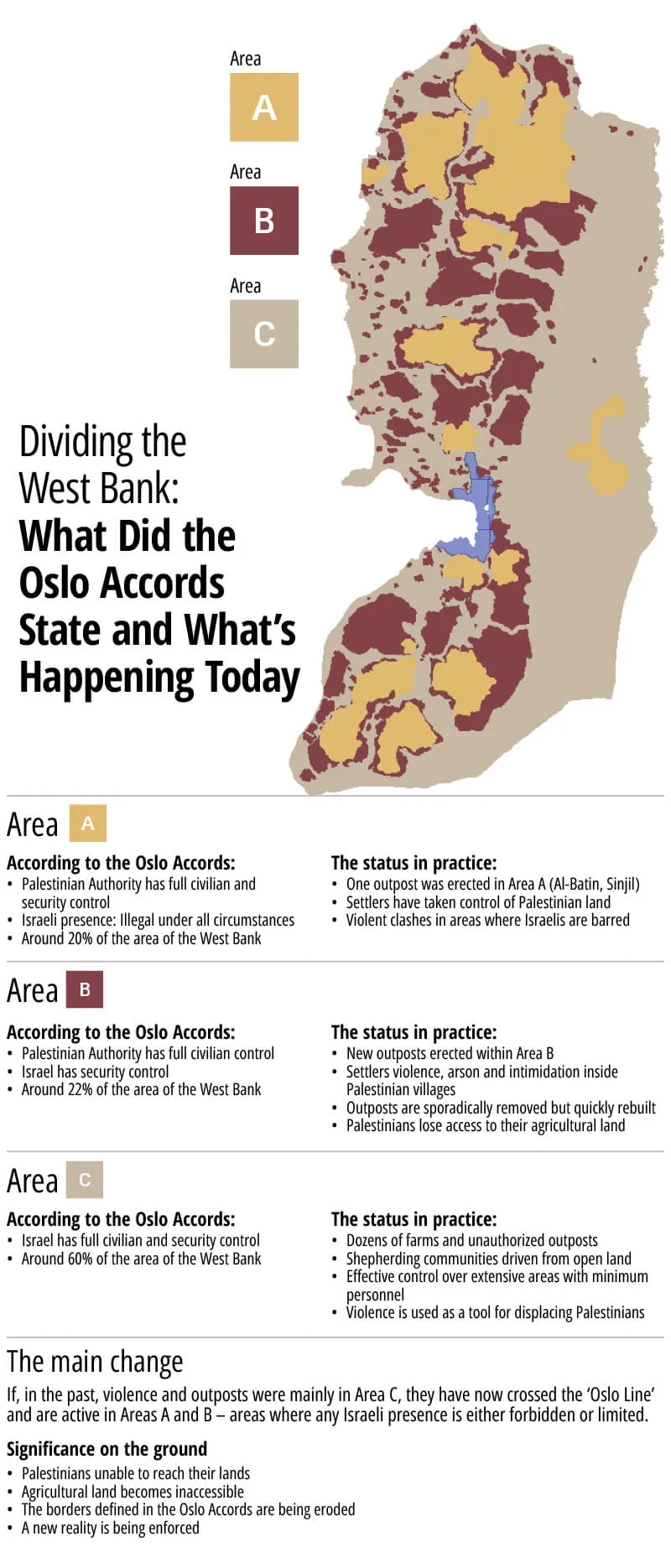
The division of the West Bank into Areas A, B and C is part of the legacy of the Oslo Accords. Area A, which includes the largest Palestinian cities and several large towns, makes up a little less than 20 percent of the West Bank, and Israelis are barred from entering it. Area A is under full Palestinian control for civilian and security matters. Area B, which makes up a little more than one-fifth of the West Bank’s total territory, includes hundreds of Palestinian villages and is under Palestinian civilian control, but the IDF remains responsible for security. Area C, around 60 percent of the West Bank, includes most of the Jewish settlements and is under Israeli civilian and security control. (See map).
In recent years, settlers have made intensive efforts to drive Palestinians from Area C. One of the methods they have used is the establishment of dozens of “agricultural farms” – a euphemism for illegal outposts – which benefit from government support.
These farms, as Finance Minister Bezalel Smotrich has made clear on more than one occasion, control large areas of land using a minimum amount of manpower. The farms themselves, the access paths leading to them, and the grazing land are no longer accessible for Palestinians. It is not rare for one of these outposts to be built adjacent to a Palestinian village, and the settlers use threats and violence against the locals – while the police and the army either support them or, at best, turn a blind eye – until the Palestinian communities simply leave. That is what happened, for example, in May in the shepherding community of Mughayyir al-Deir. The process has been accelerated since October 7 and, according to human rights groups, dozens of such communities have been driven from their land in recent years.

Over the past two years, settlers from the hilltop outposts have also established unauthorized communities in Area B. Unlike the farms, the IDF continues to remove these outposts – but, for the most part, they are soon rebuilt. Even when the military conducts repeat evacuations, authorities are unable to deal with the violence used against the Palestinians.
In Area C, the bulk of the settlers’ violence has been directed at shepherding communities in open areas, but with the outposts, they are targeting residents of large and long-established villages. One such village is Atarah, located in Area B of the West Bank. One morning, residents woke up to find a new outpost on their land. On August 15 2025, just four days after the outpost was erected, cars were torched in Atarah. Since then, there have been at least two additional incidents of arson and, in another case, graffiti in Hebrew reading “Administrative Price Tag” were sprayed on a building.
The head of the Atarah Local Council, Nizar Mughrabi, told Shomrim about a settler who regularly grazes his herd in the village and, during the first week of December, even approached the school located at the center of a village with a drone flying overhead. “People are scared,” Mughrabi says. “How can anyone go to work under these conditions? They don’t feel secure at work and they don’t feel secure with their children.”
.webp)
The outpost adjacent to Atarah is called Kfar Tarfun. Since its establishment in August, it has been evacuated by the IDF and the Israel Police, but the settlers quickly returned. Most recently, a hilltop settler called Elisha Yarad tried to raise funds to pave an access road to the outpost. A video posted to social media in October shows two settlers harvesting a mature olive tree. “Kfar Tarfun – Enjoying the best the Land of Israel has to offer,” Yarad wrote. What is clear, however, is that settlers from the outpost – which was only erected a few weeks previously – were not the ones that planted the tree.
.webp)
Outposts began to pop up outside Area C during 2024. In a social media post by an account identified with the so-called “hilltop youth,” it was claimed that five outposts had been erected in Area B. However, Peace Now’s settlement monitoring team recorded seven such outposts, of which five were located inside the “Agreed Nature Reserve” in the Bethlehem region. The reserve is an area of land set aside in the Oslo Accords on which both sides have agreed not to build. A year ago, Haaretz revealed that – even though the area falls inside Area B – Israel had passed a cabinet resolution granting the state permission to demolish several Palestinian buildings in the area and it was around this time that settlers began erecting outposts.
.webp)
The phenomenon, however, is spreading. Dror Etkes, the founder of Kerem Navot, an Israeli NGO that monitors settlement construction in the West Bank, has identified almost 20 new outposts outside Area C: there are around 10 in the Agreed Nature Reserve, six in the Binyamin Region of Area B and one in Area A. Having said that, not all of the outposts that have been erected still exist, since some are sporadically evacuated by Israeli authorities. The attacks, however, are even more prevalent than the outposts. An outpost was built to the east of Taybeh in the Binyamin Region on land from which a shepherding community was expelled. Even though the outpost is in Area C, the settlers also took control of land in Area B.
Nadim Khoury, one of the owners of the Taybeh brewery and vineyard, appears frustrated as he shows Shomrim a video of a settler plowing a plot of land adjacent to the village. Khoury shows us the ownership deeds proving the land is his, as well as the form showing that he filed a police complaint over illegal invasion of his land. To no avail. “I even sent a copy of my complaint to the U.S. Ambassador to Israel, Mike Huckabee, because I also have American citizenship,” Khoury says. “He promised that he would make [the settlers] leave, but they’re still there.”
.webp)
Seems far-fetched? The settlers make no secret about it
According to Etkes, the farms and outposts cover an area of one million dunams – 1,000 square kilometers (386 square miles) – of which around 10 percent is in Area A or B. He believes that there are two goals to the process: pushing the Palestinians out of the open areas in the West Bank into the towns and villages – and destroying the Oslo Accords. “The goal is for the Messiah to come and for the Holy Temple to be rebuilt, but, on the road to that, they want to limit the Palestinians into built-up areas and make their lives as difficult as possible to ‘encourage migration.’ They are forcing them into built-up areas. They’re crushing Palestinian culture, economy and agriculture.”
If there was any doubt that this is a well-thought-out plan, an article by Elisha Yarad in the Small World Shabbat newspaper in July surely removed it. “Two years ago, people said that the first settlers in Area B were totally delusional; now, even the official settlement organizations are starting to wonder out loud about the viability of such a move,” he wrote. At the end of the article, he urged, “now of all times is the time for the official settlement organizations and the right-wing ministers in the government to stop prevaricating and hesitating … They must raise the standard now and declare loudly and without fear – this is our land and it is our historic and natural right to settle it…”
Settlement Minister Orit Strock encapsulated a similar approach in December in an interview with Kan 11. “In three years, we are rectifying 30 years of damage from the Oslo Accords,” she said. “You on the left still haven’t sobered up from that.”
IDF Spokesperson Response:
“When IDF soldiers encounter a violation of the law by Israelis, they are required to intervene in order to stop the violation.”
In Response to Shomrim’s questions, the IDF spokesperson unit said: “IDF forces, including the Central Command, operate in Judea and Samaria in accordance with the directives of the political echelon, the law, and legal regulations. The mission of the IDF is to safeguard the security of all residents of the area and to act to prevent terrorism and activities that endanger the citizens of Israel. When IDF soldiers encounter a violation of the law by Israelis, they are required to intervene in order to stop the violation, and if necessary, to detain or arrest suspects until the arrival of the police.”
“All actions, including the evacuation of illegal construction and defence against terrorism, are carried out in accordance with situational assessments and out of responsibility for the security of the State of Israel and the lives of all residents of the area, regardless of their place of residence. With regard to the illegal structures mentioned, enforcement proceedings are being conducted concerning them and will be enforced in accordance with situational assessments and approval by the political echelon. The Supervision Unit of the Civil Administration operates on an ongoing basis to locate illegal structures and enforce the law.”
“Regarding the claim about the incident that occurred near Sinjil on July 11, terrorists hurled stones at Israeli civilians near the village, as a result of which two Israeli civilians were lightly injured. Shortly thereafter, a violent confrontation developed in the area between Palestinians and Israeli civilians, which included vandalism of Palestinian property, arson, physical confrontations, and stone-throwing. Claims regarding a Palestinian who was killed and several Palestinians who were injured as a result of the confrontation are being examined by the Shin Bet and the Israel Police. Upon receiving the reports [of confrontations], IDF forces, the Judea and Samaria District Police, and Border Police units rushed to the scene in order to disperse the confrontation. The forces used riot dispersal measures against the violent disturbance, and all rioters dispersed.”
.webp)