


Pillaging the Five-Year Plan: Ministers Seek to Divert Funding from Arab Society to the Police and Shin Bet
Without any consultation and despite opposition from most ministries, May Golan and Itamar Ben-Gvir – the ministers of social equality and national security respectively – want the cabinet to vote on their proposal to divert 2.5 billion shekels ($750M) away from government programs aimed at improving the lot of Israel’s Arab citizens and giving it instead to the police and the Shin Bet. Shomrim reveals the figures and the internal correspondence warning of catastrophe
Without any consultation and despite opposition from most ministries, May Golan and Itamar Ben-Gvir – the ministers of social equality and national security respectively – want the cabinet to vote on their proposal to divert 2.5 billion shekels ($750M) away from government programs aimed at improving the lot of Israel’s Arab citizens and giving it instead to the police and the Shin Bet. Shomrim reveals the figures and the internal correspondence warning of catastrophe
Without any consultation and despite opposition from most ministries, May Golan and Itamar Ben-Gvir – the ministers of social equality and national security respectively – want the cabinet to vote on their proposal to divert 2.5 billion shekels ($750M) away from government programs aimed at improving the lot of Israel’s Arab citizens and giving it instead to the police and the Shin Bet. Shomrim reveals the figures and the internal correspondence warning of catastrophe
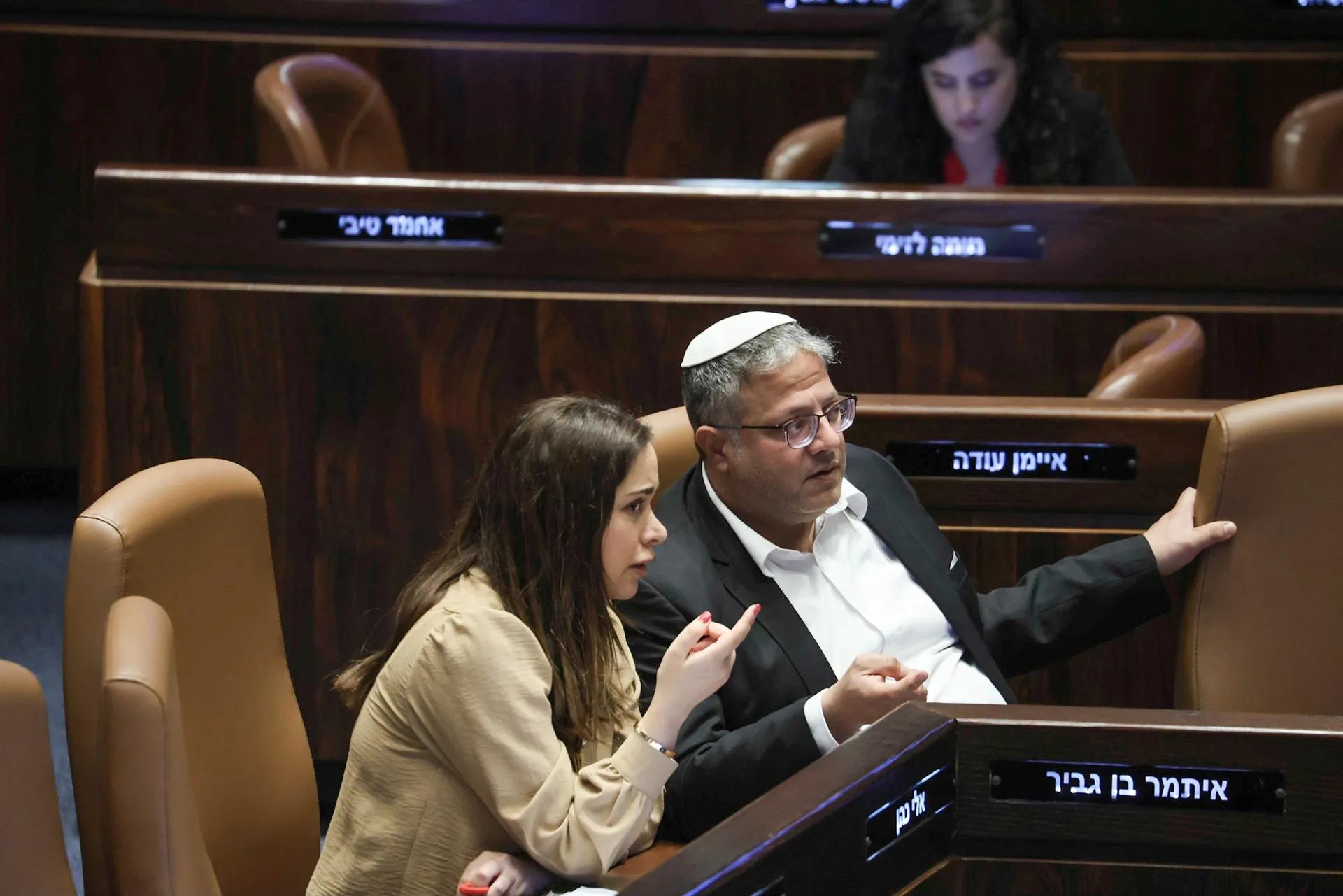
Ministers May Golan and Itamar Ben-Gvir in the Knesset. Photo: Danny Shem-Tov, Knesset Spokesperson

Haim Rivlin
December 8, 2025

Summary


Listen to a Dynamic Summary of the Article
Created using NotebookLM AI tool
Directors-general of Israeli ministries have made their fury clear in their private WhatsApp group, following the publication of a plan by ministers May Golan and Itamar Ben-Gvir to slash hundreds of millions of shekels from their budgets – a proposal drafted without consulting them or their ministers. According to a draft proposal circulated just days ago to the other members of the cabinet – and which will come up for a vote at the end of this week (a government meeting to approve the plan has been scheduled for Thursday evening), when ministers meet to approve the state budget for 2026 – some 2.5 billion shekels ($750M) will be transferred away from programs operated by several different ministries in the framework of the five-year plan for bridging socioeconomic gaps between Arab society and the Jewish sector. Instead, this money will be allocated to the Shin Bet and the Israeli Police, in what those behind the proposal are presenting as a plan to tackle crime in the Arab community.
According to the draft drawn up by Golan and Ben-Gvir, the Ministry of Education will lose 677 million shekels ($205M), which had been earmarked for, among other things, schools, classrooms and kindergartens. The Ministry of Welfare will lose 142 million shekels ($43), which were supposed to help recruit more social workers and to provide support for at-risk youth. Miri Regev’s Ministry of Transportation will have 200 million shekels ($60M) stripped from its budget – money that was allocated for improving roads, public transport and a train station in Tira. The Ministry of Culture and Sport, for its part, will have to make do without 114 million shekels ($34M), which it has planned to use for building sports facilities and supporting outstanding athletes. Elsewhere, the Housing and Construction Ministry’s budget will be slashed by 608 million shekels ($184M), the Employment Service will lose 187 million shekels ($57M), and the Israel Innovation Authority will lose 26 million shekels ($8M). Among the other bodies to be affected by the plan are the Fire and Rescue Service, the Ministry of Tourism, the Ministry of Economy, the Ministry of Energy and the Ministry of Agriculture. See table below.
The Golan-Ben-Gvir Plan | Where will most of the budgets be diverted from (2025-2026)
- Ministry of Education - $205million
- Ministry of Housing and Construction - $184million
- Ministry of Transportation - $60 million
- Employment Service - $57 million
- Ministry of Welfare - $43 million
- Ministry of Sport and Culture - $34 million
- Water and Sewage Authority - $27 million
- Ministry of Economy - $20 million
- Ministry of Negev and Galilee - $19 million
- Ministry of Environmental Protection - $18.7 million
- Ministry of Agriculture - $9 million
- Innovation Authority - $8 million
- Fire and Rescue Service - $6 million
As soon as the draft was published, the directors-general of all ministries sent furious letters to cabinet secretary Yossi Fuchs, as well as to Golan and Ami Cohen, the director-general of the Ministry of Social Equality, who heads the standing committee which is supposed to advance the five-year plan but which, in practice, is obstructing it. All of these letters complain that the proposal was drafted without any consultation and warn of the dire consequences for their departments’ operations if the plan is implemented. “What May Golan is doing is not legitimate,” the director-general of one ministry, who asked to remain anonymous, told Shomrim. “From the day that she took over [as Minister of Social Equality], she has deliberately been putting spokes in the wheels of the five-year plan so that she can take the surplus budget for some other cause.”
Judging by internal letters obtained by Shomrim, which are being published here for the first time, it is evident that there is wall-to-wall agreement within government ministries that if Golan and Ben-Gvir’s plan is approved it will not only fail to reduce the crime rate in Arab society, but could lead to an even steeper rise since hundreds of projects in that sector – from education to employment – would be eradicated. For example, Eti Kisus, the deputy director-general of the Ministry of Welfare, wrote the following to her counterpart in the Ministry of Social Equality, Sophie Cohen: “Currently, [the Ministry of Social Equality funds] around 303 programs and services of different kinds for local authorities. If this proposal is approved, it will lead to their immediate closure and to significant harm to the work done to reduce gaps and help combat violence and crime. The immediate closure of all these plans will significantly undermine implementation of the plan to develop Arab society, will cause a regression and a crisis of confidence between the government, the authorities and the citizens.” Kisus added that the upshot of the proposal would mean that Arab local authorities would find themselves in budgetary deficit since “our ministry would have to take back all of the funds allocated to them.”
Attorney Moran Schnaider, head of the Social Justice Division at the Ministry of Justice, wrote a letter on behalf of colleagues. In it, she stated that “this proposal, which was drafted without consultation or any prior dialogue, not only fails to provide an effective solution to the problem of crime in Arab society, but it could also exacerbate the situation.” Avi Cohen Scali, the director-general of the Ministry of Diaspora, wrote a letter to his counterpart at the Ministry of Social Equality to express his disappointment, given that the Ministry of Diaspora, which is also responsible for the Authority for the Development and Settlement of the Bedouin in the Negev, is among the ministries that will be affected by the proposal.
“We were stunned to stumble across your proposal, which was not shared with our ministry,” Cohen Scali wrote back in October. “It is unclear to us why you did not see fit to inform our ministry of the issue, especially given the personal and professional acquaintance and the good working relationship at the professional level.”
A month later, Cohen Scali wrote another letter to the director-general of the Ministry of Social Equality, saying that “it is unacceptable that such a significant proposal has been put forward – a proposal that has direct ramifications on Government Resolution No. 1279 [for the socio-economic development of the Bedouin population in the Negev] – without holding discussions at the professional level between the ministries. This diversion of funds is a significant blow to multi-year processes and fundamental plans, which were carefully drawn up in conjunction with the local authorities, government ministries, and other partners. We welcome the desire to tackle crime and violence, but this can be achieved by formulating an agreed-upon and data-based working plan, as well as allocating funding – not by causing severe harm to other processes, which are already being implemented.”
Another letter, penned jointly by the heads of the Employment Service, the Governmental Institute of Technological Education and Training and other senior civil servants, warned that the budget cuts would be a fatal blow to programs aimed at providing career guidance, improving occupational language skills and integrating Arab academics and engineers in the Israeli high-tech industry, as well as the network of technological colleges and high-quality vocational training.
Yossi Dayan, director-general of the Ministry of Energy and Infrastructure – which is slated to lose 90 million shekels (27M) if the proposal is accepted – tried rather naively to appeal to Golan’s conscience. “Diverting funding will harm the multi-year plan to narrow the gaps in the field of renewable energy and will delay Israel’s ability to meet its national targets on greenhouse gas emissions,” he wrote in a letter last month. “I would ask that you intervene to prevent this from happening.”

Criminal gangs fill the vacuum
To fully understand how problematic the proposal being pushed by Golan and Ben-Gvir really is, it is important to go back to the end of 2021, when the government passed two resolutions: Resolution 550 to tackle socioeconomic gaps between Jews and Arabs in Israel and Resolution 549 to tackle the crime wave in Arab society. While the decision to implement these five-year plans were made during the time of the short-lived Bennett-Lapid government, it was based on the recommendations of a government committee appointed in 2019 by none other than Prime Minister Benjamin Netanyahu.
“A very serious government committee sat to find solutions to the issues of crime and violence,” says Ofer Dagan from the Sikkuy-Aufoq NGO for equality and partnership between Jewish and Arab citizens of Israel, which played an active part in drafting the five-year plan and continues to monitor its implementation. “Members of the committee included directors-general of government ministries and the heads of various Israeli law-enforcement bodies – and they decided that, in order to effectively deal with crime, the country needed a coordinated plan that included enforcement, prevention and a solution to the underlying economic, social and civil factors. For example, the lack of frameworks and professional training for young people who are defined as NEET - not in employment, education or training. We’re talking about 18- to 24-year-olds and, according to studies, between 30 and 40 percent of them do not have a framework and some of them end up working for organized crime groups. We have to find them frameworks for training and employment.”
The five-year plan sought to simultaneously address the underlying factors in the areas of education, employment, housing and transportation – as well as energy, water infrastructure, the sewage system and the banking system. “There is discrimination when it comes to business loans, housing and investment in Arab society,” Dagan explains. “As a result of this market failure, criminals enter the picture and offer gray-market loans. This is an issue which Resolution 550 sought to address.”
At around the same time as it approved Resolution 550, the government also passed Resolution 549, which was a five-year plan to tackle crime and violence and which involved joint work by several enforcement agencies – police, tax authorities, antilaundering bodies and others – to address the growing problem of organized crime. “The resolution is still in force, it is budgeted for and it worked very successfully in 2022,” Dagan adds. “For the first time in almost a decade, there was a drop in the number of homicides in Arab society. The moment that Ben-Gvir was appointed minister, he neutralized significant parts of the plan and de facto dismantled the implementation apparatus. There were 2.5 billion shekels there. They messed it up and now they want to take something like 2.5 billion shekels away from the parallel program [the 550 five-year plan] in order to fund the police and the Shin Bet.”
According to Dagan, this is not the first time that Golan has used this system: on the one hand, she impedes implementation of Resolution 550, which she is responsible for, and, on the other hand, she claims that the since the resolution is not being implemented, its funding should be diverted elsewhere. “The moment that she was appointed social equality minister, she froze the work of the standing committee,” he explains. “The standing committee was supposed to overcome any obstacles that led to budgets not being utilized. She cancelled its meetings, which were supposed to be held every six months and prevented officials from her own ministry’s Economic Development Authority from attending Knesset hearings – deliberately sabotaging a plan for which her ministry was responsible.”

So far, just one minister has spoken out
The original budget for the five-year plan for Arab society was 27 billion shekels. In 2024, that was cut by 15 percent because of the cost of the war in the Gaza Strip – even though the across-the-board cut imposed on all the other government ministries that year was just 5 percent. By the end of 2024, the program had utilized 39 percent of its allocated budget. While this may not sound like a lot, it is a relatively high figure that was only expected to grow over the years since there is an inbuilt delay between allocating funding and actually utilizing it – for example, paving a new road or erecting a public building. According to reports prepared by the PMO into the extent to which government resolutions are implemented, the five-year plan for Arab society has among the highest implementation rates of any resolution.
Budgets of the five-year plan for reducing socioeconomic gaps in Arab society | By Ministry
- Ministry of Education: 4.2 billion shekels ($1.27B) for upgrading the education system, funding schools, building classrooms and kindergartens
- Ministry of Welfare: 205 million shekels ($62M) for increasing and operating welfare programs, hiring additional social workers, building and renovating welfare departments, and at-risk youth
- Ministry of Sports and Culture: 198 million shekels ($60M) for building and renovating sports facilities, sports basket, supporting elite athletes
- Ministry of Health: 91 million shekels ($27.5M) for establishing health clinics in local authorities, bolstering healthcare services and family clinics
- Ministry of Transportation: 2.9 billion shekels ($878M) for urban roads, public transport, train station in Tira
- Water and Sewage Authority: 512 million shekels ($155M) for sewage infrastructure
- Employment Service: 527 million shekels ($160M) for career guidance centers, professional training, high-tech programs
- Ministry of Economy: 513 million shekels ($155M) for planning and developing industrial zones, helping small businesses, employment tracks
- Ministry of Housing and Construction: 1 billion shekels ($303M) for subsidizing the cost of developing private land, funding public institutions and developing public spaces, developing and rehabilitating infrastructure in old neighborhoods.
“May Golan argues that there are funds which have not been utilized, but, in practice, what she’s trying to do is prevent utilization of the 2025 budget,” Dagan explains. “Resolution 550 was designed in such a way that half of the funding comes from the budget of the ministry implementing the program, and the rest comes in the form of supplementary budget funds – in other words, money that the treasury transfers via the Finance Committee, usually toward the end of the year. This year, however, the Ministry of Finance has not yet transferred the money. If Golan manages to get her proposal approved, she will prevent utilization of those funds.”
It remains unclear whether the proposal will be approved. Sources in the political system are afraid that, despite opposition from most cabinet ministers, Ben-Gvir and Golan have already managed to get it on the agenda when the cabinet meets this week to approve the state budget for next year. These sources say that the two ministers are expected to condition their support for the budget on their colleagues backing their proposal – a system that Golan successfully used last year to divert 66 million shekels from the five-year plan for Arab society to other causes.
These sources say that the proposal was not only unacceptable from a professional perspective, but that it also showed huge disrespect to ministers who come from the same party as Golan. In fact, they point out, the proposal takes money away from ministries run by Likud members – Transportation, Diaspora Affairs, Education and so on – and gives it to a ministry headed by a politician from a rival party. Worst of all, it’s happening in an election year. “In essence, Golan is working to implement Clause 94 of the coalition agreement between Likud and Otzma Yehudit, which deals with diverting funds away from the 550 plans in favor of dealing with crime in Arab society,” Dagan adds.
Given the financial hit their departments will take, it is rather surprising that most ministers have opted not to speak publicly about the proposal, leaving their directors-general to address the issue – for the meantime, at least. The one exception is Minister of Education Yoav Kisch, who sent a letter this week to the cabinet secretary, in which he wrote: “We will not approve any change to the Ministry of Education budgets for 2026 that have been allocated as part of Resolution 550 since any change will lead to severe harm to ministry’s programs in Arab society. It should be clarified that, in addition to the severe harm to students in Arab society, cutting the aforementioned budgets will lead, among other things, to the dismissal of teachers, the closure of classrooms and the violation of existing commitments with suppliers.”
Ministers Ben-Gvir and Golan did not respond to requests for comment by publication time. Any comment from them will be added to the article.
Update: Following widespread public criticism after the publication of the proposed cuts plan, the proposal was not brought to a vote at the government meeting on Thursday. It was also decided that changes to the budget allocations under Government Decision 550 will require the approval of the Director-General of the Prime Minister’s Office.
.webp)