


With the draft conscription law rarely out of the headlines, the Haredi street is angry and, for the first time, is turning its anger on ultra-Orthodox politicians, who are worried about how this will impact their performance in the upcoming elections. Their solution: pounding the Haredi community with an old-new narrative with a new veneer. A Shomrim report
Israel’s Ultra-Orthodox Street Is Fuming as Leaders Stoke a Victimhood Narrative
With the draft conscription law rarely out of the headlines, the Haredi street is angry and, for the first time, is turning its anger on ultra-Orthodox politicians, who are worried about how this will impact their performance in the upcoming elections. Their solution: pounding the Haredi community with an old-new narrative with a new veneer. A Shomrim report
With the draft conscription law rarely out of the headlines, the Haredi street is angry and, for the first time, is turning its anger on ultra-Orthodox politicians, who are worried about how this will impact their performance in the upcoming elections. Their solution: pounding the Haredi community with an old-new narrative with a new veneer. A Shomrim report
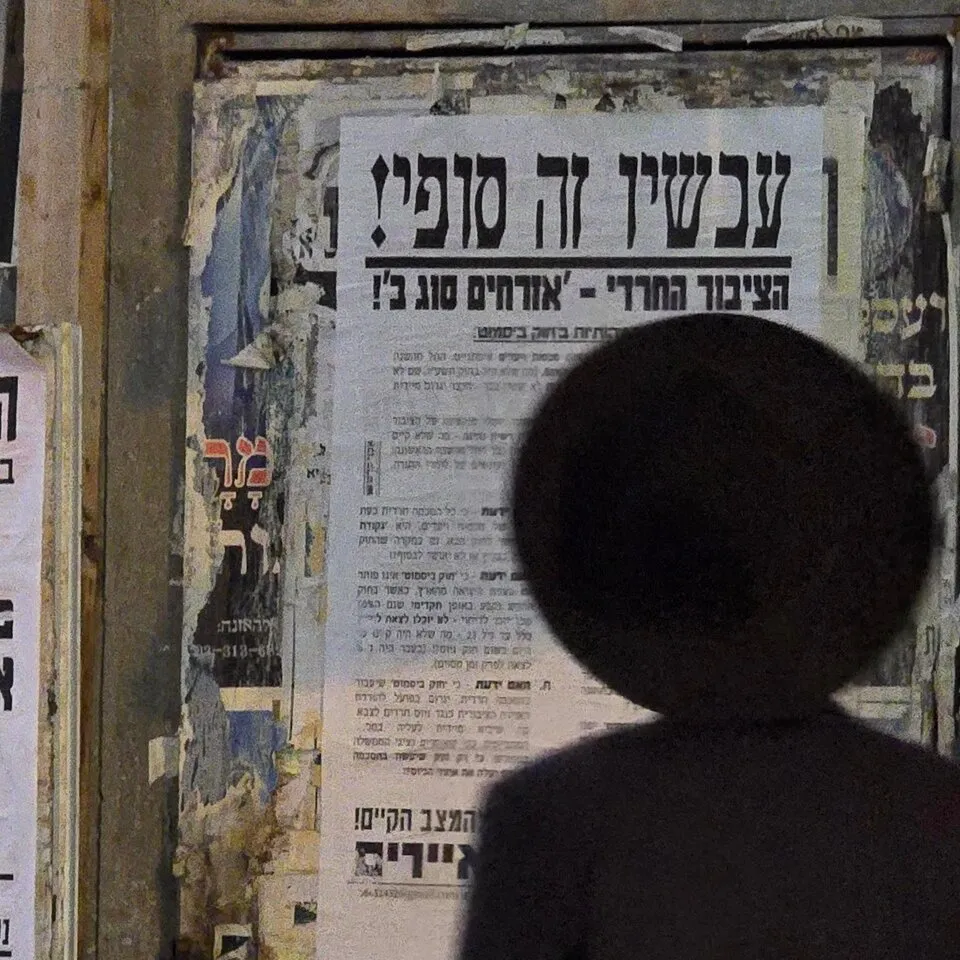
"Now it's final! The Haredi public are second-class citizens!". Poster in Bnei Brak this month. Photo: Lir Spiriton

Lir Spiriton
December 9, 2025

Summary


Listen to a Dynamic Summary of the Article
Created using NotebookLM AI tool
At the time of writing, no one in the Israeli political system has any idea what will happen next with the ultra-Orthodox draft exception bill – if at all. Although the Foreign Affairs and Defense Committee is holding intense hearings, vehement opposition from coalition members raises serious questions over whether it will ever be approved by the Knesset. Whether the legislation becomes law or merely yet another footnote in the decades-old saga of the ultra-Orthodox draft, it has already created a new and very significant problem for the Haredi political leadership: there is unrest and anger on the ultra-Orthodox street – a precedent in that sector of Israeli society. Even worse, it’s happening in an election year.
Although the anger is coming primarily from a relatively small number of protestors and is being blamed, with only a partial degree of accuracy, on “radical elements,” it is hard to overstate its significance in a community that sanctifies the value of obedience. Ultra-Orthodox society is not used to seeing protests outside the homes of Knesset members, leaders being called traitors, toxic wall posters slamming political parties, and other similar phenomena. The main concern among the Haredi leadership is that discontent will spread and that it could have an impact on the outcome of the election. A survey conducted by the ultra-Orthodox Kikar Hashabbat website highlights this concern all too well: around 24 percent of people who voted for United Torah Judaism in the last elections said that they would not do so again if the elections were held today. Among Shas voters, the figure is even higher, with 29 percent saying that they would vote for a different party. It’s still too early, of course, to predict who these furious voters will actually cast their ballots for on Election Day, but the survey represents the very fears that the Haredi leadership harbors and makes it clear yet again that the law – irrespective of its content – will not be an easy pill for their voters to swallow.
While secular parties are forced to deal with disillusioned voters on an almost permanent basis, this is a new challenge for the ultra-Orthodox parties. How, then, are they dealing with it? In the meantime, at least, it appears that Haredi politicians are looking for alternative narratives with which they can pound their voters. The main option, based on several indications on the ground, is to reiterate a narrative that has established firm roots in ultra-Orthodox society in recent months – namely, that the Haredim have become the new “Second Israel” and that they, in fact, are the most disadvantaged population in the country.
“Second Israel” is a socio-political term used to describe a sense of marginalization among large groups in Israeli society – most commonly Mizrahim, residents of the geographic and economic periphery, and at times also parts of the traditional religious public – visa-à-vis “First Israel,” a label associated with the country’s longstanding elites in the center: Ashkenazi backgrounds, higher socio-economic status, and dominance in state institutions, academia, and the media. The phrase is often functions as a political frame that casts society as divided between “the people” and “the elites.” It is not a formal statistical category, but a way of organizing lived experience and historical memory of inequality, and it continues to shape identity and politics in Israel. Comments by ultra-Orthodox MKs, articles in the Haredi media, and conversations with regular ultra-Orthodox citizens reveal that this is fast becoming the prevalent view among every part of ultra-Orthodox society.
“This belief that we are the unfortunate ones, that we’re being screwed over, that we’re victims of discrimination – it’s the result of decades of brainwashing that has trapped people in a kind of matrix,” says writer, academic and journalist Dov Elbaum in a conversation with Shomrim. He says that this belief has undergone a renaissance thanks to the draft issue and the upcoming elections. “The anti-draft campaign is based, in part, on this. Secular Israelis also dodge the draft, they’re saying, but we’re the only ones being hassled.”
.webp)
“Haredi society is one that very much nourishes the idea of persecution. We’re always being persecuted: the establishment is persecuting us, trying to secularize us; the police are persecuting us, and so on."
Posters and WhatsApp messages: You’re suckers
A short walk along the main street in Bnei Brak shows just how deeply this old-new narrative has taken root. “Now it’s final! The Haredi population – second-class citizens!” screams one huge wall poster, while the one next to it details the crimes committed against the ultra-Orthodox community.
It’s not hard to get the passersby who glance at the poster to talk. One woman in her 30s from the Lithuanian ultra-Orthodox community who works as a sales assistant in a clothes store, is convinced that the poster’s claim is true. “We are treated a lot worse,” she argues with passion. “First of all, the army. Everything has been blown out of proportion. They might need a few extra people to join up. It’s deliberate harassment, and we’ve been saying that for years. The problem isn’t the draft, it’s their fear that we’ll take over the country. But that won’t help them; in a few years, we’ll outnumber them big time.” The discrimination, she says, isn’t limited to the draft. “They treat us like second-class citizens in everything – in education and culture. I pay taxes just like everybody else, but they invest less in me and my family.” A moment later, a man stops next to the poster. He’s in his 40s and a father of nine, and has similar things to say. “The state doesn’t treat us well, not only when it comes to the draft, but in other laws. Like they did with the daycare centers and like how they raised taxes on single-use utensils and soft drinks.”
M., a 52-year-old Haredi man, adds his own angle to the issue of discrimination, one that he says every ultra-Orthodox person experiences when looking for a job outside the community. “This is a secular country that is built on secular values – and the ultra-Orthodox are not part of the system,” he says. “They block us the whole time. It’s not an even playing field for everybody. It’s designed for the rich, the secular and the white people. Even those who served in the army get something in this area. If you want everyone to work and to earn a living, then everybody needs to have the same horizon – and we don’t.”
Another indication of the proliferation of this narrative comes from private WhatsApp groups, which have become increasingly popular among the more modern sectors of ultra-Orthodox society and sometimes have thousands of members. Although the groups were originally set up to deal with other issues, dozens of threads have popped up discussing anti-Haredi discrimination. For example, one random group of parents, originally established to talk about education, is full of messages reporting discrimination. “Every time a Haredi person gets a shekels, it’s the lead headline, but no one even reports about all the budgets the Arabs get,” one participant wrote. Soon after, someone responded: “What’s happening in the country and the treatment of the ultra-Orthodox is pure antisemitism.” A third contributor agreed: “They’ll always find a reason to hate us.”

“This belief that we are the unfortunate ones, that we’re being screwed over, that we’re victims of discrimination – it’s the result of decades of brainwashing that has trapped people in a kind of matrix.”
Haredi politicians and media: We’re being persecuted
The use of “Second Israel” and similar phrases is not entirely alien to the ultra-Orthodox political sphere. Shas has used them in the past, although it did so in a measured way and always playing second fiddle to the party’s main campaign slogan, such as glorifying chairman Aryeh Deri (in the last elections, the slogan was “Bibi needs a strong Aryeh”) or invoking the memory of the movement’s late spiritual leader, Rabbi Ovadia Yosef. UTJ’s campaigns, in contrast, have focused exclusively on obeying the great rabbinical leaders of the generation and voting for whichever party they instruct.
Since the outbreak of the draft crisis, Haredi politicians have started using this narrative, and the more it took root on the street, the more they used it. It is mainly UTJ that employs the rhetoric of discrimination in order to create the impression that elected officials are standing shoulder to shoulder with the people against an external threat. Unlike the Haredi street, however, it’s worth noting that ultra-Orthodox politicians still feel more comfortable using a nuanced word from within the Haredi lexicon that is close to discrimination but not identical: persecution. In other words: the rest of the population gets rights and benefits, but we are persecuted. Specific cases are attributed to a broader reality of discrimination and deprivation. For example, MK Yisrael Eichler (UTJ) has claimed before that there is anti-Haredi discrimination – after the Miron disaster, for example, he claimed that “it appears that the police feel the same way as many citizens, because of incitement, that the Haredim are subhuman or at least don’t have any human rights” and he also claimed that the ultra-Orthodox were discriminated against during the coronavirus pandemic – uses this narrative freely. In an interview with Kikar Hashabbat, for example, he argued that “we,” that is, the ultra-Orthodox, “fund them” – the non-Haredim. He went on to explain: “Most of the taxes the state raises are indirect taxes, levied on everything we buy.” Despite this alleged funding, he believed that the ultra-Orthodox are suffering cuts because of sanctions and discriminatory treatment.
In 2024, during a discussion about the New Horizon education reform, whose rollout for the Haredi sector was stalled due to administrative issues within the Haredi school networks (this also coincided with suspicions that the networks were stealing money from their teachers), MK Moshe Gafni framed the entire situation in the Knesset as a deliberate attack on the ultra-Orthodox public. “I have to say, this is deprivation compounding deprivation, discrimination compounding discrimination,” he said: “It's simply not right; the education system isn’t functioning there.” He went on to compare the salaries of teachers, claiming that ultra-Orthodox female teachers are paid a lot less than their secular counterparts. “The best math teachers in any school are ultra-Orthodox,” he said. “So why are they being discriminated against?”
MK Meir Porush also addressed the issue of “persecution” in a column he wrote for ultra-Orthodox newspaper Kol Ha’ir. “It is no secret that we are facing the most challenging period for the ultra-Orthodox community since the establishment of the state. We have never seen such cruel and intense persecution against people who study the Torah. Economic and criminal sanctions which should be used against law-breakers are being used against Torah students […] the attorney general, the High Court and the rest of the regime of jurists prefer to focus on what appears to them to be easy prey. They persecute the ultra-Orthodox community and they incite against Torah students.”
The Haredi media also reflects the pervasiveness of the narrative of persecution and discrimination – and there are countless examples. In another column in Kol Ha’ir, the author writes that, “the Haredi public is persecuted in every possible way, by those with power and influence, who impose their decrees day and night. Every day, they look for new ways to harm and bother us.” Meanwhile, the Mishpacha magazine published a long interview with a young Haredi man from Ateret Shlomo Yeshiva who had been arrested for ignoring his army call-up paper. “He was selected by the military establishment to be the victim of the rampant incitement in Israel.”
.webp)
‘Second Israel? We feel like the Seventh Israel’
“The feeling is that we’re being persecuted all the time. What is someone who is being persecuted? A victim. We’re not strong, we’re victims,” says ultra-Orthodox journalist and a member of the Haaretz editorial board, Aaron Rabinowitz. He adds that this approach is entrenched deep within Haredi society and that now, because of the draft legislation and ahead of the election – it is being more widely used again.
“Haredi society is one that very much nourishes the idea of persecution. We’re always being persecuted: the establishment is persecuting us, trying to secularize us; the police are persecuting us, and so on. The government might not be persecuting us at the moment, but it isn’t stopping others from doing so,” he says. “Recently, the whole discourse of persecution has intensified because now the army and the attorney general and the High Court have joined in. And the people making this argument have proof: yeshiva students are being arrested, sanctions are being imposed, Lieberman and Lapid are proposing we shouldn’t vote in the next election – and so on.”
According to Elbaum, ultra-Orthodox life can lead to – and serve as a justification for – feelings of deprivation and, at the same time, a sense of entitlement. “The ultra-Orthodox see themselves as making a great sacrifice, so they are also deserving. They live with restrictions and rules, which makes for an austere and complicated life. Even with all the funding that exists, raising a family with 10 children, when you’re a yeshiva student and your wife is a teacher, is not exactly easy. Even if you don’t join the army, life is still pretty tough. And, in other words, even though the Haredim enjoy a lot of privileges, they don’t see themselves as privileged. From their perspective, secular Israelis don’t understand them. The secular citizens live and enjoy their lives. We, in contrast, live lives of abstinence, austerity and devotion – and they don’t appreciate it.”
“The sense of ultra-Orthodox inferiority is built into the system,” says Avi Widerman, a strategic advisor and presenter on Kikar Hashabbat’s online video channel. “It’s a general feeling shared by everyone, including the Haredi aristocracy; they don’t feel like Second Israel, they feel like Seventh Israel. As far as they are concerned, they are the most screwed-over community in the State of Israel and even if we manage to pass one law or another, the High Court will simply strike it down. We are the most trampled population; nobody cares about our rights.”
Widerman adds that this may be one of the reasons for the affiliation between the ultra-Orthodox and the right-wing bloc. “It’s one of the reasons,” he says. “It may be conscious and may not be, this huge identification with Netanyahu. Something like, “If they’re screwing Netanyahu over, they’re screwing us over, too’.”
Widerman believes that the ultra-Orthodox parties “will put together a campaign using this narrative. I don’t know how much it will help them. It won’t help them fully, because in the end the ultra-Orthodox public blames them, too, but it could help them somewhat.”
Elbaum goes even further, saying that he believes there are some people already preparing the groundwork. “There are campaigners and there are people who are busy with it. And the goal, as far as they are concerned, is to leave the situation exactly as it is – and that the Haredim will continue to see themselves as hard done by. That’s how you keep control over the community.”