


Thousands of Arab Doctors Left Out in the Cold as Israel’s Residency Crisis Worsens
Israel is facing a severe shortage of doctors – especially in the peripheries. Yet, some 5,000 doctors from the Arab community who studied abroad, mostly in Eastern Europe, and who have passed the Ministry of Health licensing exam, are unable to find a residency position or employment in the Israeli healthcare system. ‘I sent resumes to all the hospitals and all the HMOs,’ says Maya, while Khaled ‘knocked on the doors of department heads.’ They are stuck, some are thinking about leaving the country, and some believe it’s not by accident. A special report.
Published also in Ynet (Hebrew) and Wasla (Arabic)
Israel is facing a severe shortage of doctors – especially in the peripheries. Yet, some 5,000 doctors from the Arab community who studied abroad, mostly in Eastern Europe, and who have passed the Ministry of Health licensing exam, are unable to find a residency position or employment in the Israeli healthcare system. ‘I sent resumes to all the hospitals and all the HMOs,’ says Maya, while Khaled ‘knocked on the doors of department heads.’ They are stuck, some are thinking about leaving the country, and some believe it’s not by accident. A special report.
Published also in Ynet (Hebrew) and Wasla (Arabic)
Israel is facing a severe shortage of doctors – especially in the peripheries. Yet, some 5,000 doctors from the Arab community who studied abroad, mostly in Eastern Europe, and who have passed the Ministry of Health licensing exam, are unable to find a residency position or employment in the Israeli healthcare system. ‘I sent resumes to all the hospitals and all the HMOs,’ says Maya, while Khaled ‘knocked on the doors of department heads.’ They are stuck, some are thinking about leaving the country, and some believe it’s not by accident. A special report.
Published also in Ynet (Hebrew) and Wasla (Arabic)
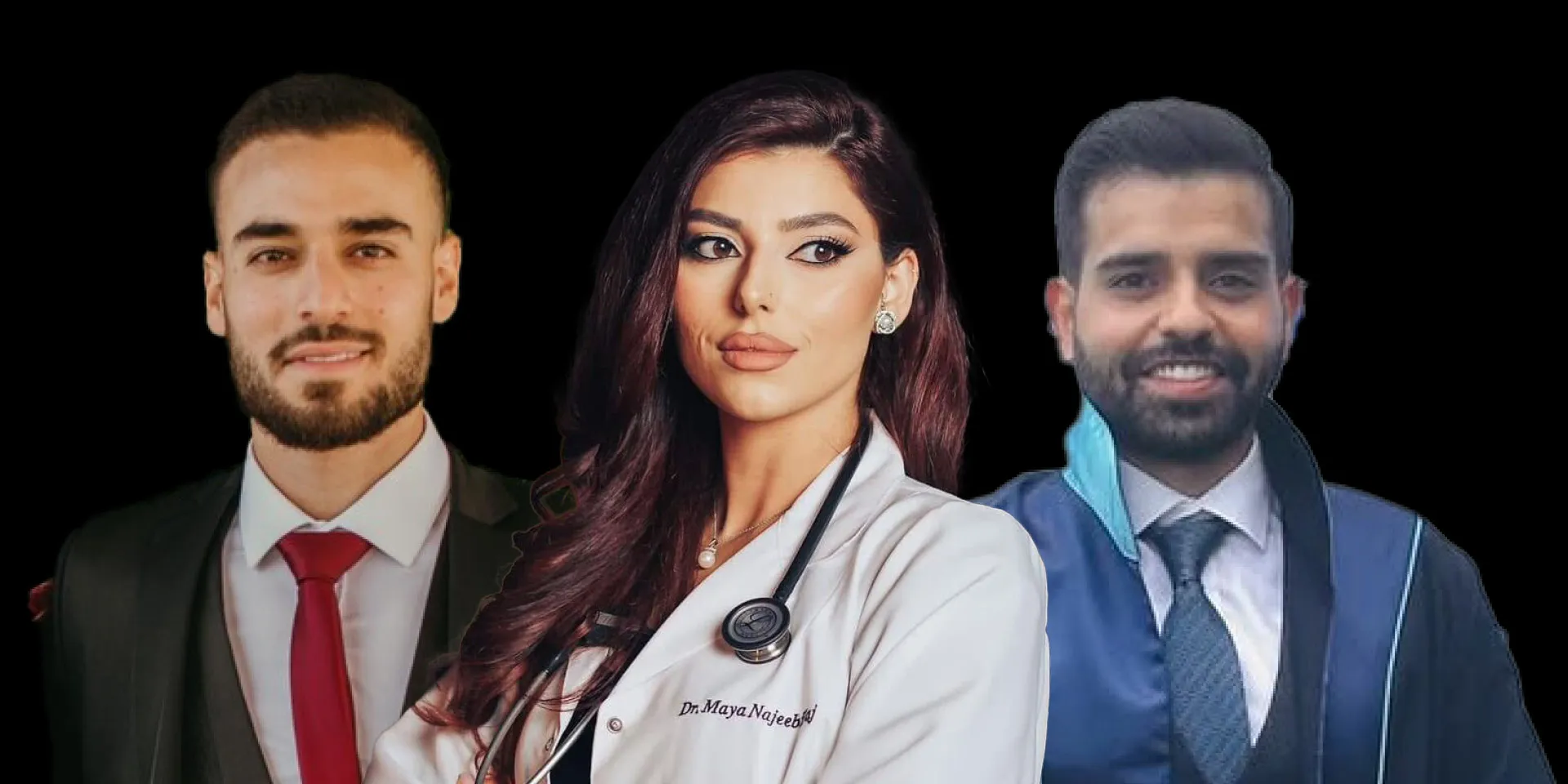
Left to right: Dr. Khaled Shalabi, Dr. Maya Najib Haj, and Dr. Amir Al-Fakih. Photos courtesy of the subjects
Yahya Amal Jabareen and Nabil Armali, Wasla
May 28, 2026

Summary


Listen to a Dynamic Summary of the Article
Created using NotebookLM AI tool
When Maya finished her internship at the Rabin Medical Center in Petah Tikva late last year, it never crossed her mind that she would still be unemployed six months later, waiting for a residency to become available or for a job working as a general practitioner. After all, there is a shortfall of physicians in Israel. A serious shortfall. This is patently evident not only from the dry statistics, which show how Israel is lagging far behind other members of the OECD in terms of number of physicians per capita. Any Israeli citizen who has waited months for an appointment for a medical test knows this only too well. The wait is even longer when it comes to seeing a specialist or seeing someone located away from the center of the country, which is the case for Maya herself.
But there’s another important factor that needs to be taken into consideration before we continue: Maya, who completed her medical studies three years ago in Moldova and has since passed the Ministry of Health’s Medical Licensing Examination, is Dr. Maya Najib Haj from Ibillin in the Lower Galilee. She is an Arab and, like some 5,000 other physicians from the Arab community who have passed their government licensing exam, she is not integrated into residency tracks within the healthcare system.
“There are no positions,” says Maya, who wants to specialize in pediatrics – one of the most sought-after fields. “To this day, I haven’t found a job, neither as a general practitioner nor as a resident.” With no professional horizon in sight, she has already begun looking for an alternative source of income, at least temporarily. “I am engaged to be married and the wedding is coming up soon, so I started to participate in courses for cosmetic surgeons, such as Botox and fillers.” She says that around half of the people on these courses are, like her, young doctors who are looking for a solution to their employment problems. “If the situation stays like it is today,” she says sadly, “I will seriously consider moving to Europe to begin the medical career that I worked so many years to build.”
Jihan – who asked for her full name not to be published – is from Arabah in the Lower Galilee. Like Maya, she never thought she would find herself in the position she is today. “I completed my medical studies in Romania in 2023, after which I came back to Israel, passed the licensing exam at the first time of asking and completed a one-year internship in June 2025. Since then, I have been unemployed. I sent my CV to every hospital in the country and to all of the HMOs to try and start my residency – but to no avail. I got the same answer every time: ‘There are no open positions at the moment. We will reach out to you at a later date.’ In short, if you don’t have connections, you can’t get a residency.”
In the case of Amar, who also asked not to be identified in full name, the length of time that has passed means that he had no choice but to seek alternative employment. “I had to take a job in a chemical factory in southern Israel just to make a living and to start being able to think about getting married,” the Be’er Sheva resident tells us with evident frustration. He spent seven years studying medicine in Romania and passed the licensing exam – but was eventually forced to swap the stethoscope and the white coat for the overalls of a manual worker in a factory. “I got my license to practice medicine in 2024 and I completed my internship at Barzilai Hospital, but I was unable to find a job or a residency path after finishing my training.”

According to Amar, he was supposed to take up a residency at Barzilai Hospital’s anesthesiology department. “During my internship, they told me there was a position waiting for me,” he says. However, “everything changed when a new hospital director was appointed.” As part of cost-cutting measures, more than 150 residency positions were cancelled. “That was the official version of events at least,” says Amar, who has been waiting for a new opportunity ever since, knocking on every door possible. “Even retirement homes don’t have jobs,” he says, adding that he couldn’t even find a job as a general practitioner in southern Israel – the part of the country that has the most severe shortage of physicians.
Jerusalemite Dr. Amir Al-Fakih also found himself having to leave the medical profession in order to make a living. He studied medicine in Turkey, graduated with honors in 2023, passed the Israeli licensing exam and took two licensing exams to practice medicine in the United States – both of which he also passed. He completed a one-year internship at the Shamir Medical Center in central Israel and “what I saw and realized during my internship is that there are far more potential residents than there are available residency spots. When a position finally opens up, the decision is usually made long before, either because the doctor proved themselves during their internship or because of cronyism,” he adds.
“I completed my internship around six months ago and, since then, I have been submitting my candidacy for residencies constantly,” Amir says. “But I keep getting the same response: There are no open positions. I haven’t even been asked to come in for a single interview.” As already mentioned, Amir, like Amar, found himself having to take any job – just to survive. For the time being, therefore, he works as a courier. Asked whether he has had thoughts about emigrating, he replies: “As far as I am concerned, leaving is the very last option. I would prefer to use the medical knowledge that I acquired and the experience that I will gain in the future to specialize in internal medicine and to serve members of my community. But I have already been married for one year and I also have to think about my family. So, the possibility of emigrating is still on the table for me.”

"What I saw and realized during my internship is that there are far more potential residents than there are available residency spots. When a position finally opens up, the decision is usually made long before"
90 percent of Jewish physicians compared to 70 percent of Arab physicians
Official Ministry of Health data confirms the gap described here, which is already clearly felt on the ground: the mismatch between the growing number of newly licensed doctors and the public healthcare system's failure to actually hire them. While the annual number of physicians being granted a license climbed by around 48 percent over the course of four years (from 1,783 in 2020 to 2,637 in 2024), the number of available positions is significantly lower. For example, in 2024 there were just 1,813 new residency positions available in Israeli hospitals – significantly fewer than the 2,637 new doctors who were looking for positions that year. In other words, in 2024 alone there were 824 new doctors who failed to find a position in the Israeli healthcare industry.
“If the situation stays like it is today, I will seriously consider moving to Europe to begin the medical career that I worked so many years to build.”

Based on the traditional professional career path of young physicians, their next stage after an internship should be a residency in a hospital or medical center qualified to provide training. Unlike a year-long internship, which the Ministry of Health is obligated to provide to every med student who passes the licensing exam, it is up to each doctor to find their own residency. This leads to an utterly absurd situation, according to Prof. Bishara Bisharat – a physician and director of the Society for Health Promotion of the Arab Community. “On the one hand,” he says, “everybody is talking about the severe shortage of doctors, especially in the peripheries. On the other hand, the government decided to cut on-call shifts for hospital doctors – which only serves to increase the urgent need to recruit additional physicians for the healthcare system, in order to make up the shortfall. And thirdly, there are thousands of young doctors who are looking for work in the healthcare sector but cannot find a position.” [Shomrim and Ynet reported extensively last year on the severe crisis in the healthcare system in the peripheries].
These physicians have completed their studies, passed the required exams, and been granted a license to practice medicine in the State of Israel – but, from this perspective, they are stuck and unable to find a place in any residency course. “It’s a very serious problem,” says Bisharat, adding that the main group of people directly affected by the situation are young doctors from the Arab community.
MK Ahmad Tibi (Hadash-Ta’al) – himself a doctor by training – recently initiated a hearing on the matter at the Knesset’s Health Committee. At the hearing, Tibi spoke about the increasing workload on hospitals, the protracted waiting time for an appointment, the fatigue experienced by medical teams and the issue of thousands of Arab physicians who are waiting for a residency position in the public healthcare system in Israel. The acting chair of the committee, MK Tania Mazarsky (Yesh Atid), told participants that one of the causes of the problem is that the staffing formula in Israeli hospitals has not been updated since 1977 – despite the sharp increase in the national population and medical needs. Similarly, committee members criticized the Ministry of Finance, which, according to participants, has for years been preventing the Ministry of Health from adding a significant number of positions, citing budgetary concerns.
.webp)
“The people who are most particularly harmed are graduates of overseas universities, recognition of which was terminated following the recommendations of the Yatziv Committee,” Prof. Bisharat explains. The Yatziv Committee was established in 2018 by the Ministry of Health to assess the quality of overseas medical schools, given the sharp increase in the number of Israelis studying abroad. The conclusions of the committee indicated that there were serious discrepancies in the training provided by different overseas universities, especially in some Eastern European countries, and it recommended limited recognition of degrees awarded by education institutions that did not meet the most exacting criteria. These recommendations led to a significant shift in Ministry of Health policy, which tightened conditions for receiving a license to practice and to be accepted into a residency program.
“Most of the doctors who cannot find a position in the healthcare system are graduates of those institutions from which the Yatziv Committee decided to deny recognition in 2020,” Bisharat explains. Anyone who started their studies before that date is still recognized, but the stigma involved makes it hard for them to find jobs in hospitals – and the Ministry of Health is not dealing with the matter properly.”
An October 2024 report by the Jerusalem-based Myers-JDC Brookdale Institute, which was commissioned and partially funded by the Ministry of Health – found that, while more than 90 percent of Jewish Israeli physicians who studied overseas began residencies within less than five years, among Arab doctors that figure stood at just 70 percent. Among other things, the report found structural, professional and social impediments, as well as barriers such as a lack of proficiency in medical Hebrew among some foreign-trained graduates, limited familiarity with the organizational culture of Israeli hospitals and, at times, stigma toward specific academic institutions in Eastern Europe following the recommendations of the Yatziv Committee. So, even though these physicians have been given a license to practice by the Israeli Ministry of Health, the very fact that they studied in institutions that have been defined as “problematic” harms their chances of being accepted to a residency.
‘You can’t give a doctor a license and then tell him he’s not suitable for work’

Dr. Abeer Suleiman Awawdeh is a physician, public health activist and director general of the Academic Forum for Health Promotion in Arab Society. She believes that the residency crisis among Arab doctors does not just stem from “a lack of positions,” as per the official explanation. Rather, she believes that it reflects a more profound and complex policy within the healthcare system. She points, for example, to what she calls “a blatant contradiction” between the hospitals’ argument that there are no available residency positions and the fact that they have recently employed hundreds of Jewish new immigrant doctors, as the Ministry of Aliyah and Integration reported in January.
“Since the war began, over 1,000 new immigrant Jewish doctors have been integrated into the healthcare system, including those who studied at the same Eastern European universities whose Arab graduates are now being deemed unfit for residency,” says Suleiman Awawdeh. “If the problem really comes down to the quality of training or a lack of openings, how were so many positions suddenly found?”
She says that the state cannot negate its responsibility toward people who have passed the medical licensing exam: “You can’t give a doctor a license and then tell him he’s not suitable for work.” If there are professional shortcomings among some of the overseas graduates, the solution must be in-hospital training and extra courses – not leaving them to flounder outside of the healthcare system for years and years.
Suleiman Awawdeh points out that the Israeli government is planning on building a new hospital in the Negev – a branch of Sheba Hospital – and “that hospital will need hundreds of physicians. Instead of talking all the time about the lack of physicians, there are currently thousands of Arab doctors who are willing to work – but nobody really wants to invest in their integration.” The current situation, she says, “creates for many people a sense that there is an undeclared policy to limit the proportion of Arab doctors in the healthcare system.”

She adds that the greatest danger in this crisis is not just the fate of the existing physicians, but the change that it could engender in Arab society’s view of medical studies as a whole. “For the first time,” she says, “we are seeing families who are worried about sending their children overseas to study medicine. People have started to ask why they should invest all that money and so many years if, in the end, their son or daughter will come back only to find themselves excluded from the profession they studied.”
Suleiman Awawdeh is not only angry with the healthcare system. She is also highly critical of the passive attitude of the young doctors themselves: “We are talking about 5,000 male and female doctors, but when there’s a Knesset committee hearing or a meeting to discuss the crisis – very few of them show up,” she says. “If hundreds of doctors were to take organized action, block roads or hold protests, it would be impossible to ignore them.”
One person who has no intention of giving up is Dr. Khaled Shalabi, a 29-year-old from Iksal, near Nazareth. He went to med school in Romania, completed his studies in 2021 and got his license to practice in early 2022. “I started an internship at Hillel Yaffe Medical Center in Hadera, and I planned on starting a residency immediately thereafter,” he says. “My dream was – and still is – to do a residency in general surgery, but I very quickly came face-to-face with the same reality that thousands of Arab doctors are facing: unemployment and a lack of work opportunities.”
“I have gone uninvited to every hospital from Eilat to the far north of the country; I went to the departments and knocked on the director’s door, asking for a residency."

Shalabi says that he has submitted hundreds of applications and attended dozens of job interviews, but has been unable to get a place on a residency program. “I have gone uninvited to every hospital from Eilat to the far north of the country; I went to the departments and knocked on the director’s door, asking for a residency. I always got the same response: There are no open positions. I am the first doctor in my family and, unfortunately, I can’t rely on connections. Some of my friends got residencies without any problem because their parents are well-known physicians and they have connections.”
Despite everything, Shalabi insists that there is no way he will leave Israel. “I know hundreds of Arab doctors in the same position as me who are considering emigrating in order to find better opportunities and to build a medical career – but, as far as I am concerned, that’s not an option.” Currently, Shalabi works as a general practitioner at a dialysis clinic, but he says that any physician who does not do a residency is “simply treading water. I won’t give up on my dream and I will continue to look for a surgical residency. No matter how long it takes,” he says in conclusion.
Ministry of Health’s response
‘The Ministry works to assist physicians who have a license to practice medicine in Israel’
The Ministry of Health submitted the following response:
“The Ministry of Health is working to assist physicians who have been granted a license to practice medicine in Israel and are in the stage preceding the commencement of residency. This support is provided through dedicated courses designed to strengthen clinical and professional skills, rather than through direct placement. Over the past year, the Ministry has invested approximately 8.5 million shekels [roughly $2.3 million] in conducting these courses, which are held in the majority of hospitals.
“Furthermore, as part of an ongoing dialogue with representatives of the Arab community and in preparation for the launch of specialized programs for graduates of medical studies abroad, it has emerged that key barriers to securing a residency position include command of the Hebrew language, particularly medical terminology, as well as limited familiarity with the Israeli healthcare system and its hospitals, compared to graduates who studied in Israel. The expansion of these programs and the development of additional pathways are currently under review, and further details will be published once finalized.”
Regarding the number of physicians who are not in residency, the Ministry of Health said: “According to 2024 data, there are 9,558 physicians who are neither specialists nor residents, with this population split equally between the Arab and Jewish communities. The Ministry of Health does not possess precise data on the number of vacant residency positions, as the opening and vacancy of positions are dependent on the completion and commencement dates of residencies and vary between hospitals. The healthcare system operates on a model of coexistence, in which all sectors of society are reflected, both as caregivers and as patients. Jews, Muslims, Christians, Druze and Circassians work together there, shoulder to shoulder, to save lives.”
The Ministry further noted that the number of residency positions in each institution is determined according to patient needs, the scope of clinical activity and budgetary frameworks. In conclusion, the Ministry stated: “The Advisory Committee for Medical Manpower Planning is currently in the final stages of its work. This is an additional step led by the Ministry of Health to increase medical manpower in the system, through active planning that will ensure a sufficient supply in every medical field and in every region of the country.”
The Ministry of Finance did not submit a response.
**
Nabil Armali is the editor-in-chief of Wasla, an Arabic-language business and economics news site. Yahya Amal Jabareen is a reporter at Wasla.