


Fearing Voter Defections, Israel's Ultra-Orthodox Parties Turn on Their Coalition Allies
Public clashes over military conscription, welfare benefits and policing mask a deeper concern: ultra-Orthodox leaders fear that younger and more nationalist voters are drifting toward Itamar Ben-Gvir and Bezalel Smotrich ahead of Israel's next election. A Shomrim report
Public clashes over military conscription, welfare benefits and policing mask a deeper concern: ultra-Orthodox leaders fear that younger and more nationalist voters are drifting toward Itamar Ben-Gvir and Bezalel Smotrich ahead of Israel's next election. A Shomrim report
Public clashes over military conscription, welfare benefits and policing mask a deeper concern: ultra-Orthodox leaders fear that younger and more nationalist voters are drifting toward Itamar Ben-Gvir and Bezalel Smotrich ahead of Israel's next election. A Shomrim report
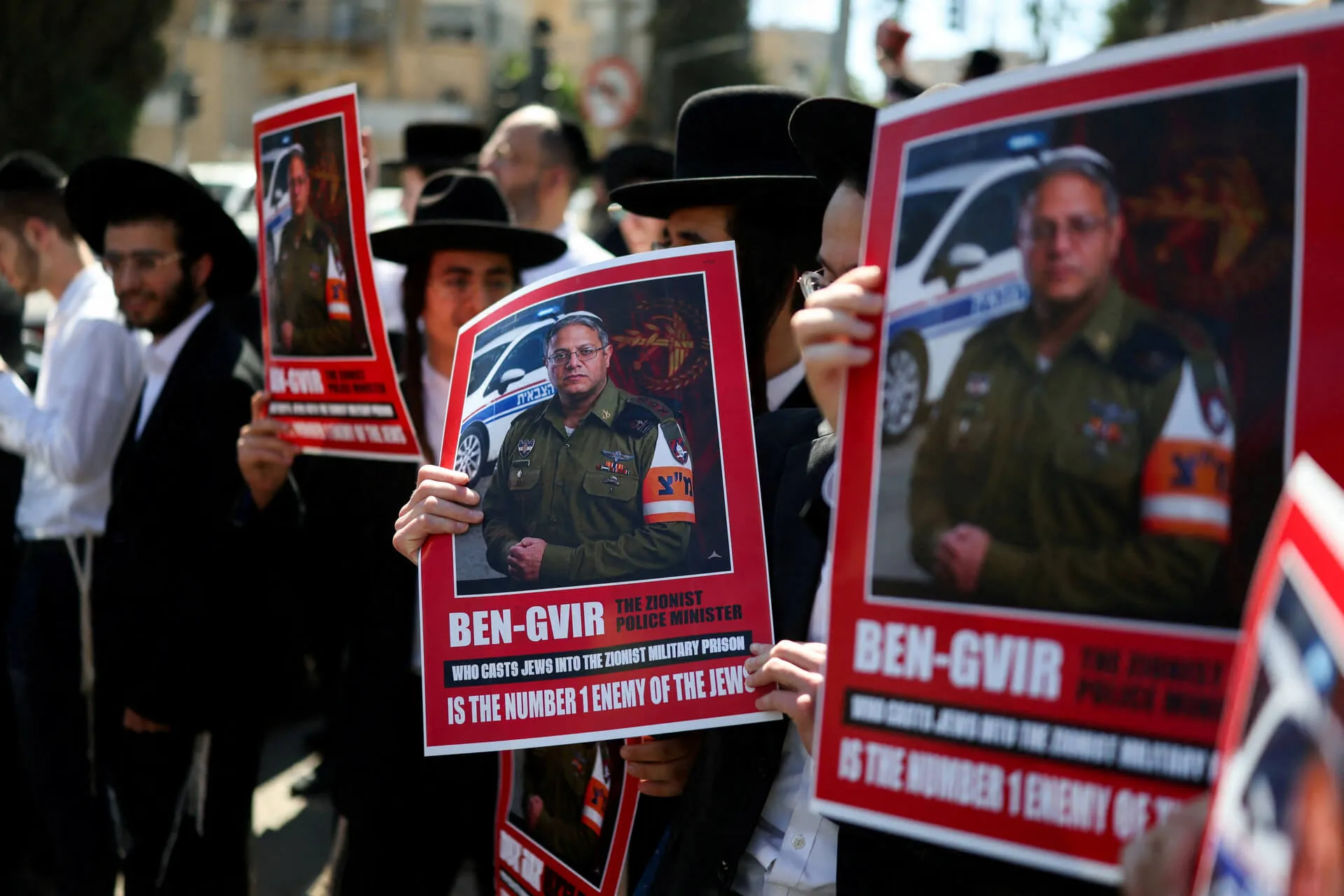
National Security Minister Itamar Ben-Gvir wearing a Military Police uniform during an ultra-Orthodox protest in Jerusalem last week. Photo: Reuters

Lir Spiriton
June 30, 2026

Summary


Listen to a Dynamic Summary of the Article
Created using NotebookLM AI tool
For decades, Israel's ultra-Orthodox parties (Shas and United Torah Judaism) and the national-religious parties have been reliable partners in right-wing governing coalitions. Although this alliance has been challenged in the aftermath of the October 7 attacks in recent weeks, as Israel moves closer to its next election, it appears increasingly strained as both sides seem to be competing for common voters.
At first glance, the latest disputes may seem like routine coalition infighting over issues such as daycare subsidies for yeshiva students, the proposed Basic Law on Torah Study, military conscription for the ultra-Orthodox and police treatment of Haredi protesters. But beneath those public clashes lies a deeper concern among ultra-Orthodox leaders: that growing frustration within their own community could drive voters toward the national-religious right, particularly Itamar Ben-Gvir's Otzma Yehudit party.
The main focus of these concerns is on groups that, while are outside the ultra-Orthodox core, have previously tended to vote for Haredi parties. These groups include young Haredim, traditional Shas voters (not necessarily self-described as ultra-Othadox), Chabad Hasidic and voters across the spectrum of the ultra-Orthodox nationalist identity, colloquially known as “Hardal” - an acronym in Hebrew for "nationalist ultra-Orthodox," referring to a group that combines ultra-Orthodox religious practice with nationalistic ideology.
There has been a series of indications on the ground that disappointment with ultra-Orthodox politicians over their abject failure to resolve issues like the military draft law, coupled with the erosion of financial benefits, is pushing these groups to examine different political options. Parties from the national-religious camp are well aware of the situation and are trying to turn it into electoral gains – which in turn only intensifies the pressure among the Haredi political apparatus.
Recent clashes appear to offer a glimpse of the coming election campaign. Ultra-Orthodox politicians and Haredi media have stepped up attacks on Smotrich and Ben-Gvir, while the two national-religious leaders are appealing directly to Haredi voters, seeking to position their parties as an alternative for those frustrated with the traditional ultra-Orthodox leadership.
From Allies to Rivals
The most public confrontation between the sides came around two weeks ago and centered on allegations of police violence against anti-draft Haredi protesters. The ultra-Orthodox protests, which led to clashes with police, quickly escalated into a public feud between Shas leader Aryeh Deri and National Security Minister Itamar Ben-Gvir. Each sought to cast the other as responsible for the violence in a bid to win over the Haredi street.
Another clash happened in late May over a preliminary Knesset vote on the daycare center law. While lawmakers from the Otzma Yehudit faction supported the bill, along with the Haredi parties, MKs from the Religious Zionism party were absent from the vote. The United Torah Judaism party was furious. MK Moshe Gafni issued a harsh response, aimed at Haredi ears: “The Religious Zionism party is also acting deviously and with utter ingratitude. We gave them everything they wanted – for settlements, budgets and appointments – but when it comes to issues that matter to the ultra-Orthodox community, they turn their backs and work against us.”

UTJ chair Yitzhak Goldknopf was quick to join in: “Bezalel Smotrich’s abstention in the vote on the daycare center law shows his true face,” he said. “When he comes again to scrounge votes from the Haredi sector, the public will remember that, in the moment of truth, he didn’t give a damn about Haredi families.”
Another flashpoint is a proposed Basic Law declaring Torah study a fundamental national value. The measure has put the Religious Zionism party in a difficult position: advancing it risks alienating its own base, while blocking it could cost the party support among Haredi voters it hopes to attract. According to Yaakov Hershkowitz, Israel Hayom's ultra-Orthodox affairs correspondent, even the party's reluctance to move forward with what he describes as a largely symbolic bill has reinforced Haredi leaders' perception that their allies are no longer committed to issues important to the ultra-Orthodox community.

‘We won’t forget and we won’t forgive’
Alongside statements from politicians from both camps, there has also been a struggle in the media. For example, there was recently an online campaign against Knesset members from the Religious Zionism party, featuring slogans such as “We won’t forget and we won’t forgive” and “They were silent when Torah scholars were arrested,” accompanied by images of Smotrich and Prime Minister Benjamin Netanyahu with their mouths taped over. Various sources who spoke to Shomrim say that the campaign was launched by people close to the Haredi parties.
The national-religious parties aren't neglecting the Haredi media either. In an interview with Kol B’Rama radio, following allegations of police violence toward ultra-Orthodox protesters, Ben-Gvir said that he is examining incidents in which yeshiva students claim to have been beaten or otherwise mistreated, but stressed that “the Haredi public is no different from other citizens.” Later in the interview, he added: “I am the only one who didn’t try to profit from the Haredim; I could have made a political fortune but I didn’t. I love the Haredi public and we are proud to be their home, too.”
A poll conducted by a website affiliated with Chabad, which is considered politically independent within the Haredi public, presented decisive results regarding the political situation within the Hasidic movement. According to the poll, 40 percent of the movement’s members would prefer Ben-Gvir and Smotrich to run on a joint slate. If they were to do so, 32 percent of respondents said that they would vote for Ben-Gvir and 28 percent said they would vote for a Haredi party.
It is difficult to determine how reliable this poll is or how accurately it reflects the actual results that would be seen at the ballot box among Chabad members, but it does give a sense of the current mood.

Shas has the biggest problem
Dr. Gilad Malach, director of the Ultra-Orthodox in Israel Program at the Israel Democracy Institute, tells Shomrim that efforts by right-wing parties to woo ultra-Orthodox voters are nothing new. Nevertheless, he highlights the hallmarks of this phenomenon ahead of the current election campaign and suggests distinguishing between United Torah Judaism and Shas. “Around 90 percent of Ashkenazi Haredi voters vote for United Torah Judaism,” he says. “There is almost no leakage outward. This means that nearly all UTJ are Haredi. It is a party that is ‘closed’ in two respects: the entire group votes for it and all of its voters are from within the group.”
Therefore, Malach explains, the threat to UTJ is smaller. The treat that does exist, is found primarily among Chabad members and more right-wing youth; according to Malach, UTJ also faces a threat from the more extreme side of the Haredi spectrum: Hasidic sects who are angry at the very attempt by the Haredi parties to promote agreements around the draft law.
%20(1).webp)
In the case of Shas, Malach says, things are different. “Shas has at least three or four Knesset seats’ worth of voters who are simply not Haredi,” he says. “They could vote for any party. Even some of the Shas Haredim are ‘soft’ Haredim. They might send their children to study in Haredi schools, but also identify with the Likud or Ben-Gvir. Therefore, the threat facing Shas is much greater.”
According to Malach, this is also the reason that Shas needs to send two different messages at the same time: it needs to maintain a line that is far enough to the right not to lose votes to Ben-Gvir, but also to stress that he and Smotrich do not really care about the ultra-Orthodox population or poorer segments of society. “Shas is competing for the votes of a certain Mizrahi demographic,” he says. “To keep hold of them, it needs to present a very right-wing line, while also showing that the other parties are either socially insensitive or do not care about the Haredim and cannot be trusted.”
A source familiar with the inner workings of Shas told Shomrim that the party is preparing for a potential drop in support. According to the source, internal assessments suggest that if Shas manages to win nine seats in the next election (compared to its current 11 seats), it will be considered a success.

.webp)