


An Alleged Russian Influence Operation, an Israeli Think Tank and the People Behind It
After OpenAI and Meta identified an ‘Israeli think tank’ in connection with a pro-Russian influence operation, Shomrim traced its founders, media activities and links to individuals named in an Estonian court ruling concerning Russian influence operations.

After OpenAI and Meta identified an ‘Israeli think tank’ in connection with a pro-Russian influence operation, Shomrim traced its founders, media activities and links to individuals named in an Estonian court ruling concerning Russian influence operations.
After OpenAI and Meta identified an ‘Israeli think tank’ in connection with a pro-Russian influence operation, Shomrim traced its founders, media activities and links to individuals named in an Estonian court ruling concerning Russian influence operations.
Illustrative photo: Shutterstock
Uri Blau
October 22, 2026

Summary


Listen to a Dynamic Summary of the Article
Created using NotebookLM AI tool
An Israeli research institute identified by OpenAI and Meta as part of an alleged Russian influence operation was founded by two men whose activities extend beyond academic publishing, a Shomrim investigation has found.
The International Burke Institute, registered in Israel in July 2025, was established by Igor Kaminnyk, an Israeli citizen living in Haifa, and Gabriel Mart, formerly known as Innokentiy Martynov. The institute published articles in Israeli and international media, promoted a proprietary index that frequently portrayed Russia favorably.
Shomrim also uncovered links between Kaminnyk and Alexey Martynov, a Russian political figure named in a 2022 Estonian court ruling concerning Russian influence operations. The investigation found that Kaminnyk, Martynov and Gabriel Mart were photographed together in 2022.
The findings come after OpenAI and Meta reported that a covert influence network originating in Russia had used the institute’s purported academic credentials to promote pro-Russian narratives online.
The institute has denied cooperating with or being funded by the influence operation.
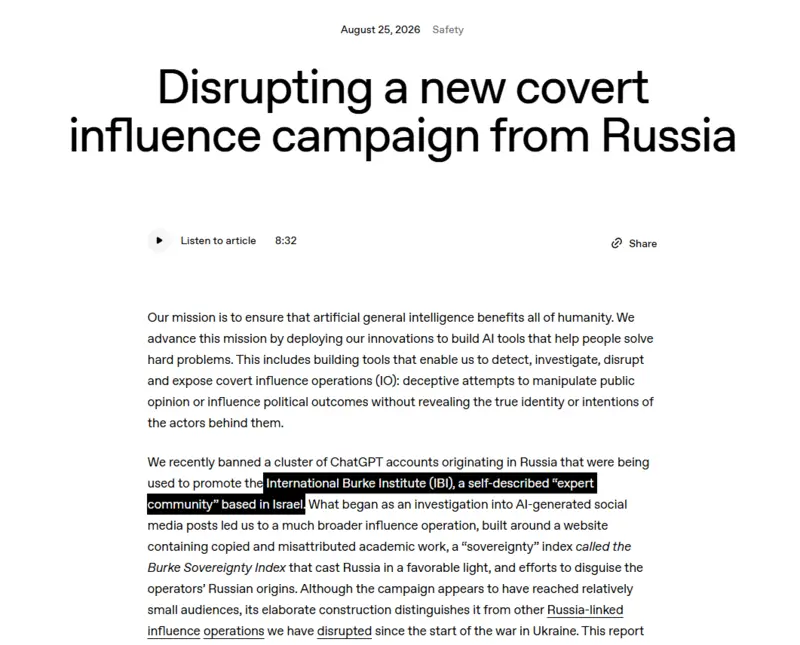
On August 25, tech giant OpenAI published a report on a new covert influence campaign that allegedly used its popular ChatGPT model to create and promote pro-Russian narratives to criticize Ukraine, the European Union and Western European governments. The content was disseminated via social media networks like X, Facebook and LinkedIn, as well as platforms like Telegram. According to OpenAI, the accounts in question “very likely originated in Russia,” adding that they were part of “a new and previously unreported covert influence campaign.” The people behind the accounts, according to OpenAI, used VPNs to bypass the geoblocking measures it has taken against users in Russia. “Most of the comments they generated were in English,” OpenAI reported, “and the operators instructed ChatGPT to hide any linguistic clues that they were Russian.”
According to the report, the content that was generated sought to promote articles published by an Israeli organization called the International Burke Institute (IBI), which described itself as an “expert community.” The institute’s website attributed articles to prominent intellectuals, but OpenAI reviewed a sample of 36 articles published on the site and found that 34 of them were copied from other sources or were attributed to the wrong authors. OpenAI experts believe that the immediate influence of the operation was limited, assessing that it was “at the lower end of Category Three” in the Brookings Breakout Scale, affecting multiple platforms and with some indications of breakout to authentic audiences. However, OpenAI added that the operation was significant not necessarily because of the audience that it reached, but because of the infrastructure used to create the posts that linked to an organization that appeared totally credible, with “experts,” “academic articles” and even a purported proprietary “risk index.”
After the OpenAI report was published, the Burke Institute issued a statement in which it vehemently rejected the allegations against it. According to the IBI, incorrectly attributing articles “does not, in itself, constitute evidence of cooperation, coordination, funding, or a common underlying purpose.” The statement explained that the IBI is located in Tel Aviv because Israel “provides a natural setting for independent thought, scholarly inquiry, and the critical examination of prevailing international interpretations.”
A few days after OpenAI’s report, Meta – the parent company of Facebook, WhatsApp and Instagram – published its own report, in which it said that it had deactivated seven Facebook accounts, nine Facebook pages and eight Instagram pages that had been linked to an alleged Russian influence operation. Meta also identified Israel and the IBI as a focus of the operation. According to its report, the Russian network ran a “fabricated think tank” that “posed as a legitimate academic institution based in Israel.” Meta added that the operators had tried to “launder” their narratives into academia. As in OpenAI’s report, Meta said the network’s operators did so through fabricated research papers.
Shomrim can now reveal more about the affair, and the people behind it.
How the Institute’s Research Reached the Media
A Shomrim investigation has revealed that the Burke Institute was registered as a nonprofit association in Israel in July 2025, according to records filed with Israel’s Registrar of Associations. The organization was founded by Igor Kaminnyk, an Israeli citizen who lives in Haifa, and Gabriel Mart (who changed his name from Innokentiy Martynov). In the months following its establishment, the Burke Institute published a long list of articles in the international media, in websites dedicated to academic writing and in the Israeli media. In April, for example, the Jerusalem Post published an opinion article by a journalist called Rachel Avraham, under the headline “Sovereignty under siege: The multidimensional war against Iran.” The article sought to analyze the war with Iran using the Burke Sovereignty Index, which ranks countries based on seven criteria.
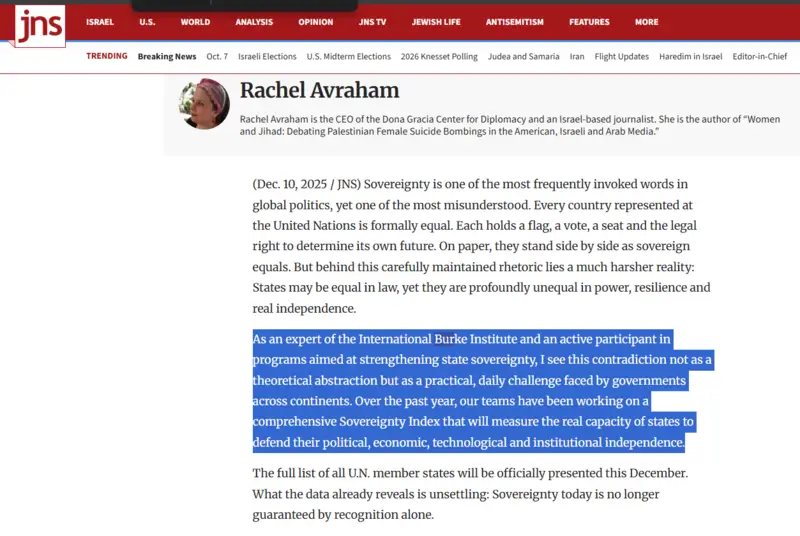
According to the OpenAI report, the same Sovereignty Index was one of the main tools used on the International Burke Institute website, where it often portrayed Russia in a positive light and the West in a much more negative light. At the bottom of the article, Avraham is described as “the CEO of the Dona Gracia Center for Diplomacy and an Israel-based journalist.” Her connection to the Burke Institute is not mentioned at all, but, in a different article, she describes herself as “an expert of the International Burke Institute.” In correspondence with Shomrim, Avraham initially told Shomrim that she had worked with the institute and had been paid for her contributions. In a subsequent conversation, she denied that.
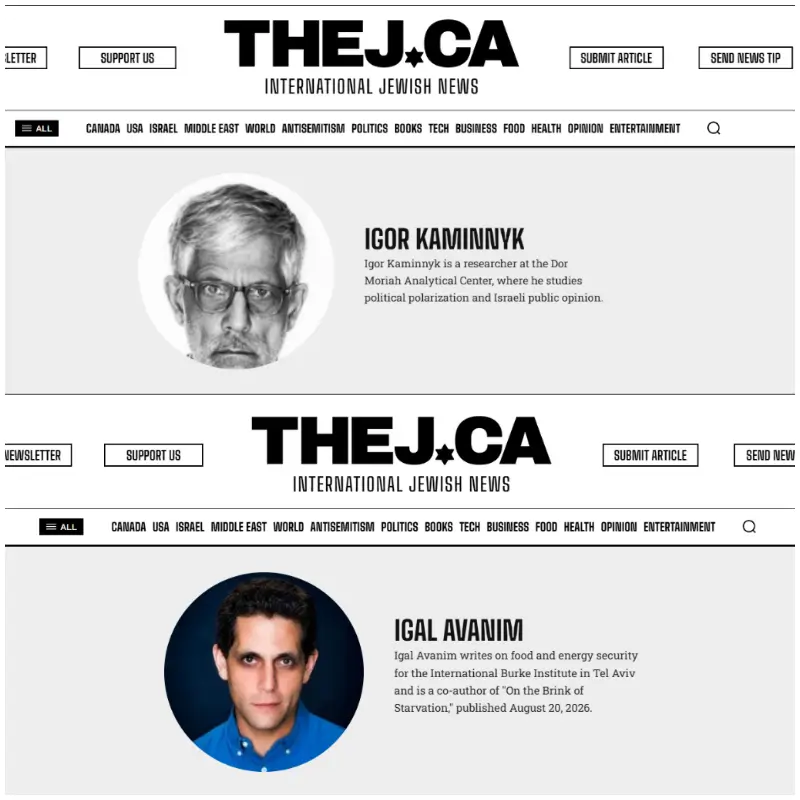
Kaminnyk himself has written two articles this month for The J – a “Canadian-based Zionist international media platform” – both of them about the upcoming Israeli Knesset election. The same website also published articles in recent months by someone called Igal Avanim, who, according to his bio, “writes on food and energy security for the International Burke Institute in Tel Aviv.” His articles have dealt with subjects such as corruption in Ukraine, the European food system and the European Union’s efforts to add Ukraine as a new member. Shomrim found that a Telegram account and an email address using the name “Igal Avanim” were linked to a phone number also used by Kaminnyk. The name “Avanim” means “stones” in Hebrew, echoing the meaning of Kaminnyk’s surname in Russian.
In August, Kaminnyk published an article under his own name on the Zman Yisrael website, where he was described as “a political strategist and leading Israeli civic activist” whose work “largely bridges public policy research and media advocacy, with a particular focus on Israel’s large Russian-speaking demographic.” An example of Kaminnyk’s political activity came last year, when he promoted a bill to introduce borough councils in Israeli cities. He was also behind the founding of the “Lobby for Personal and Community Representation in Local Government,” which MK Amit Halevi (Likud) established in the Knesset and which has met twice since. Halevi did not respond to a request for comment.

A Connection to a Russian Figure Named in an Estonian Court Ruling
The Burke Institute is not the first that Kaminnyk has set up. In 2017, he founded Dor Moriah, which defines its mission as helping immigrants from the former Soviet Union in Israel. According to its reports to the Registrar of Associations, Dor Moriah did not have any income before 2023. Since then, it has been getting around 200,000 shekels (around $65,000) annually.
In 2018, an article under Kaminnyk’s name was published on the website of a Russian organization called the International Institute of Newly Established States, in which the writer addresses the influence of foreign think tanks on Russian elections. The co-author of that piece was Alexey Martynov, a former director of the same organization. Estonian journalist Martin Laine, for the website Delfi, who worked with Shomrim on this investigation, found that Martynov is named in a 2022 ruling in Estonia against an Estonian citizen who was accused of acting against the state on behalf of Russian officials, among them Martynov.
The ruling states that IINES worked to advance Russian influence operations under the Presidential Administration in Moscow, and that Martynov was banned from entering the Schengen Area, the European countries that allow free movement among them without internal border checks. In response to Laine, Martynov confirmed that he had met Kaminnyk in 2008 through his academic work; he added that he had written for the institute Kaminnyk headed. He claimed, however, that he had never worked for any official body in Russia.
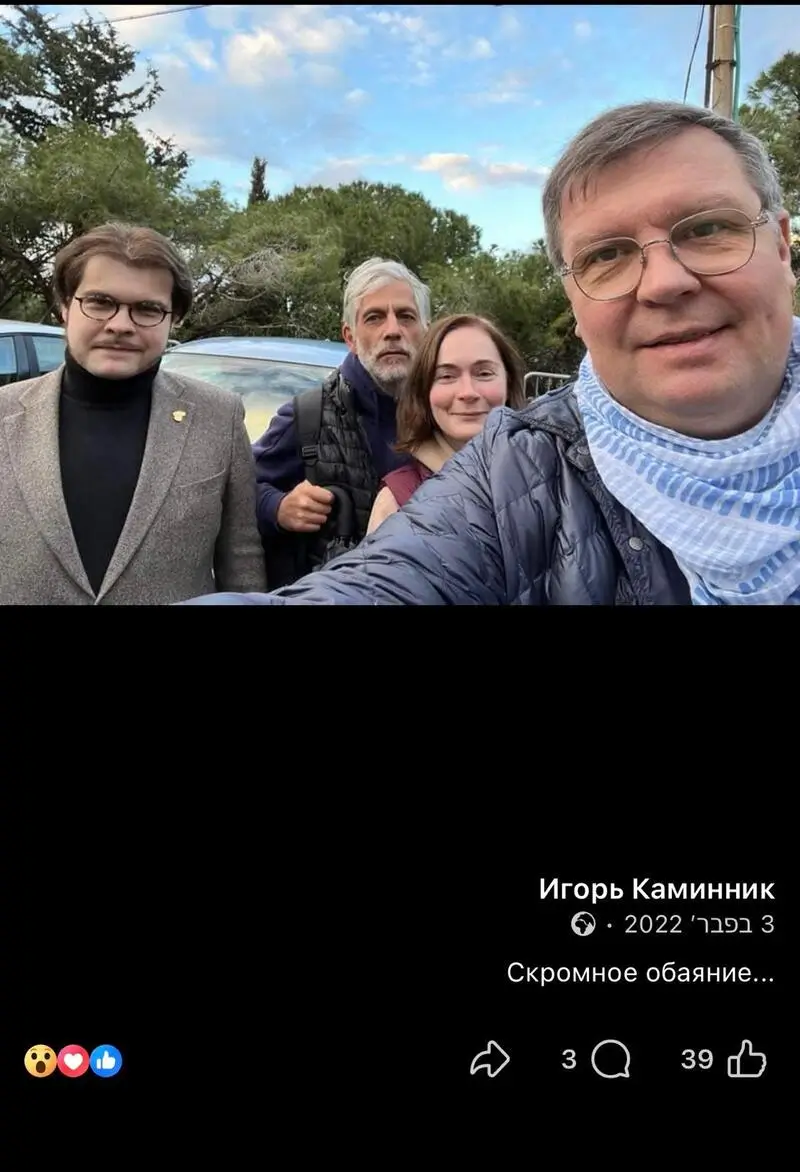
The Cyfluence Research Center, an independent research body based in Berlin that investigates influence operations, is planning to issue its own report about the Burke Institute. Among other things, the investigators found an online photograph from 2022 showing Kaminnyk, Martynov and Gabriel Mart together, as well as evidence that Kaminnyk visited Moscow in December 2025.
It is worth noting that Kaminnyk’s academic background is also under some question. According to legal cases that he was involved in as a plaintiff in recent years, it appears that he used to work installing windows and solar panels. In one of the cases, from 2021, he is described as “a simple worker, 58 years old ... (who is) looking for any job that will allow him to feed his family with dignity.”
The Burke Institute’s file at the Registrar of Associations shows that just three days after OpenAI’s report was published, the association’s members met at Kaminnyk’s home in Haifa and announced their resignation from their posts at the institute. Kaminnyk and Mart did not respond to a list of questions Shomrim sent to them. The person who replaced Kaminnyk at the association said in a brief conversation that he speaks only Russian – but also declined to answer questions in Russian.
Shomrim asked the Mossad, the Israeli foreign intelligence agency, whether it was aware of the Burke Institute’s activity. In response, it said that the Shin Bet deals with such issues. The Shin Bet, for its part, did not respond to requests for comment by publication time.