


Tens of Thousands of Haredi Children Are Missing From Israel’s Education System
An estimated 30,000 Haredi children in Jerusalem attend unlicensed schools largely beyond the reach of state regulators. Officials have known about the phenomenon for years — raising questions about education and child safety.
An estimated 30,000 Haredi children in Jerusalem attend unlicensed schools largely beyond the reach of state regulators. Officials have known about the phenomenon for years — raising questions about education and child safety.
An estimated 30,000 Haredi children in Jerusalem attend unlicensed schools largely beyond the reach of state regulators. Officials have known about the phenomenon for years — raising questions about education and child safety.
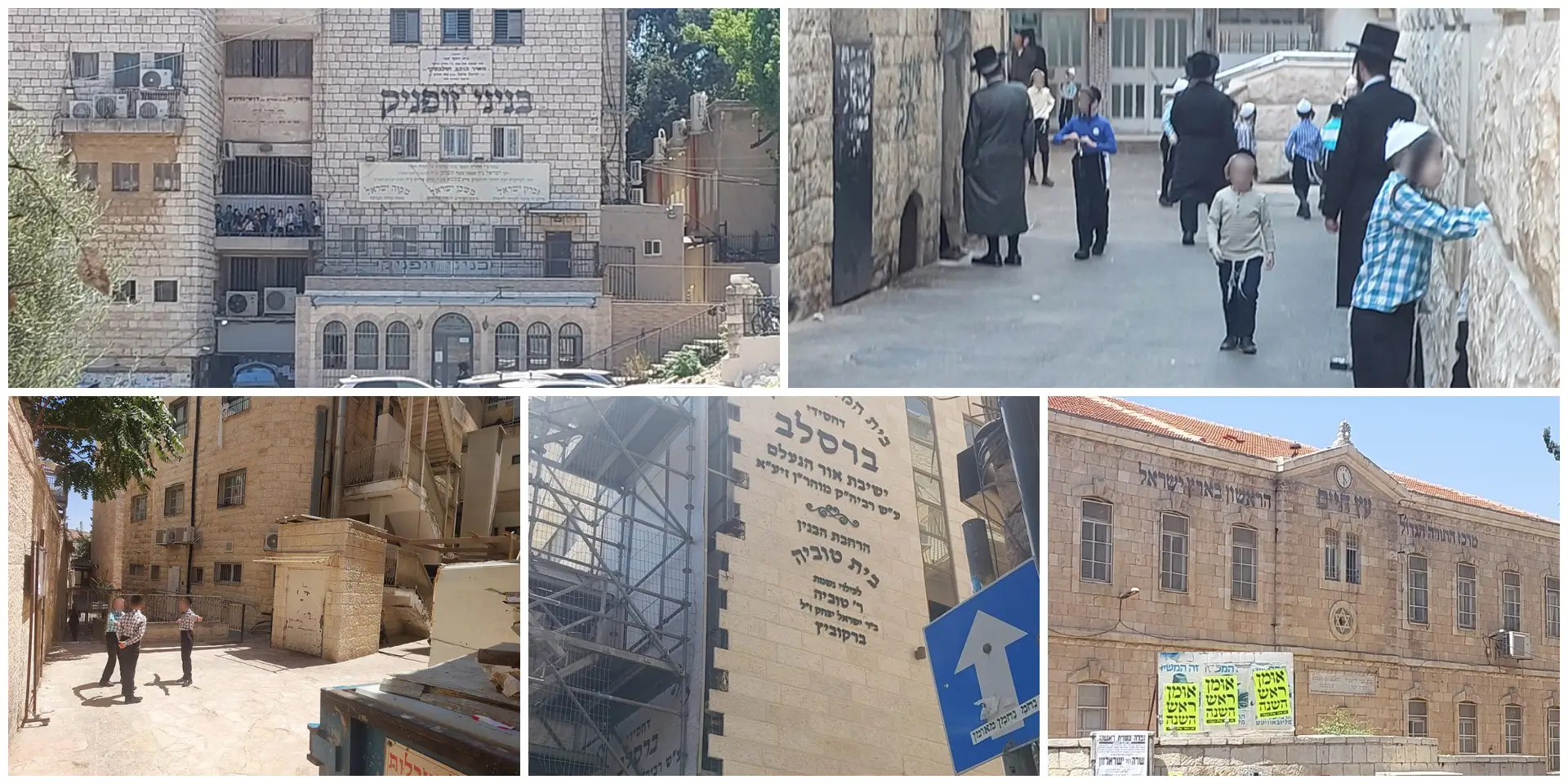
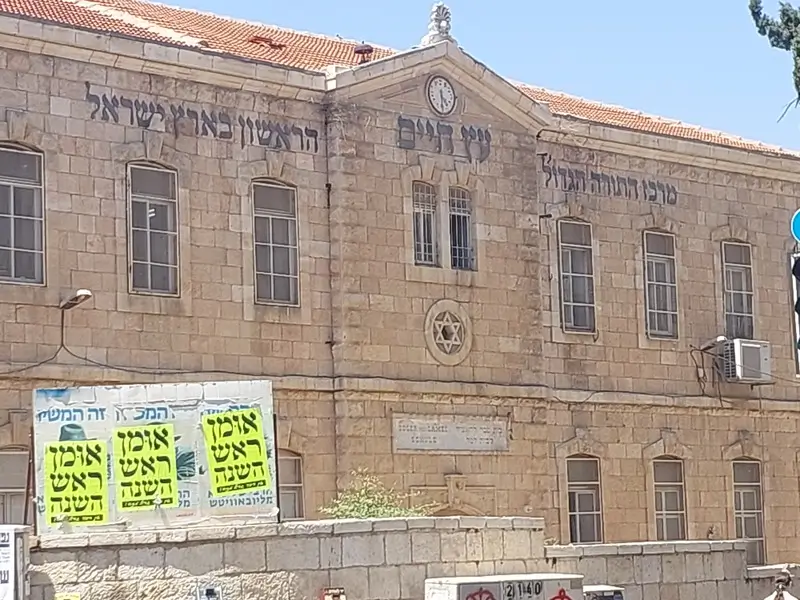
Hasidic sect buildings in Jerusalem, clockwise from top left: Dushinsky, Toldos Aharon, Satmar and Breslov; and the Etz Chaim Yeshiva. Photos: Shuki Sadeh
Shuki Sadeh
September 3, 2026

Summary


Listen to a Dynamic Summary of the Article
Created using NotebookLM AI tool
A few blocks from the offices of Israel’s Ministry of Education, in central Jerusalem, hundreds of boys study in a school that, as far as the ministry is concerned, does not exist. The school, affiliated with the Toldos Aharon Hasidic community, has no Education Ministry license. Its students learn in Yiddish, and the institution receives no government funding or state supervision. Yet it is hardly an anomaly.
More than 42,000 school-age children in Israel do not appear on the rolls of any recognized educational institution, according to a 2026 analysis by Israel’s Central Bureau of Statistics. Education officials and Jerusalem municipal sources estimate that roughly 30,000 Haredi children are attending unlicensed schools.
These are typically students from the extremist Hasidic factions of the Edah Haredit in Jerusalem – a strictly Ultra-Orthodox and anti-Zionist umbrella organization of communities. They study in illicit schools which do not receive a cent from the state; they are funded exclusively by donations and parents’ fees – and they are all illegal. By law, anyone opening a school in Israel must have a license to do so from the Ministry of Education. Moreover, the law stipulates that parents who do not register their child in a state-recognized school can be prosecuted.
We also found unlicensed educational institutions on Yeshayahu Street. The sign on the building, which is known as the Lemel Compound, says that it belongs to the Etz Chaim Yeshiva, one of the oldest in Jerusalem. We checked the address in the Ministry of Education’s transparency website, which lists the addresses of every licensed school in the country, and found that there is no licensed school with that name at that location. There is an unrelated school in the Jerusalem neighborhood of Ramot with a similar name, but it is part of the state-religious system. Two buildings make up the Lemel Compound: the smaller of the two houses kindergartens, while the larger is for older students. We met with the director of the kindergarten, who told us that a total of 500 boys between the ages of three and 13 study in the two buildings.
Shomrim visited several other unlicensed schools affiliated with Haredi communities across central Jerusalem, some operating inside buildings that also housed offices, synagogues or clinics.


‘How Can You Prosecute? There Would Be Rioting in the Streets’
Overcrowded classrooms, a lack of teachers and poor academic achievement are not the only problems facing the Israeli education system at the start of the 2026/2027 school year. In parallel with the official state education system, tens of thousands of children study in schools that the Ministry of Education does not recognize. A Shomrim investigation found that 42,000 Israeli children can be considered missing from the education system’s records. Education officials and Jerusalem municipal sources told Shomrim that roughly 30,000 are Haredi children attending unlicensed institutions in Jerusalem. The main source of the data is a study published by the Central Bureau of Statistics in April this year, which compared the Interior Ministry’s population registry with the Ministry of Education’s student enrollment roster. According to that study, as of 2023 there were 42,357 school-age children in Israel – that is, between the ages of six and 18 – who were not registered in any formal educational institution.
These figures do not include attrition from the education system. Haim Moyal, director of the department for at-risk youth at the Ministry of Education, told a Knesset committee in March that there are around 20,000 students whom the system knows have dropped out of formal education.
At the same Knesset hearing, incidentally, Eldad Tam, the head of Jerusalem Municipality’s Department for Individual Care and Regular Attendance, said that there are 30,000 children, from ultra-Orthodox communities, who are missing from the education system’s records in the city. He told participants about a series of inspections he carried out alongside Moyal in ultra-Orthodox neighborhoods of Jerusalem in which these unlicensed schools operate. Speaking to Shomrim, Tam explained that the figure of 30,000 comes from a study he conducted in 2023 and that it only includes Jerusalem and not Beit Shemesh, some 20 miles from the capital, to which many ultra-Orthodox families from the more extreme sects have migrated in recent years. He added that the study was based on his conversations with the heads of these schools, who shared the names of educational programs, along with numerical data, with him.
Tam and Moyal toured ultra-Orthodox neighborhoods together after the former completed his study. “We did not go inside any of the schools during the inspection, but I was also able to show him what was happening from the outside,” Tam says. I told him, ‘Look, here there’s 1,500 students; in that school there are 1,600; and in some other building there’s another 500.’ That’s a lot of institutions, not all of them are hardline zealots. There are a lot of children here and we don’t even know who they are. They’ve disappeared. The government should know, to a certain extent, who lives in the country. It’s inconceivable that there’s such a large group of people who have disappeared from the state’s view. The state has no information about these children.”
According to Israeli law, responsibility for ensuring that Israeli children are registered for school lies with the local authorities, but Tam insists that they simply don’t have the resources to deal with such a massive issue. “It’s a political hot potato,” one official from Jerusalem Municipality tells Shomrim. “How can you file an indictment against 15,000 parents? There would be rioting in the street. City Hall should have to deal with this. The Ministry of Education should have a genuine policy.”
.webp)
The High Court Rejected One Petition – But There Will Be Another
Dr. Laura Wharton, a Jerusalem city council member since 2008 who currently represents The Democrats, makes a point of touring these institutions and assisted Shomrim in locating some of the sites previously surveyed in the city. Wharton has been involved in the issue for many years and has been assisted in exposing these unlicensed schools by people who have left the ultra-Orthodox community with whom she has been in contact. She has repeatedly sounded the alarm about these unlicensed schools in correspondence with various bodies, especially in terms of the lack of supervision of sanitation and safety at these institutions.
In 2020, Wharton decided that nothing would change without legal intervention, so she petitioned the High Court of Justice. In a joint petition with social justice organization Hiddush, she asked the court to order Jerusalem Municipality and the Ministry of Education to enforce the law when it comes to these schools and the parents who send their children there – given that, by law, they are obligated to send them to state-recognized institutions. In the petition, the plaintiffs demanded that any school that did not obtain a license from the Ministry of Education be forced to close.
.webp)
.webp)
The High Court petition argued that both the Ministry of Education and Jerusalem Municipality had long known about the schools but failed to enforce compulsory-education laws. The petition cited a 2016 municipal meeting in which then-Mayor Nir Barkat said the city should not force Haredi families to adopt educational requirements they rejected.
More recently, Wharton asked Barkat if that is still his position today, given that somebody like Rabbi Berland – a convicted sex offender and fraudster – can head such an institution, he replied: “As long as we don’t know that there are problems, then yes.” It is worth noting that the petition also contained affidavits from two former students at these schools, who reported severe abuse throughout their years at unlicensed schools in Jerusalem.
In 2021, a High Court panel of judges headed by Justice Noam Sohlberg rejected the petition, saying, inter alia, that the unlicensed schools themselves had not been a party to the petitions – and after representatives of the Ministry of Education and Jerusalem Municipality said that the issue would be discussed and investigated. The court did leave the door open to future legal action, however, and the petitioners were given the right to refile their motion if necessary. According to Wharton, this will happen soon.
“The Ministry of Education continues to ignore the mass violation of the Compulsory Education Law, thereby neglecting tens of thousands of Haredi children,” she says. “Nobody knows where these children study – or whether they study. There is no supervision of the schools we saw – not even of the buildings themselves or that sanitary conditions. Parents are under the sway of hardline leaders who endanger the children – and the government refuses to get involved. Young men who left the Haredi community are rightly asking how this situation has been allowed to go on. Why did no one protect them? We must not ignore this.”
According to Wharton, “the whole of Israeli society is now suffering as a result of them, as we see extremist Haredi youths running riot in public spaces. If we continue to turn a blind eye, these phenomena will only get worse.”
MK Moshe Tur-Paz (Yesh Atid), who is very familiar with the issue from his time as director of the Jerusalem Education Administration, agrees with Wharton. “It’s like when a teacher walks into the classroom and asks the students there ‘Where is everyone?’ the education system has black holes that no one is dealing with,” he tells Shomrim. “The students who are not registered with any recognized educational institution throughout their school years is a black hole in the education system that no one is dealing with. We don’t have official data, but it affects tens of thousands of Israeli children. It’s high time the government lived up to its responsibility to every Israeli child – by amending the existing legislation and proper educational treatment.”
During the abovementioned Knesset committee meeting, incidentally, Tur-Paz mentioned a higher number of children who are missing from the education system’s records, in the ultra-Orthodox community, saying there were around 65,000. He got that figure from Yoel Krois, a prominent and radical Mea She’arim activist widely known in the media as the former self-styled operations chief of the Edah Haredit – something that Krois confirmed to Shomrim. Even if the real figure is lower Tur-Paz has no doubt that the state is not doing enough to tackle the phenomenon.
.webp)
Even the Government’s Records May Be Wrong
At first glance, none of this should be particularly complicated. The Ministry of Education’s guidelines, according to a director-general circular called “From Regular Attendance to Dropout Prevention,” state that registration must include full name, ID number, residential address and parents’ names. This database allows the education system and the local authorities to deal with attrition – a phenomenon that is at the center of the public discussion when it comes to children or youths who are not part of the education system. This is not the case when it comes to children who are altogether missing from the records or falsely recorded.
Shomrim spoke to two senior officials from the education system and discovered that the situation is far more complex. According to one of them, the problem starts with the fact that, even in state-recognized schools, registration is not as it should be. For example, there are children who are registered in institutions recognized by the Ministry of Education but who, in practice, attend an unlicensed school. The petition filed by Wharton and Hiddush also touched upon this issue, mentioning the specific case of a young man who left the Haredi community and, as an adult, discovered that someone had used his name and ID number to register him at an Ministry of Education-recognized school.
The same former official openly admitted that the system as a whole is not equipped to seriously deal with the issue. “There were instances when I got concrete information about a school, so I went to the location to check the safety situation,” he says. “I do not want to defend anybody, but, in the end, you have to decide whether you want to go to war.”
During the COVID pandemic, officials tried to use vaccination records to close the gap between the population registry and school enrollment data. They improved their estimate of the number of missing students, a former senior official said, but still could not identify where individual children were studying.
Yoram Greidi, a rabbi who previously managed educational institutions for the Yemenite community in the ultra-Orthodox areas of Jerusalem, currently runs kindergartens that are not supervised by the Ministry of Education and says that he also managed an unlicensed and unrecognized talmud torah for more than a decade without any interference from authorities. “It was just like a regular talmud torah,” he tells Shomrim, “only I didn’t get any money from the state.
According to Greidi, “you have to realize that, even in places where there is allegedly supervision – there’s no supervision. The Ministry of Education may check to see that things are running properly in terms of safety and other technical matters. But when it comes to substantive matters, to the education itself, there’s zero supervision. And it’s better for the Ministry of Education not to interfere; the principal and the teachers know better than the state.”
‘There’s a Conspiracy of Silence Here’
One of the burning questions on the agenda in Israel today is what happens to these children who are missing from the education system’s records, when they reach the age that they are supposed to start their mandatory military service. Until April 1, 2024, the legal situation in Israel was such that yeshivas would report to the state about the students for whom it wanted exemptions from service under the Torato Umanuto doctrine, whereby anyone studying Torah full time is exempt from army service. However, these are students who were in any case registered with the state, as students in the national education system – and not part of the tens of thousands who were never in the system to begin with.
In every stream of Haredi education, students up to the age of 14 learn in primary schools, also known as cheder. Thereafter, they graduate from a yeshiva ketana (or junior yeshiva) and, at the age of 17, they move on to yeshiva gedola (or senior yeshiva). Through a body known as the Yeshiva Council, it is the yeshiva gedola that reports to the IDF the names of its students to be exempted from service. According to one of the former Ministry of Education officials who spoke to Shomrim, some of the unlicensed educational institutions would send their students, once they reached the age of 17, to a yeshiva gedola, which would issue them an army exemption.
But this is just one path to an exemption from military service, as Shmuel Horwitz – an attorney who represents several Haredi sects, including Satmar – explains to Shomrim. “There are several routes,” he says. “Some people get their military service deferred through a yeshiva that is recognized by the state. Every such yeshiva takes on between 20 and 30 of these guys, and they get their exemptions through them. There are others who prepare themselves from a young age to get an exemption, citing mental health issues. Children as young as eight or 10 would start visiting a psychologist and then turning up with a thick patient file to the army induction center when they turn 17. There are also those who ironically call themselves ‘heroes of valor,’ who don’t show up at all for their first draft notice.”
.webp)
Horwitz’s comments fit in perfectly with the findings of an October 2024 investigation by Shomrim, which revealed that between 15 and 20 percent of the ultra-Orthodox youths who have been exempted from military service cited mental issues in their request – three times more than the rate among the general population. A source from within Haredi society adds that many members of the community marry at a very young age – often as young as 17 or 18 – and very quickly become parents. Once they are fathers, of course, the army is no longer interested in recruiting them. Either way, it is evident that if the tens of thousands of ultra-Orthodox youths were registered within the education system to begin with, it would be a lot easier for the IDF to work out how many Haredim it needs to draft.
According to Maj. Gen. (res.) Moti Almoz, a former head of the IDF’s Manpower Directorate, the Israeli military did try to track down missing students – but without success.
“This is the biggest cover-up story of the Ministry of Education,” he said in a conversation with Shomrim. “We tried to track down these Haredi institutions to understand how things operate, but it is a black hole. On the face of it, this is public information: provide the lists of who is studying where. After all, the entire exemption issue is based on ‘Who is Haredi.’ Meaning, someone who was registered as studying in a yeshiva for two years before reaching draft age. I wanted us to go through the entire age cohort name by name based on Interior Ministry data, not just regarding the extremists but in general, but I was sent away empty-handed by the Ministry of Education.” Almoz does not beat about the bush in his summation: “My impression is that there is a conspiracy of silence here, a collaboration to suppress data between the Ministry of Education and the Haredi community.”
Responses:
‘In the past two years, closure notices have been issued against 75 schools that operated without a license – of which, 57 belonged to the Haredi education system’
Text: In response, the Ministry of Education said that it “works on an ongoing basis to locate and enforce the law against institutions operating without a license. In the past two years alone, the ministry has issued 75 closure orders for schools operating without a license, 57 of which were for institutions belonging to the Haredi education system.
“When an institution is found to be operating without a license, the ministry takes the enforcement measures stipulated by law through the Licensing, Control and Enforcement Administration and in cooperation with local authorities and the Israel Police, which have authority and responsibility in the matter. The ministry will continue to work to locate institutions operating without a license and enforce the provisions of the law.”
The Jerusalem Municipality said that “responsibility for licensing educational institutions, supervising their activities and enforcing the provisions of the law against them rests primarily with the Ministry of Education, which is the authorized government regulator in this field. The Ministry of Education possesses the relevant enforcement tools, including issuing and revoking licenses, withholding funding and in appropriate cases even taking steps to halt an institution’s operations.
“The Jerusalem Municipality operates in accordance with the powers granted to it by law regarding registration and regular inspection, and it cooperates with the Ministry of Education and authorized state entities as required. Insofar as there are claims regarding the operation of educational institutions without a license or without legal recognition, the authority to examine their status and take licensing and enforcement measures against them lies with the Ministry of Education.”
.webp)