



Promises of Redemption and Unauthorized Charges: Or Harashbi’s Fundraising Machine
Psychological pressure, promises of miracles and standing orders that can’t be canceled: the Or Harashbi association of Meron has become an aggressive fundraising machine with revenues of almost 100 million shekels a year ($33M) – even though the Registrar of Associations once recommended dissolving it. The association: ‘We reject these claims. Donations are made only with free consent.’ Also published in TheMarker
Psychological pressure, promises of miracles and standing orders that can’t be canceled: the Or Harashbi association of Meron has become an aggressive fundraising machine with revenues of almost 100 million shekels a year ($33M) – even though the Registrar of Associations once recommended dissolving it. The association: ‘We reject these claims. Donations are made only with free consent.’ Also published in TheMarker
Psychological pressure, promises of miracles and standing orders that can’t be canceled: the Or Harashbi association of Meron has become an aggressive fundraising machine with revenues of almost 100 million shekels a year ($33M) – even though the Registrar of Associations once recommended dissolving it. The association: ‘We reject these claims. Donations are made only with free consent.’ Also published in TheMarker
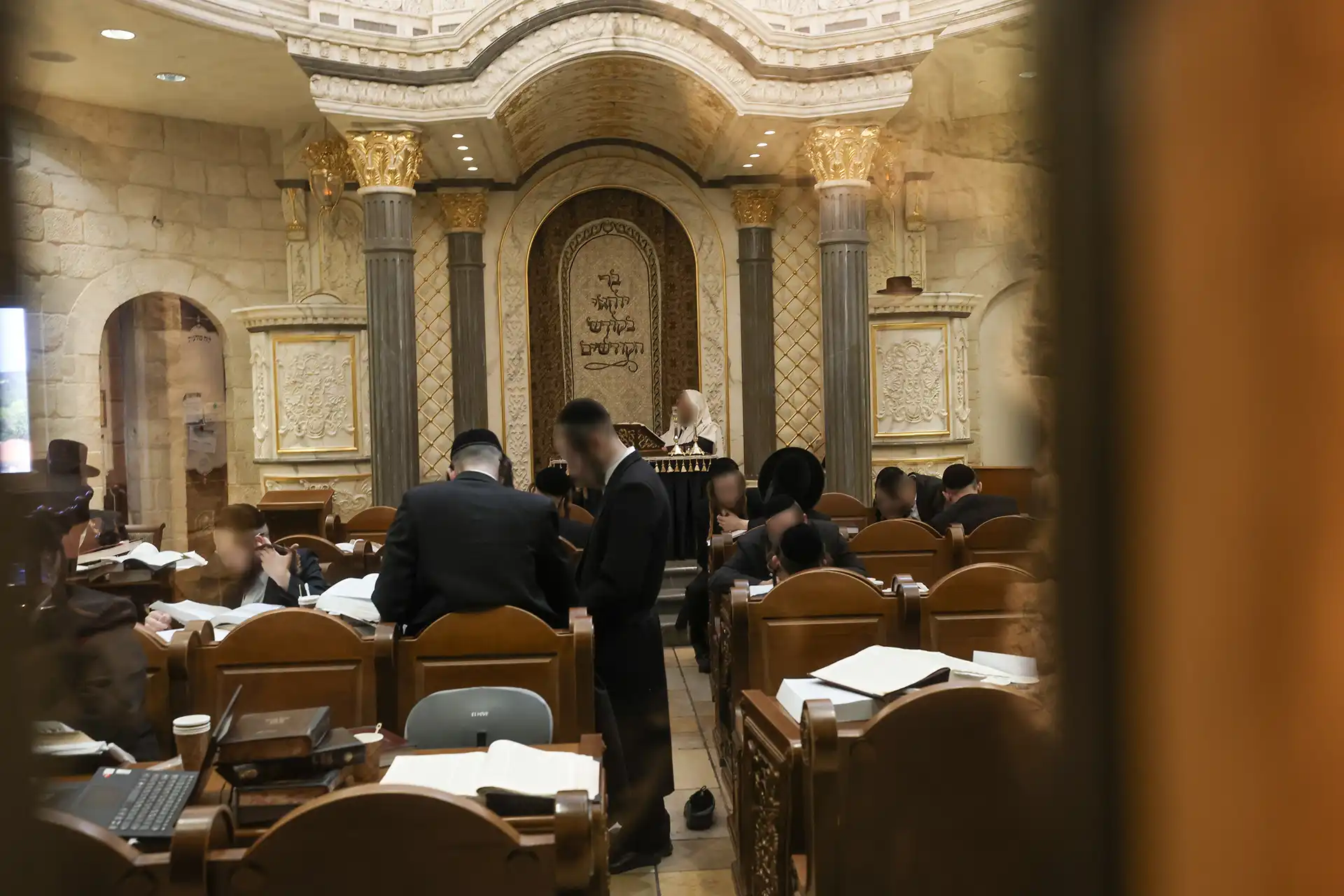
The study hall at Beit Harashbi. Photo: Shlomi Yosef

Keren Cohen Kivelä
October 9, 2026

Summary


Listen to a Dynamic Summary of the Article
Created using NotebookLM AI tool
When Hamas attacked southern Israel on October 7, 2023, Liat (a pseudonym, as are the names of the other individuals interviewed for this article) and her family, like many residents of the Gaza Envelope, found themselves trapped for many hours in the safe room of their kibbutz home, waiting in terrified agony for the Israeli security forces who were slow to arrive. They were saved thanks to the heroism of members of the kibbutz rapid response team, which fought off the terrorists and prevented a slaughter.
Shortly thereafter, Liat decided to join those who give, in acknowledgment of the divine grace she believed had been shown to her – and set up a fixed monthly donation of NIS 360 (about $120) to the Or Harashbi association, a nonprofit based on Mount Meron in northern Israel. The association promises donors that all the commandments performed at its compound, including prayer, Torah study and hospitality, will be recorded in their name and earn them blessings and divine redemption. The site is revered by many Jews as the burial place of Rabbi Shimon Bar Yochai (known by the acronym Rashbi), a second-century sage whom tradition credits with writing the Zohar, the central text of Kabbalah.
Almost two years later, the financial circumstances of Liat and her husband had changed for the worse and, in an effort to reduce expenses, they asked to stop their monthly donation to the association. To their astonishment, instead of thanking them for their generous donations over the past 24 months or so, the Or Harashbi representative with whom they spoke tried to intimidate. “She told my husband that if we don’t continue to donate money, the Rabbi would not be on our side and our household would not benefit from his blessing,” Liat says. “They continued to collect our donation for several more months, even though my husband told them time and time again to stop. It was only after a very fraught and highly unpleasant conversation that they stopped deducting the monthly donation.”
Liat’s story, it seems, is not unusual and Shomrim has heard of several similar incidents. According to the testimony of those involved, the pattern is identical each time: the association aggressively tries to persuade donors not to stop their payments and uses manipulative tactics; when that fails, it continues to take money from their accounts without permission and endlessly harasses the very people who opened their hearts and their pockets and tried to do a good deed.
The Or Harashbi association – the full legal name of which is Or Harashbi and the Holy Zohar Institutions, Meron – is a well-resourced organization that reported revenues of about 96.6 million shekels in 2024 alone ($32M). According to its financial records for 2024, 98 percent of the association’s income comes from donations from individuals, and its biggest expenditure is on salaries and associated expenses, which totaled around 14.5 million shekels ($4.8M). In addition, the association owns shares in two companies: the Company for the Welfare of Rashbi Pilgrims Ltd. and Or Harashbi Meron Ltd.
Free events to pressure donors
In recent years, Or Harashbi has been offering its events hall at the Mount Meron compound for private events such as bar mitzvahs, thanksgiving meals and, most notably, halaka ceremonies (the Jewish custom of cutting a boy’s hair for the first time at age 3). Or Harashbi offers to provide celebrants with a hall for their events and a rabbi to conduct the ceremony – ostensibly at no cost at all. One of the campaign videos that the association published on social media asks, “Did you know that there’s a banqueting hall at Mount Meron and that it’s totally free?” However, people who have taken advantage of the association’s ostensible generosity say that this free service is actually just the start of an intensive campaign of pressure designed to get them to make regular donations.
Moria met a representative of the association at her nephew’s halaka ceremony. The ceremony was conducted by a rabbi sent by the association, who was accompanied by an assistant. “She wouldn’t stop pestering me to make a donation and to get a gift,” Moria tells Shomrim. “At first, I committed to donating 120 shekels ($40) a month. When I tried to cancel the standing order, they convinced me instead to reduce my donation to 70 shekels ($23) a month, which I agreed to – but it was a total nightmare. They said I would get gifts, blessings from the rabbi and prayers. In practice, I didn’t get a single gift. They gave me the runaround for months, until I lost my temper and told one of their representatives to cancel my monthly donation entirely.”
Zohar was also persuaded to start donating to Or Harashbi after she was promised gifts at a family halaka ceremony. When she decided to cancel her monthly donation, the association did not cooperate. “The representative made me feel terrible,” Zohar says. “She told me that I had made a commitment for 36 months and that I couldn’t cancel until I had completed that.” Zohar stresses that she signed no such commitment and that, in the end, she had to contact her credit card company to unilaterally halt payments to the association.
Writing on Facebook, financial adviser Shay Abu described the case of a woman whose only son had recently been killed in a traffic accident. “We wanted to cancel the standing order she had set up to make a regular donation to Or Harashbi,” he says, “but they simply refused.” Abu says that, in the end, she was forced to simply cancel her credit card. “I will never forget the problems we had with them. As a religious person, I am ashamed of what I saw as cynical exploitation.”
Following these accounts, Shomrim joined forces with Chen, a donor to the association who had tried unsuccessfully to cancel her standing order. “When I want to stop donating, the association representative simply wouldn’t let me get off the phone. She lectured me for 20 minutes and in the end, I was so desperate that I agreed to cut the donation in half, instead of cancelling it completely,” Chen tells Shomrim. We also contacted Or Harashbi in an effort to help but ran into the same brick wall. The association representative started the conversation with a shower of blessings: “I see you’ve built up a lot of credit here, in the Zohar scroll and the Holy Ark and that Rabbi Shimon will look after you from above... May you have health and nachat... You have a very big share in this, Chen.”
As soon as the representative realized that the purpose of the call was to cancel Chen’s standing order, she explained that her job is merely to relay names for prayers and that while she does not have the authority to cancel a standing order, she can freeze it for one month. When we insisted that it be canceled, she promised to hand the request on and promised to get back to Chen very soon. Almost exactly the same conversation was held two days later, when Chen called back. The representative again promised to relay Chen’s request and said she would call back to confirm. A few days later, the representative did indeed call Chen back – only to tell her that the association would not cancel the standing order since Chen had committed to be a donor for three years.
“Three or four years ago, my mother fell ill and I wanted to donate money to a good cause to help with her recovery. Nobody told me that I was making a three-year commitment to the association. They just asked for my credit card details and the names of the people I wanted them to pray for,” Chen says. “I explained that I was a student, that I didn’t have an income and that I couldn’t afford it. Their response was to ask me what I live on if I don’t have an income.” The same representative promised to send Chen a recording of the conversation in which she committed to be a donor for three years but did not do so by the time this article was published.
Or Harashbi said in response that it will thoroughly examine any allegation that its representatives or suppliers have violated regulations. According to the association, in order to do so it requires the date of the call or charge, the last four digits of the phone number or payment method, details of the cancellation or removal request and supporting documentation; it assured us that these details can be provided without revealing the sources’ identities. The association added that every case submitted would be checked against its records and that any deviation from procedure would be dealt with without delay, including halting charges or calls and issuing refunds as needed.
‘They won’t stop pestering me’
Additional testimonies suggest that even those people who successfully cancel their regular donations to Or Harashbi are unable to evade incessant fundraising calls from the association. According to legal databases, the association has been sued no fewer than four times for harassment under Israel’s antispam laws, including a class-action suit for 2.5 million shekels ($800,000) that was filed late last year and is still being heard.
Another person who experienced the full force of Or Harashbi’s aggressive marketing tactics is Moran, who signed a standing order after hearing a radio ad. “After a while, it started to be too much for me and I asked to cancel the standing order. They tried to persuade me to cut my donation or to freeze it for a few months, but I insisted – and they cancelled in the end. It’s been two years since then and they are still calling me – even though I asked dozens of times for my number to be removed from their database. Instead of allowing me to feel that I did a good deed, I now regret ever having agreed to donate to them. They start the conversation by asking for a list of the people who you want them to pray for and then they don’t let you get a word in edgewise. It feels more like a scam than something sacred.”
Tamar, who stopped donating more than a decade ago, also still gets incessant calls from the association. “I have asked them countless times to stop calling me, but they keep calling from new numbers after I block them; they send me text messages and even contact me on WhatsApp. They just won’t stop pestering me.”
According to claims made on social media, the association is also engaged in another troubling practice: donors who made a one-time donation to Or Harashbi found that they had been signed up to a standing order. In a public post on Facebook in 2024, Makor Rishon reporter Matan Hasidim wrote that, “my wife’s grandmother made a one-time donation to Or Harashbi. For over a year now,” he added, “her bank account has been showing a transfer of 120 shekels every month, without her having agreed to any regular donation!” Hasidim added that the family tried to call the association but was transferred from official to official – none of whom agreed to cancel the standing order or even to apologize.
Two years before that, another donor published a similar complaint on her Facebook page. “I gave them my credit card details for a one-time donation of 180 shekels ($60). This week my card went missing, so I ordered a new one – and that’s when I first found out I had a standing order on it. 110 shekels every month.” She claims that when she called the association to try to cancel, she was promised a callback by evening, “and for a week now, not a peep.”
On a Facebook page for people seeking legal advice, another person described a similar incident. His 70-year-old mother had given her credit card details to Or Harashbi in order to make a one-time donation, only to discover that she had been charged 180 shekels ($60) a month for almost a year. In this case, too, repeated calls to the association failed to convince it to stop taking the money.
Responding to allegations that it violates the antispam law, the association replied that it does not contact anyone who has asked for their number to be removed from its database and that the moment someone submits such a request, their phone number is supposed to be blocked for any messaging from Or Harashbi – calls, text messages or direct mailing. The association added that the fact that there are lawsuits against it is not proof that it has broken the law and that no legal ruling has ever been issued to the effect that Or Harashbi has broken any laws.
A children’s entertainer in Or Harashbi’s service
Or Harashbi maintains a massive presence on social media and in the traditional press. The association has funded dozens of digital campaigns, some of them via its official Facebook page and other via pages with names like Redemption Hotline, Miracles of Rashbi and Light of Redemption. In some cases, Or Harashbi is not mentioned at all, which would appear to be a violation of the Associations Law, which stipulates that all such material must carry the name of the association behind it.

In order to attract young parents, the association has collaborated with children’s TV personalities Yuval Hamevulbal and Little Michal. In a sponsored ad currently doing the rounds, the latter appears against the backdrop of a halaka ceremony held on the organization’s grounds, declaring: “The atmosphere here is so moving. Joy and holiness are in the air!”
In addition, the association also retains the services of celebrities to sell amulets. For example, television presenter and right-wing activist Natali Dadon promotes the association’s Blessed Honey, which promises “miracles and wonders.” Reality TV stars Ma’ayan Ashkenazi and Yuval Ma’atuk, meanwhile, both regularly collaborate with the association, having recently posted ads for the ‘Holy Rashbi Candle’ on their Instagram pages. Alongside a link to order the product, they asked potential buyers: “Have you ever wondered why you are destined to suffer difficulties? Why you have been subjected to life’s disappointments? The Kabbalah secret of the ‘Holy Rashbi Candle’ – your redemption is just a click away.” Clicking on the link, of course, will not lead to redemption. Instead, it leads to a form where a potential buyer can leave their contact details. After all, the candle is not for sale as part of a one-off transaction; it’s only available to people committing to make a monthly donation to the association.

At the same time, the association is also active on the political front. Last year, it published on its Facebook page a video starring National Security Minister Itamar Ben-Gvir of the far-right Otzma Yehudit party and senior Israel Police officers “making a joint visit to the Idra Cave in the Holy Compound to seek a blessing” along with calls for followers to share the video. In another post, Transportation Minister Miri Regev (Likud) appears in a series of PR photos at Beit Harashbi, lighting a candle in the Idra Cave and receiving a “personal blessing from the holy Kabbalists.”
The association’s massive social media presence is augmented by widespread exposure on Israeli television: in recent years, channels 13 and 14 have both aired long broadcasts in collaboration with the association. These shows, which masqueraded as holiday specials or current affairs programs, were in fact nothing more than fundraisers for Or Harashbi. Most of these broadcasts, which lasted for three or four hours each, were hosted by ultra-Orthodox radio personality Menachem Toker, who interviews reality TV stars and online influencers.
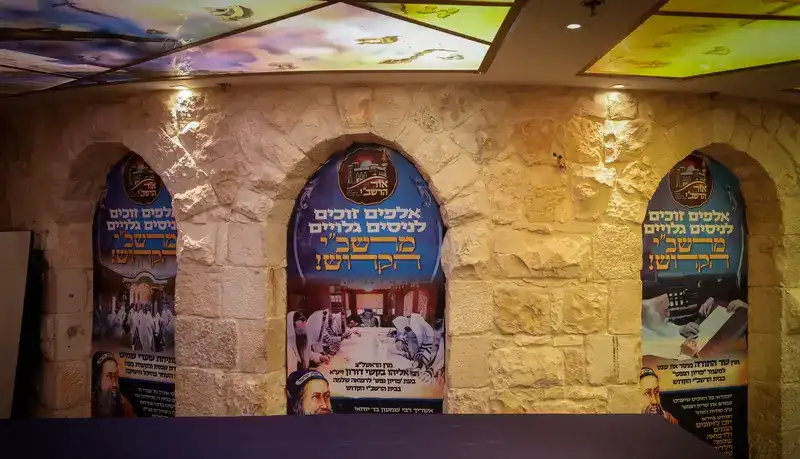
The guests all tell the audience about the miracles that they were privileged to witness thanks to prayers offered to Rabbi Shimon. During last year’s Hanukkah special on Channel 13, for example, actress and model Liron Revivo spoke about her personal deliverance. She said that worrying findings from an early pregnancy scan completely disappeared in the next test – thanks to the Rashbi and her prayers. “The doctor held the machine up to my stomach and my fetus said Shema Yisrael twice! He examined me and told me, ‘Listen, everything’s fine.’ The baby was born perfectly healthy. Thank God. Thank Rabbi Shimon.” Five months later, the story of Revivo’s miracle was reheated and served to viewers who tuned into Channel 14’s fundraising broadcast for Lag B’Omer.
During the fundraising broadcasts, producers insert live reports from Or Harashbi’s compound in Meron, alongside interviews with Kabbalistic scholars and endless repetition of the phone number for donations. The viewers are showered with promises of redemption, financial success, a successful relationship and even recovery from disease. Anyone calling the number will be told that everything Rabbi Shimon has to offer is within reach – for nothing more than a monthly donation of 120 shekels for at least three years.
Despite the many complaints that were submitted to the Second Authority for Television and Radio, which is supposed to enforce broadcasting standards, these televised fundraisers continue to prosper. In November 2024, the Second Authority announced that it would limit each association to one televised fundraiser a year. However, Shomrim has found that in 2025, Channel 13 alone aired three fundraising broadcasts for Or Harashbi. This year, too, the channel marked Lag B’Omer with a special fundraiser for Or Harashbi, with exactly the same celebrity-heavy format; this time, too, viewers were told that if they open their pockets, they could expect miracles. One source at Channel 13 told Shomrim that the station does not plan on holding any more fundraisers for the association any time soon and that, despite the fact that they are hugely profitable for the channel, it will probably not air more in the future. He said that the channel was completely unaware of the association’s alleged behavior and that testimony from donors would be taken into account if there were future proposals for additional fundraisers.
‘My heart aches for these people’
The Or Harashbi association – or, to give it its full name, The Light of the Holy Zohar and the Redemptions of Rashbi – was established in Safed in 2008 by several Haredi activists, including Haim Zeibler, who remains CEO to this day. Shortly after it was established, Yitzhak Kluger, who was already serving on the boards of several other nonprofits, including Rachel Imenu in the Holy Land, was added to the association’s board.
As far back as 2012, an article was first published in the Israeli media that raised questions about the association’s conduct. A Mynet reporter in the Jezreel Valley went to the Mount Meron compound to look for the Shaarei Dima yeshiva, for which funds had ostensibly been collected by Or Harashbi, only to discover that no such yeshiva had yet been established. The compound’s custodian told the reporter at the time: “Every day I get inquiries from people who are looking for this yeshiva and who donated money by credit card. My heart aches for these people. I’ve been working here for 26 years, and I can say with certainty: there is no such yeshiva here.”
About a year after that article was published, the Corporations Authority demanded full details of the association’s activity and fundraising. The association ignored most of the claims against it in its response, and in October 2014 the Registrar of Associations issued another letter detailing a long list of serious deficiencies and suspected irregularities in its financial and organizational conduct.
%20-%20%D7%A9%D7%9C%D7%95%D7%9E%D7%99%20%D7%99%D7%95%D7%A1%D7%A3.webp)
In his letter, the registrar ruled that the association had failed to maintain financial and operational separation from related associations, running joint telephone fundraising centers and transferring funds between them. He also found that the association had omitted its official name from promotional material, recorded messages and its website, using various other names instead, in violation of the Associations Law.
An examination of the association’s books exposed further irregularities: debts erased under an advertising line item, expenses recorded for related associations and payments of hundreds of thousands of shekels to call centers not registered in its name. The association was also found to have failed to report, as required by law, its ties to related corporations in which board members hold parallel positions and to have failed to produce detailed receipt books to prove the scope of its donations. In light of the findings, the registrar rejected the association’s request for a certificate of proper management for 2015 and ordered an inquiry. The inquiry concluded in 2017 with a harsh report recommending that the association be dissolved, but the Corporations Authority decided to give the organization a second chance and allowed the board members to sign a plan to correct the deficiencies. The plan was signed in October of that year at the registrar’s offices, and the Corporations Authority appointed an outside accounting firm to monitor compliance. The monitoring process, which lasted about two years, exposed an entire world of improper conduct.
According to the final report, the association had no finance or salary committees despite operating on a scale of millions of shekels. Salaries were paid without supporting documentation and relatives were employed without a defined scope of work. It was also revealed that the association had introduced an incentive scheme at its fundraising center, under which even the female rabbinic advisers whose job was to provide spiritual support were encouraged to close deals and received extra compensation for calls that ended in a donation. The report also noted that the association had exceeded by more than 20 percent the budget it had agreed with an advertising firm owned by the association’s own CEO.
Despite the grave findings in the monitoring firm’s summary report, the registrar was persuaded that the association had completed the recovery process it had committed to, closed the supervision proceedings and gave it the green light to continue raising donations, while potential donors remain unaware of the skeletons in its closet.
A review of the registrar’s documents shows that while the authorities took their eyes off the ball, Or Harashbi’s fundraising machine posted phenomenal growth: in just six years, the association’s revenue leapt 212 percent, from about 31 million shekels (about $10M) in 2018 to around 96.6 million in 2024 (about $32M). Of the association’s total expenditures in 2024, about 21.2 ($7M) million shekels went to salaries, with the spiritual-support rabbis and fundraising-center staff regularly appearing on the list of top earners. Meanwhile, the donors, who mostly just sought a little comfort, are left with disappointment and a bitter sense of having been exploited. As one of them put it painfully: “I donated for a whole year, truly with pure intent, and this is what I get back? I came away with a hole in my heart.”
‘The class-action suit was not submitted in good faith’
In response to the investigation, the association rejected out of hand the claims that donors were charged without consent, that cancellations were refused or that people were knowingly contacted after requesting removal. The association claims that the conduct described is completely contrary to its procedures and to the instructions it gives employees, that a donation is charged only with free and explicit consent regarding the amount and duration of the charge and that association representatives may explain its activity to the person who contacts them but may not apply pressure or manipulation.
Association officials also argued that Shomrim’s allegations were worded in a manner that does not allow them to conduct a proper inquiry, since they were not given identifying details that would allow them to identify the incidents and figure out how many cases are involved, when they occurred and what exactly is claimed to have been said or done in each of them. Regarding the motion to certify the class action, the association asked to note that, “the very filing of the motion is not a judicial determination or proof of a pattern of conduct. As we understand it, this is an invalid motion to certify a class action, filed in bad faith by parties who despise all religious activity. The association does not send messages to anyone who has requested removal. The matter will be proven in court.”
The association added that if further details are received, an urgent inquiry will be conducted, and an orderly response will be provided: “Publication of incorrect information will unjustly harm the association’s reputation and its services and could even constitute defamation. We therefore warn you not to publish incorrect information, and certainly not to publish it without checking or without the association having been given a real opportunity to respond to the claims. A general inquiry such as the one just sent does not, in practice, give the association an opportunity to address the specific claims, as required by law and justice.”
The Second Authority said in response: “The rules regarding fundraising broadcasts on television were published in the Official Gazette and went into effect at the end of January 2026. The broadcasts you refer to were aired in accordance with the old rules that were in force at that time. The authority enforces the rules against all channels. Since the rules went into effect, Channel 13 has not aired fundraising broadcasts that do not comply with the rules, and violation proceedings have been opened against Channel 14 over fundraising broadcasts that were not in accordance with the rules. The associations are supervised by the Associations and Public Benefit Companies Unit (the unit that deals with associations and public benefit companies) at the Corporations Authority, and not by the Second Authority.”
The Corporations Authority said in response: “In 2017, an in-depth audit of the association was completed, following which a monitor was appointed to correct the deficiencies until 2019. A certificate of proper management was granted after review of the reports and compliance with the purposes of the law. Documentation of improper conduct will be examined at the Associations Unit in order to decide whether to open a supervision proceeding. The registrar does not provide information about inquiries or future supervision proceedings so as not to harm the examination. If deficiencies are identified, enforcement tools are employed, ranging from denial of a certificate of proper management to a request for dissolution.”