


People say they are psychotic, that they are delusional, that things like this cannot possibly happen in reality – and certainly not in Israel. But now, four therapists – three psychiatrists and a social worker – who repeatedly heard about this phenomenon from patients and also saw the physical proof on their bodies, are courageously declaring: Yes, ritual abuse exists in Israel – and it’s not an isolated phenomenon. Yes, there are women and men, most of them children, undergoing sadistic, violent rituals that usually include sexual abuse, with cult-like elements and serious psychological manipulation. Yes, abusers include rabbis and doctors and there are even allegations against a judge. And yes, we must first of all believe the victims and then do everything we can to end it – right now
Published also in Yediot Aharonot “7 days” supplement (Hebrew).
Breaking the Silence Around Ritual Abuse
People say they are psychotic, that they are delusional, that things like this cannot possibly happen in reality – and certainly not in Israel. But now, four therapists – three psychiatrists and a social worker – who repeatedly heard about this phenomenon from patients and also saw the physical proof on their bodies, are courageously declaring: Yes, ritual abuse exists in Israel – and it’s not an isolated phenomenon. Yes, there are women and men, most of them children, undergoing sadistic, violent rituals that usually include sexual abuse, with cult-like elements and serious psychological manipulation. Yes, abusers include rabbis and doctors and there are even allegations against a judge. And yes, we must first of all believe the victims and then do everything we can to end it – right now
Published also in Yediot Aharonot “7 days” supplement (Hebrew).
People say they are psychotic, that they are delusional, that things like this cannot possibly happen in reality – and certainly not in Israel. But now, four therapists – three psychiatrists and a social worker – who repeatedly heard about this phenomenon from patients and also saw the physical proof on their bodies, are courageously declaring: Yes, ritual abuse exists in Israel – and it’s not an isolated phenomenon. Yes, there are women and men, most of them children, undergoing sadistic, violent rituals that usually include sexual abuse, with cult-like elements and serious psychological manipulation. Yes, abusers include rabbis and doctors and there are even allegations against a judge. And yes, we must first of all believe the victims and then do everything we can to end it – right now
Published also in Yediot Aharonot “7 days” supplement (Hebrew).
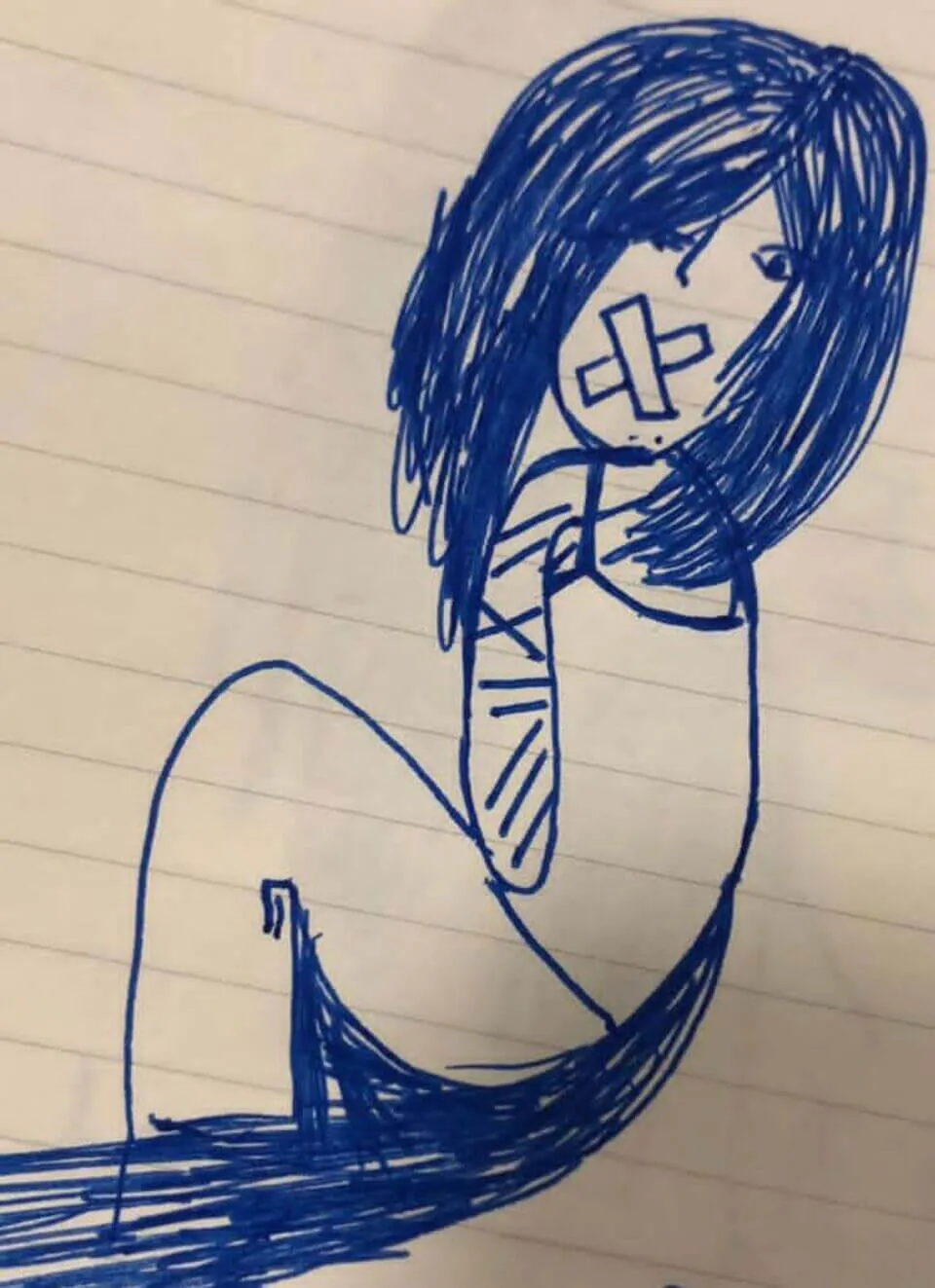
A drawing by N., a survivor of ritual abuse
Haim Rivlin
May 15, 2026

Summary


Listen to a Dynamic Summary of the Article
Created using NotebookLM AI tool
Suddenly, the stories began trickling in. One after another, their patients – male and female alike – started to tell them about depths of human evil that are hard to fathom. And they – who thought that they had heard it all, who dealt with every kind of life-altering trauma – realized that something entirely different was happening here. That in Israel, too, a phenomenon known as ritual abuse exists – and that almost no one is talking about it.
Now, they say, they have collated testimonies from more than 50 victims and are ready to end the conspiracy of silence surrounding ritual abuse in Israel. Three female psychiatrists – Dr. Inbal Brenner, Dr. Sharon Levy and Dr. Daphna Armon – along with social worker Tanya Oren-Chipman, all four of whom hold very senior positions and who have many years of experience, have come together to issue a wake-up call: This is happening right here, it is far more widespread than you think – and it is taking a devastating toll.
At first, they also found it hard to believe what they were hearing from their patients. “They told us stories that simply didn’t sound reasonable; they sometimes even sounded absurd,” says Oren-Chipman, who served for many years as director of the Ministry of Welfare's Tamar Center for Sexual Trauma in Jerusalem. “They told us things that I found hard to deal with,” adds Dr. Levy, the deputy head of the Meuhedet HMO’s mental health services in the Jerusalem district.
%20-%20%D7%A9%D7%9C%D7%95%D7%9E%D7%99%20%D7%99%D7%95%D7%A1%D7%A3.webp)
What began as a trickle, however, soon became a steady stream of testimonies: men and women from all walks of life, without any previous connection between them, who came from different places and at different times – all of whom offered strikingly similar accounts of what they experienced. “We heard stories that included multiple attackers, stories about extreme cruelty and sadism, about the use of deliberate starvation to control and punish,” says Levy, who has personally met with dozens of patients, each of whom separately described to her the same horrific situation. “I said to myself, ‘Hang on, there’s something odd here.’ I searched through the literature and came across something known as ‘ritual abuse’ and I knew I had found the answer.”
None of them were previously familiar with the phenomenon of ritual abuse. They had not encountered it during their medical studies or their specialized training in treating complex trauma. Hearing such harrowing accounts in the therapy room pushed each of them, on her own, to look for answers – whether in the professional literature or by consulting colleagues abroad.
In December, Israel held its first-ever professional conference on ritual trauma, organized by the Israeli Society for Sexual Trauma Treatment and Prevention (ISST), which operates under the auspices of the Israeli Medical Association. All four of the interviewees for this article are members of ISST and it was Levy who presented the conference with the professional definition of ritual abuse: “Organized and repetitive abuse involving physical, emotional, sexual and spiritual violence, often carried out within the framework of structured rituals, at times utilizing religious and cultic symbols. Its purpose is total control over the victims and the deep indoctrination of patterns of submission within the victim.”
According to Oren-Chipman, one of the messages to emerge from the conference was that “we recognize that this issue exists and that we have to start addressing it on a professional level. It makes no sense that every professional therapist who encounters it will have to make their own way through the darkness, with all of these horrors. We have to say: This is unacceptable, it is inconceivable – but it exists and we have to recognize the phenomenon in order to start dealing with it.”
“It’s easier for to frame it as fantasy or a mental condition and say, ‘She’s crazy,’ or ‘She’s imagining things.’”
In March 2025, when the late Shoshana Strook – daughter of Minister of Settlements Orit Strook – published videos in which she claimed that she suffered ritual abuse – the public response fell between outright denial that the phenomenon even exists, factional division and political sniping. It is important to note that none of the four therapists interviewed in this article has any information that confirms or contradicts the allegations made by Shoshana Strook. In April 2025, a court rejected a request to lift the gag order placed on the case, ruling that “at this stage, reasonable doubt is extremely meager, if not less than that.” What set the alarm bells ringing for the four therapists, however, were the responses. “I am not familiar with Shoshana’s story, may she rest in peace,” says Oren-Chipman, “but when I saw the first video that she uploaded, I immediately turned to my husband and said, ‘Shit. Now they’ll say that it’s all political.’ I was really annoyed by that, because I knew that it would split everyone right back into the same old camps and entrenched positions we’re all familiar with, where it’s impossible to think outside the box. Long before [Shoshana Strook] posted that video, I had heard stories – not one, or two or even three – and it certainly was not political.”
Following Shoshana Strook’s tragic death on March 14 of this year, social media was awash with dismissive and violent rhetoric which, among other things, rejected victims’ testimony about the phenomenon as “delusional” and called the women who claimed to be victims of ritual abuse “crazy.” This was also the stage that the subjects of this article, who belong to the very core of the Israeli medical and therapeutic establishment, realized that they could no longer remain in the sterile space of the clinic. They decided to exert the full professional gravitas by joining forces and saying something that Israeli society simply refused to hear: We have seen the wounds with our own two eyes. It’s not imagined; it’s real.
“The impact of this kind of narrative on our patients is devastating,” says Inbal Brenner, chairperson of ISST and director of the Sexual Trauma Clinic at Lev Hasharon Mental Health Center. “We felt that we had to say something, because we saw our patients falling apart and becoming suicidal. The discourse was extremely blunt and very violent and we felt, as female professionals, that we had to say: We have seen with our own two eyes and we have heard these stories for years from men and women. We had to speak out and say: The phenomenon does exist. You can’t just say ‘You’re all crazy,’ because that essentially means abandoning our patients.”
Oren-Chipman adds: “The greatest fear of anyone who has been sexually abused is that they are crazy, that they imagined it, that they made it up or that they are exaggerating. When that encounters external denial, it becomes even more paralyzing, even more shocking and it raises feelings of guilt, loneliness and self-loathing. Every imaginable form of evil.”
This blanket denial does not usually come from a place of malice or evil, they say. “Sometimes there’s ignorance, there’s a lack of understanding and there’s a very human inability to believe that such evil exists,” Brenner explains. “It’s hard to believe that there are sexual assaults that happen in such an organized way, that adults can hurt children in this way – and it’s easier for us to say that it’s nothing more than a fantasy, a troubled psychological state – and to say ‘She’s crazy’ or ‘She’s imagining it’.”
“After all, who wants to live in a society like that, in which there are such evil people and evil is institutionalized?” Armon adds. “It’s a lot easier to believe that evil only comes from beyond our borders, that it is different, foreign, that it has a different color or accent. Who wants to think that people with power in our country behave in this way? That entire communities do this? Who wants to believe that? You can’t sleep at night.”
In response to this wave of denial, doctors and therapists from a variety of fields – all of them members of ISST – last month published a position paper. “Ritual abuse and organized sexual abuse networks are an existing and recognized phenomenon worldwide, including in Israel, requiring urgent and profound institutional, therapeutic and legal attention,” it read.
Armon, director of the Complex PTSD Department at the Be’er Yaakov Mental Health Center, explains why they decided to break their silence: “The hardest part is that the victims themselves don’t believe their own memories. The question of whether it happened or not is always relevant – but it’s even more so when it comes to ritual abuse of this kind.”
And then the doubt that the environment expresses merely exacerbates it?
“That’s why we published our statement. We don’t know what did or did not happen in the specific case of Shoshana Strook, but we cannot stand idly by when people are dismissing the phenomenon. This denial of the phenomenon harms every victim – and we 100 percent believe that people have been harmed in this way.”
The abused children are accused of being ‘impure’
The individual testimonies received by all four therapists are of course confidential, but Levy can describe in general terms what ritual abuse of this kind looks like. The abuse is always carried out by a group of adults, “with each of them having a specific role,” she says. “For example, there is someone running the ceremony, someone recording it and so on.” The children must be naked and the ceremony itself includes severe sexual abuse and life-endangering torture such as strangulation. “I have heard descriptions of drowning in the mikveh or at sea, or situations where a child was placed in a grave-like hole and covered in dirt or trapped inside a circle of fire.”
Another characteristic that keeps reappearing is that the perpetrators often use restraints or cages as part of the ritual abuse. In some cases, victims have told the therapists that they were taken to a room or pit with spiders or the carcasses of dead animals, “or a child was led to believe that this is what was happening,” Levy says. She adds that, according to her patients, their abusers lacked any emotion and were indifferent to the pain they were causing and their victims’ screams.
In many cases, ritual abuse took place within the family itself. “And then,” Levy says, “there are several family members involved, whether that be abusing the victim and participating in the ritual or by preparing the child for abuse or treating their wounds afterwards. In many cases, the children are handed over to other adults who will abuse them.”
In most cases, the rituals have cultic or religious overtones. In cases where there is no cultic-religious element, Levy says, the framing “can be that of a game, where the child is staged in various situations of abuse and photographed.”
According to the four therapists, even rituals which have cultic or mystic characteristics are not actually like that. Rather, they are a calculated mechanism designed to destroy the victim’s identity. “There was one victim who was very capable of describing exactly how they led her into the abusive situation,” says Oren-Chipman. “It was a description that I later heard from other places and other people – whereby the victim was ‘sacrificed’ by one of her relatives. It’s something that happens again and again. And the abuse itself, which is incredibly sadistic, is extremely harsh. Among the most violent I have ever heard of. Waiting nervously for the abuse, which could mean several children waiting together for their turn. And, of course, muttering verses, incantations and all kinds of religious conceptualizations.” Brenner adds that, according to testimony she has heard, the abusers also made use of religious artefacts: “It could be a shofar or a staff said to have powers. The abused children are accused of being ‘impure,’ so the ‘purpose’ of this specific ritual is to bring them to a higher level of spirituality, to some kind of purity and holiness.”
The use of religious or cultic symbols is designed to create an impossible conflict for the child. “It’s a cheap manipulation, but it’s a very powerful tool for creating psychological control over the victims,” Oren-Chipman explains. “They deliberately made them sin – stealing, violating the Shabbat, eating leaven during Passover, all kinds of things that sound petty to someone who is not religious, but ‘You sinned’ and ‘You should atone for your sins’ and now part of what you are going through is atonement and you are redeeming your soul and bringing about redemption through this thing. If they were abused in the name of God, and if God Himself wanted these things to happen to them, then it’s a lot harder to free themselves.”
Behind the cultic disguise and the pseudo-religious mumbling is a twisted internal logic that is as dangerous as it is ancient. Researcher Dr. Udi Frohman, who has studied the historic roots of the phenomenon, identifies the source of this warped ideology in movements like Sabbateanism and Frankism – movements which espouse the principle of “a commandment that comes by means of a transgression,” out of a belief that the abolition of old values requires the deliberate trampling of the most severe sexual prohibitions and a descent into impurity. The reports that Frohman cites from today’s victims sound as if they were taken from those same dark periods of history: “A circle surrounded by burning candles... The rabbi recites the blessing ‘Blessed is He who permits the forbidden’... They would repetitively recite Psalms... And they told me ‘You are special, you are chosen’.”
However, the modern-day version of ritual abuse often includes, according to victims’ testimony, a video camera documenting everything that happens. The therapists believe that the reason for this is financial: the videos are sold on the darknet. “There are buyers for these things,” says Brenner. “And a lot of our patients live in fear because there is videotaped evidence of them being abused circulating God knows where online.”
The camera, therefore, is not just a tool to make money on the darknet; it is also the ultimate weapon for extortion and to ensure the victims’ silence for the rest of their lives. “There are all kinds of ways to extort someone,” says Armon. “They want to get married or start dating someone [and the abusers threaten] to expose them or ruin their reputation.”
“The ritual is their way of controlling. Using brainwashing, intimidation, profound psychological strategies,” Armon adds. “The abusers are intelligent, powerful people of means; it’s not some marginal phenomenon that happens by mistake or something private that happens behind closed doors.”
We see broken bones and we see a lot of urinary tract infections.
Indeed, it is only natural for us to want to view the abusers as monsters, members of the society’s fringes or criminals who emerge from darkened alleys. But the reality, as depicted by victims’ testimonies, is rather different: “In quite a few of the cases we’ve come across,” Brenner reveals, “the perpetrators were high-status community members. They either held respected religious or spiritual authority, like a rabbi or a rebbetzin, or occupied other influential, prominent positions, such as a judge. It’s mind-boggling – the gap between the public persona and these stories. No one would believe such far-fetched stories about a judge, yes, a judge, or a teacher, or a school principal.”
“As a physician,” says Armon, “it’s important for me to point out that I have heard of doctors who have taken part in such things; who have deliberately harmed people. I have heard about births that took place in secret, all kinds of things that the medical team was involved in. I feel a responsibility to point this out. People are trying to turn ritual abuse into something political – which it is not. It exists everywhere that there is power and influence.”
According to Levy, some of her patients who suffered from organized abuse still carry the silent scars of what they endured in the medical files: “We see broken bones and we see a lot of urinary tract infections. When it comes to deliberate malnourishment, you see a lot of children who need infusions of iron. Why should a child need iron infusions without any medical reason?”
“On occasions, the abuse also included the denial of medical treatment,” says Brenner. “There are patients who told us that they were not allowed to see a doctor for years or that they only got medical treatment after they left the cult or the abusive environment.”
This “abusive environment,” as already mentioned, can often be the immediate family. The gateway to the world of organized abuse is often through a relative who traffics/pimps out the child victim. “It doesn’t have to be a parent. It can be an uncle or grandfather whom the parents trust who commits these abuses and who takes the child to a network of abusers,” Brenner adds.
Proximity and easy access to children explain why the victims are so young: “Usually around the age of three, four or five. And it continues for quite a long time,” Brenner says. “There are also cases of abuse of children of primary school age. Beyond that, it is apparently less common.”
Armon also wants to dispel the stigma around the victims’ families: “The victims can come from families that are considered upstanding; we’re not talking about children who have been picked up from the street because they come from the fringes of society.” The understanding that evil resides in the hearts of perfectly normative communities is perhaps the hardest to fathom. “The average citizen does not want to know that such things exist,” Armon admits. “The problem is that evil is good and good is evil – and that is also why it is impossible to believe them.”
They use drugs, electric shocks, hypnosis and lots of lies
Apart from sadistic abuse, part of the reason for ritual abuse is to force the victim into silence about what they have been subjected to. “The goal of the perpetrators of ritual abuse is simple,” Levy explains. “They want to keep on doing what they are doing, without their secret being exposed, and that’s where they invest all their efforts.” To this end, they do not stop at ordinary intimidation; they employ a practice known in professional circles as mind control. “The abusers deliberately create a state of dissociation,” Oren-Chipman explains. “They do not just rely on the fact that it is traumatic, causing the mind to forget, but also employ a variety of sadistic methods, such as using various types of drugs and mind-altering substances.”
“Many patients describe having all kinds of substances injected into them between their toes,” Levy confirms. “They use drugs, electric shocks, hypnosis and lots of lies, threats and brainwashing, repeating the messages again and again – all as part of the effort to induce a state of dissociation in the child.”
Armon says that the tactic is sadistic in a particular cold and calculating manner. “There are all kinds of techniques used, like flashing lights, mirrors or sleep deprivation. Certain words are used that become code words that trigger something. There are patients who will dissociate if I say a sentence a certain way, but if I express the meaning differently, they will stay with me in the conversation. There are those who know that these sentences are dangerous for them – sentences that leave them with no memory of what happened, no idea what they are doing or what is going on around them, and no ability to fight back.”
The therapists refer to this as psychological programming. “The word ‘programming’ might sound like it comes from some science-fiction movie or from the days of the Cold War,” Brenner says, “but since the victims are children of a very, very young age, there is something with repetition, with repeating a certain ritual, or an activity or spoken word that is repeated in a certain way. When it happens again and again, it’s a way of controlling the child.”
According to Brenner, these manipulations are accompanied by humiliating phrases repeated over the years, until they become ingrained in the victim’s inner consciousness, leading them to believe that they wanted what happened to them and that they are to blame. “On many occasions, the victims will tell themselves that they cooperated with their abusers because part of this programming forces her to lie in a certain position, for instance, while it happens over and over again,” Brenner adds. “When we look at this from the outside, it’s obvious that there is no and there can be no cooperation or consent here, but these manipulations make them feel as if they did these things of their own free will.”
The result of this prolonged torture is total emotional collapse. A child who undergoes such unbearable experiences cannot get out of bed in the morning, cannot go to school or function like a normal child without falling apart. “We are living creatures and we are designed to protect ourselves and to survive,” Armon explains. “When there is something so terrible that threatens to tear us apart, something that we cannot live with, we tend to disconnect. Separate personas develop, as it were, because each part of the psyche develops independently, without communication.”
This phenomenon, known as Dissociative Identity Disorder (or split personality in layman’s terms), is actively exploited by the abusers. “The abusers are familiar with these ‘parts’ [these different personas] and, in fact, they deliberately create them,” Levy explains. “They create more and more ‘parts’ and give each part a role to keep the other parts quiet – and the child will never speak about what happened.” Thus, within a single person, a completely intelligent and functioning part may exist that is totally unaware of the horrors, alongside other damaged and terrified parts that carry the memory of the trauma.
It is evident that the abusers have a very deep understanding of the human psyche, Levy says. One of the psychological methods for committing “the perfect crime” is to turn the victim into a perpetrator. Levy describes how abusers make young children hurt other children or animals. “They were forced to hurt others. And then it is as if they have no reason to go and tell what happened, because they are part of it, because they also caused harm,” Armon adds.
You cannot fake what happens to the body
It is hard to digest the horrors that victims of ritual abuse report when they are speaking to their therapists. That is why some of the online skeptics claim that the whole phenomenon is nothing more than psychotic hallucination, perhaps even false or implanted memories. “People cannot imagine that things like this happen. It is very healthy in my view not to want to believe it,” Oren-Chipman admits. “When I first encountered it, I also looked for psychological interpretations that would allow me to say ‘No, it can’t be true. The world surely isn’t so disturbed’.”
The clinical picture, however, presents a completely different reality from that of a mental health struggle. Levy explains the medical diagnoses: “With psychosis, we see fixed delusions that are completely unrelated to whether they talk about what happened or the bond between the patient and therapist, and there are no physical symptoms.” For victims of ritual abuse, in contrast, the body itself carries physical evidence of the horror: “Victims of ritual abuse have many physical symptoms, which sometimes manifest as if a part of them is silencing them. Every time they start to share something, they suddenly get nauseous and you can actually see them freeze. They also experience various pains linked to the abuse itself, which is something you just do not see with psychosis.”
%20-%20%D7%A9%D7%9C%D7%95%D7%9E%D7%99%20%D7%99%D7%95%D7%A1%D7%A3.webp)
Armon adds: “You cannot fake what happens to the body, the physical response. The feelings and things that come up make no sense and cannot be put into words. But the disgust, the pain, the terror, the things you see inside the person’s body and eyes – you cannot fake that. And you feel it yourself too, as if it is passing into you. I have never felt anything like that with a psychotic patient.”
And what about the claim these are nothing more than “false memories” implanted by therapists? Armon rejects this claim out of hand: “I have encountered so many patients whose behavior is similar and whose accounts are similar. Are we supposed to believe that they all had false memories implanted? That they all went to therapists who implanted these thoughts, these memories? In the end, there is a reality and we know it and see it.”
In fact, the fragmented way in which these memories come to the surface is perhaps the best proof that they are genuine. “A traumatic memory is always fragmented, always partial,” Brenner explains. “Usually, a traumatic memory resurfaces in the form of physical feelings, flashbacks or panic attacks. In fact, if someone comes in and suddenly tells a story from beginning to end, detailing exactly what happened, that actually raises questions for us.”
However, this “physical truth,” which screams from within the therapy room and leaves the therapists with no room for doubt, collapses entirely in police investigation rooms. The inherent gap between how traumatic memories work – fragmented, partial and silent – and the strict demands of the law enforcement system explains how it is possible that not a single indictment has ever been filed in Israel for ritual abuse.
According to Armon, the famous case of Ka-Tzetnik’s (the author Yehiel De-Nur) dissociative collapse on the witness stand during the Eichmann trial illustrates this difficulty. “He was unable to answer the judges’ questions in the way that they demanded. So, our first demand is to establish a specialist unit for these cases. You also need investigators, prosecutors and judges who have expertise. And you need a court that specializes in ritual abuse.” Currently, when victims get up the courage and go to a police station, they are asked to provide a coherent narrative. “They are asked to provide a timeline, with a beginning, a middle and an end – and to talk about things that happened to them perhaps before they even acquired a language,” Armon says. “And all of this is happening at a time when, inside their heads, there are voices shouting that they mustn’t tell or they will be killed. And then they seem terribly distracted and cannot listen to the questions – and it looks bad.”
Levy adds that a psychiatric diagnosis itself, when it comes about as the result of abuse, is often used as a “weapon” against the survivor during police questioning. “If a patient arrives at the police station having already been diagnosed with Dissociative Identity Disorder, then that’s it – as far as the police are concerned the story is over. And that doesn’t make sense.” This is even more infuriating when one understands that Dissociative Identity Disorder is a very common diagnosis. “Around 1 percent of the population,” Brenner says. “And it’s a disorder that, in 99 percent of the cases, is caused by severe childhood trauma – usually involving the sexual abuse of girls and extreme physical violence. In my experience, all of the male and female victims of ritual abuse that I have treated suffered from Dissociative Identity Disorder; and that means their testimony is even less valued by authorities.”
We try not to let the fear paralyze us
It is hard to gauge the extent of the phenomenon in Israel, in part because of the different ways of defining the abuse: organized, ritual or cultic. “When you ask professionals who treat girls who were sexually abused, most of them will tell you that they have encountered at least one or two cases,” says Brenner. “I would say that, over the years, I have encountered at least 20 such cases – mainly women and a few men.”
Overseas, in contrast, more and more data has been collated over recent years. A report published in July 2025 in the United Kingdom by the two official organizations responsible for monitoring and treating sexual abuse – the National Police Chiefs’ Council (NPCC) and the National Association for People Abused in Childhood (NAPAC) – found that 2.5 percent of all calls to a dedicated helpline between 2006 and 2024 mentioned ritual abuse. The report found that, in the four years leading up to 2025, British welfare services and police received 211 reports of organized sexual abuse. At least 14 of these cases led to convictions.
A study surveying workers at a sexual assault support center in Melbourne, Australia found that 28 percent of them had supported one or more survivors of ritual abuse and, in the decade preceding the study, 153 such cases were documented in the city. In a survey conducted among 2,709 psychologists in the U.S., 13 percent reported that they had worked with one or more survivors of ritual sexual abuse. The British report emphasized that these figures are likely just the tip of the iceberg, due to immense barriers preventing victims from reporting, and that actual convictions do not represent the full scale of the phenomenon.
In Israel, as already noted, there is still not even a shred of official data. “I am worried that the phenomenon in Israel is a lot more widespread than we think,” says Levy. “Just like 50 years ago when the psychiatric world thought the prevalence of incest was one in a million, it is clear we are way off the mark here too. I can’t quantify the scale of the phenomenon, but if we as a society want to stop it, we need to be brave enough to acknowledge it.”
It takes courage to sound this kind of wake-up call. “There is concern, of course there is,” Oren-Chipman admits. “We try not to let fear paralyze us; fear is a means of control. Strength to withstand trauma comes from being together; strength is community.”
For the Association of Rape Crisis Centers’ dedicated hotline in Israel for survivors of ritual abuse call (052) 346-8541
My body wasn’t my own
N., a survivor of ritual abuse whose art accompanies this article, writes about her life after:
“In the house where I grew up, my body never belonged to me. It was common property, fair game for anything that would control and erase who I might have been, creating something fragmented, broken and useful.
When a girl is abused from birth, she doesn’t know who she is. She simply learns to be whoever they need her to be and whatever they need from her. I learned to leave my body behind, to obey rules that had no logic or predictability and to keep breathing while the people who were supposed to protect me were the ones tearing me apart.
This dissociation wasn’t a glitch. It was created intentionally and was my only way to stay alive. It was my only shelter from the smells, the pain and the horrific sensations that accompanied the abuse – and from people who placed bets on my body.
I didn’t know what I liked or wanted because I never had real choices, only painful options designed to make me think I was choosing and to blame, but no girl would choose them if she had an alternative.
Today I am out. That prison is over, but the real war has only just begun. I understand now that my silence all those years was the last thing protecting those who hurt me. They saw to that.
Breaking free isn’t just walking out the door. It is learning how to be a human being and this time – not on the terms of abuse.
No one holds me anymore. I got out of there, but it is still inside me. In nightmares, in physical sensations during the day, in the fear of eating, drinking, touching, contaminating.
In therapy, slowly and with almost impossible pain, I am trying to connect to this body that was a stranger to me for so many years. To a body that was taught it could only satisfy the needs of others. That it gets hurt because it is disgusting, guilty and undeserving of anything else.
I gather shard after shard of memory, of pain, of who I really am. Trying to learn how to touch the pain without falling apart. Learning to know myself as an adult for the first time. Trying to figure out what I think, want or love.
My greatest victory is not that I survived. The victory is that every morning I choose life anew.
The victory is that despite everything they planned for me, I am a woman, I am a wife and I am a mother. That I am taking ownership of my story and shining a bright light on the places where they tried to extinguish my soul.
The victory is that I am walking my difficult, complex path toward a life I never dreamed could belong to me.”