



Purple Alert: I’m Sad When I See My Neighbors Going Down into the Bomb Shelter and I Have to Wait in the Stairwell. I Want Protection, Too
Hundreds of thousands of Israelis with disabilities and elderly citizens have no way of reaching a protected space. The state is well aware of this – but there is no response: ‘When there’s a siren, there is no point in even getting out of bed; they are simply abandoning us.’ The Purple Vest initiative is attempting to fill the vacuum through donations and volunteers, but money is running out and the war, after all, ‘will continue as long as necessary.’ An overview
Hundreds of thousands of Israelis with disabilities and elderly citizens have no way of reaching a protected space. The state is well aware of this – but there is no response: ‘When there’s a siren, there is no point in even getting out of bed; they are simply abandoning us.’ The Purple Vest initiative is attempting to fill the vacuum through donations and volunteers, but money is running out and the war, after all, ‘will continue as long as necessary.’ An overview
Hundreds of thousands of Israelis with disabilities and elderly citizens have no way of reaching a protected space. The state is well aware of this – but there is no response: ‘When there’s a siren, there is no point in even getting out of bed; they are simply abandoning us.’ The Purple Vest initiative is attempting to fill the vacuum through donations and volunteers, but money is running out and the war, after all, ‘will continue as long as necessary.’ An overview
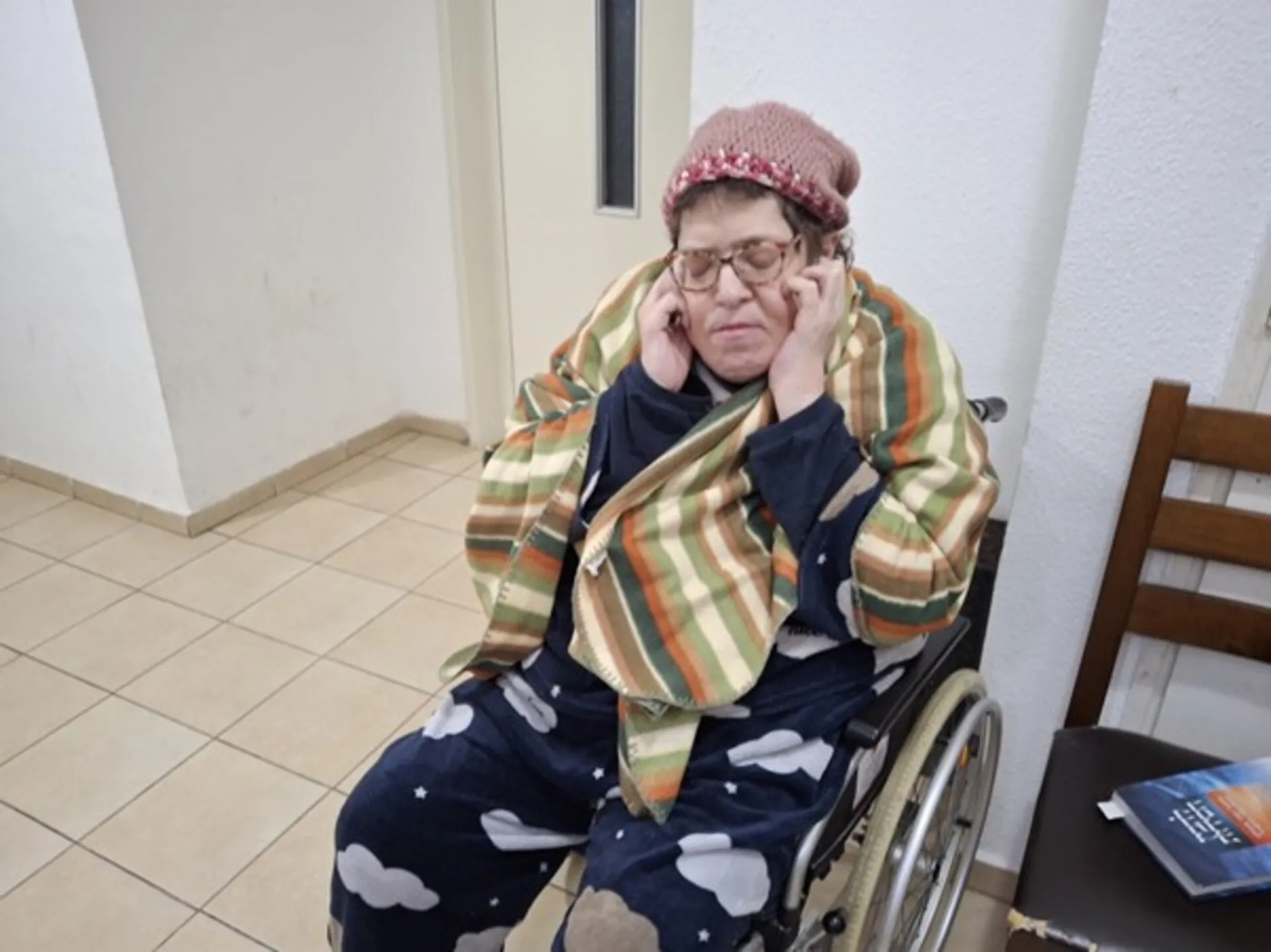
Tovit Lipkin covers her ears at her home in Petah Tikvah: “I can’t stand the booms.” Photo: Courtesy

Haim Rivlin
March 25, 2026

Summary


Listen to a Dynamic Summary of the Article
Created using NotebookLM AI tool
“When I get the warning alert, I use my walking frame to get to my wheelchair, I cover myself with a blanket to keep warm – and then I wait. Then, when the sirens are activated, I wheel myself out of my apartment and into the lobby, cover my ears with my hands and wait for the explosions. On two occasions a missile has fallen very close to where I live; both times I was shaking and crying. I’ve stopped counting how many alerts and how many impacts there have been near me. When I see my neighbors going down into the bomb shelter and I have to wait in the stairwell, it makes me sad. I want protection, too!”
This is how Tovit Lipkin describes her intense feelings of helplessness, which are compounded by post-trauma that makes it even harder for her to deal with the sirens. She is 55 years old and lives in Petah Tikvah, one of the most targeted cities in Israel. In the first 25 days of the war, there were 127 sirens in the city and a number of impact sites. She lives in an apartment building with a communal bomb shelter that residents use when the sirens sound. The problem, however, is that there is a flight of stairs from the lowest level that the elevator reaches and the life-saving bomb shelter – making it inaccessible to some residents.

Not far from there, Moshav Tirat Yehuda, located near Ben-Gurion International Airport, is home to Meirav Avitan, who lives in a building without a protected space. She is 52 years old, suffers from muscular dystrophy and relies on an electric wheelchair to get about. “Usually, it takes me about 10 minutes to get out of bed and into the wheelchair, so, when there’s a siren, there’s really no point in me getting up. All that’s left for me to do is pray to God and wait until the missiles stop,” she tells Shomrim. The nearest protected space to her apartment is in an adjacent building but, like in the case of Tovit Lipkin, there is a flight of stairs separating Avitan from the safe space. “The only accessible public shelter is nine minutes from my home by car. That means I wouldn’t even have time to get there once the siren sounds. I also can’t sleep there every night or spend any length of time there, because I need specially adapted bathroom facilities and a special bed.”
There are hundreds of thousands of Israelis who share similar experiences to those of Avitan and Lipkin; elderly people and people with disabilities who are unable to reach a protected space in a reasonable time. The tragic deaths of Yaron and Ilana Moshe – the elderly couple killed in Ramat Gan when an Iranian missile hit their apartment last week – put the issue back on the public agenda. That only lasted for a few sirens, however, before being overtaken by other war-related news. This is one of the things that fueled Avitan’s anger toward Israeli media outlets: “Every so often there’s an item, but there’s no public pressure. We feel that we are transparent, that no one cares about us; we’re simply being abandoned to our fate.”
Yaron Moshe relied on a walking frame to get about and was not very mobile. He was killed alongside his wife, Ilana, since they did not get to their protected room in time. “They were just a few steps away from the safe room and simply didn’t make it,” says Yuval Wagner, chairman and founder of Access Israel, an NGO that works to improve the quality of life of people with disabilities and the elderly. “We conducted a comprehensive survey last year, in conjunction with the American Jewish Joint Distribution Committee, which found that 42 percent of people with disabilities and the elderly live in homes without adequate protection from rockets or cannot reach a shelter in time. That’s 600,000 men and women. The government and the Knesset have known this figure for years but have done nothing whatsoever to create accessible shelters.”
.webp)
According to Wagner, no state agency has ever mapped out the needs of this population, specified who has physical problems that prevent them from reaching a shelter, who is mobile but suffers from hearing or sight problems and so on. This basic kind of analysis could have helped serve them better during emergency situations. The only tool available is a special database maintained by the National Insurance Institute and the Welfare Ministry called the “Kasefet Netzura” (Locked Safe), which is at the disposal of local authorities during emergencies and includes the list of benefit recipients. According to a report by the Knesset’s Research and Information Division, that database is limited in its usefulness, however, since it does not contain any information about the recipients’ medical condition or a description of the disability that prevents them from reaching a shelter.
When the war broke out, Wagner contacted the relevant government ministries and committees, proposing a plan of action to provide vital and immediate solutions to the problem, as well as medium- and long-term plans. He says that the plan includes solutions that are easy to implement, such as evacuating around 2,000 families from the firing line, along with long-term plans to make protected spaces more accessible, as part of urban renewal plans, as well as creating more accessible and reinforced hotel rooms.
He told Shomrim that no one even bothered to contact him. “The director-general of the Ministry of Welfare said in the Knesset last week that they don’t have a mandate to evacuate the population, apart from people who live in facilities run by the ministry. What are people without this kind of framework supposed to do? The Ministry for Social Equality has disappeared; we have no idea what it’s doing. It’s completely out of the loop.”
.webp)
‘If I were home, I would have been injured’
Wagner is a former fighter pilot who was injured and paralyzed in a training flight in 1987. During the current conflict, he has spoken about the massive gulf between the Air Force’s impressive capabilities to attack targets in the heart of Iran and the Home Front Command’s inability to provide protection to all citizens. “When it comes to waging war, the state is very well organized, but when it comes to preparing the home front, it has done nothing,” he says. “I have been writing to the Foreign Affairs and Defense Committee and the Welfare Committee for years. Years of letters and they did nothing – and now we find ourselves in dire straits. Many people are living with the fear of death; they are helpless, suffering from anxiety and trauma and there’s nothing they can do apart from pray.”
Prayers, it seems, would not have been of any use to Meirav Avitan – who is CEO of an organization that represents disabled academic lecturers – had she been at her home on Moshav Tirat Yehuda when a fragment from an Iranian cluster bomb landed nearby. Fortunately, she had somewhere else she could stay. A few days earlier, she had moved in with her parents in Lehavim, where there is an accessible bomb shelter. Her own house, she says, was severely damaged by shrapnel. “The windows were shattered, all the plaster came off and my possessions flew everywhere. If I had been home, there’s no question I would have been injured.”
“I am a strong person,” she says. “I’m optimistic and I won’t let this break me. But I am angry. The state has known for years that there are people who cannot protect themselves. During the previous war with Iran in June, the community coordinator on the moshav came to my house with representatives of the Home Front Command, who saw that I had no protected space – and just left. They didn’t come up with a solution. There are a lot of people in my situation who don’t have relatives and don’t have anyone to look out for them. I have no idea what is happening with these people. The state has had enough time to prepare for this – and didn’t.”
%20(1).webp)
“The only accessible public shelter is nine minutes from my home by car. That means I wouldn’t even have time to get there once the siren sounds. I also can’t sleep there every night or spend any length of time there, because I need specially adapted bathroom facilities and a special bed.”
.webp)
Wagner adds that, apart from the Ministry of Welfare which has opened overnight protected community centers and schools in 16 local authorities, the government has not organized anything at all. “Even the Ministry of Welfare program isn’t suitable for people who need special beds,” she adds.
Various accessibility NGOs are trying to fill the vacuum left by the state, using money donated by benefactors to run the Purple Vest Mission – so named since purple is the color used across the world in campaigns to promote awareness for the needs of people with disabilities. The Purple Vest Mission runs an operations center and a hotline; it reaches out to people with disabilities and tries to get them evacuated to hotels. “For people with severe disabilities and no social network, who are unable to cope alone, we try to find an accessible room in a hotel with a bomb shelter,” Wagner says. “Somebody donated two handicapped accessible vehicles with special wheelchair lifts and we have lots of volunteers. We are transporting the family to the hotel.”
%20(1)%20(1).webp)
“Even though we didn’t have the funds, we immediately provided a solution and raised money while we were doing it – but the demand is so high that we were forced to shut down after a few days because we ran out of money,”
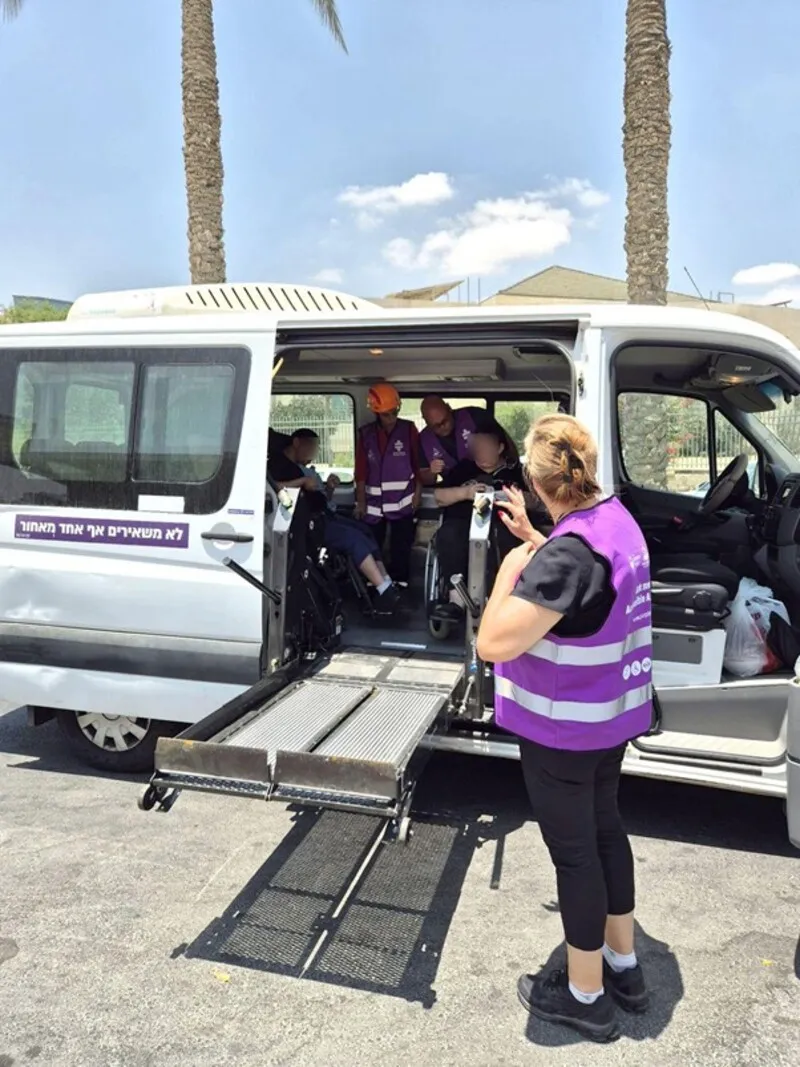
Wagner adds that the demand for reinforced hotel rooms far exceeds the supply. “On this front, too, we have been working for years with the Ministry of Tourism and the Hotel Association to advance a move – which is finally gaining traction – to ensure that hotels have 10 to 15 accessible rooms during normal times, and that in an emergency, many more people can be accommodated in a protected space.”
Wagner says that his NGO conducted a survey and found that there are around 2,000 accessible hotel rooms for people with disabilities in Israel, so that is the number of people he can evacuate from the firing line. “If, for whatever reason, the state does not want or cannot provide a solution for all of them, at least help Access Israel with funding for hotel rooms,” he says.
As already mentioned, all of the project’s activities during the war – including evacuations to hotels, the installation of safety equipment, making shelters accessible, requests for delivery assistance and providing support and training to local authorities – are done on a volunteer basis and funded by donations. “We do not get any assistance from the state. The whole operation is funded by donations from Jewish federations in the United States and from Israelis. Even though we didn’t have the funds, we immediately provided a solution and raised money while we were doing it – but the demand is so high that we were forced to shut down after a few days because we ran out of money,” he says.
Wagner points to another absurdity in the situation. The Purple Vest Mission was founded after the outbreak of the Russia-Ukraine war, when “the government of Ukraine turned to our tiny NGO, Access Israel, asking for help to train volunteers and emergency staff to help people with disabilities. Ukraine managed to get 4,000 families with disabilities out of the country and helped tens of thousands more who did not want to leave.” He adds that the Ukrainian government gave Access Israel $1 million for the project. Now, however, the Purple Vest Mission could close – because the government of Israel won’t fund it.
Responses:
The Ministry of Welfare and Social Affairs stated:
"Since the beginning of the war, the Ministry of Welfare and Social Affairs has been working to assist people with disabilities and their families, who receive services from the ministry, in coping with this complex period. Already on the first day of the war, the ministry acted to evacuate people with disabilities from welfare facilities in frontline areas, in accordance with a pre-established emergency plan coordinated with the Home Front Command.
"About two weeks ago, the ministry issued a call to local authorities to convert protected spaces into overnight accommodation facilities, fully funded by the Ministry of Welfare. This community-based solution makes use of protected facilities belonging to l5 local aut ocal authorities and the ministry, such as community centers and schools, to provide safe overnight lodging for people with disabilities and senior citizens, accompanied by professional care staff. So far, such facilities have been opened in 1horities, including Tel Aviv, Ramat Gan, Be’er Sheva and Dimona, with additional municipalities in the process of opening similar facilities. At the same time, and in accordance with guidance from welfare officials on the ground, the ministry is facilitating the relocation of people with disabilities living in the community to respite facilities within protected welfare frameworks. These settings provide participants with recreational activities, emotional support and includes personal assistance of one additional person.
"In addition, daily care frameworks for people with disabilities continue to operate in accordance with Home Front Command guidelines, allowing individuals to remain in protected environments with staff support until the evening hours and ensuring continuous care. Approximately 75% of these facilities have remained operational throughout this period."
The Ministry for Social Equality and the Advancement of Women stated:
"With the outbreak of hostilities and the transition to a state of emergency, the ministry significantly expanded its assistance framework to address the unique needs of senior citizens in light of the security situation. As part of its emergency preparedness, the ministry operates a hotline available 24 hours a day, seven days a week, serving to coordinate between senior citizens and local authorities, the Home Front Command, the Israel Police, NGOs and volunteer organizations.
"To date, the hotline has handled thousands of inquiries on a wide range of issues, including the delivery of pre-purchased food and medications, minor repairs to safe rooms, alleviating loneliness, strengthening mental resilience, and assistance in accessing rights. In parallel, the ministry has sent approximately 1.5 million SMS messages to senior citizens across the country to provide information about available assistance and ensure that every senior citizen knows where to turn when needed.
"Hotline representatives have also held Zoom sessions with more than 1,000 senior citizens to provide information about their rights, as well as in-person meetings with evacuees staying in hotels. In recent days, the hotline has begun making proactive calls to senior citizens living within 0–3 kilometers of the northern border in order to identify needs in advance."