



The Risks and Challenges of Being Hospitalized Deep Underground During Wartime
Weeks without daylight, serious concerns over a measles outbreak, not enough toilets, organ transplant recipients and oncology patients exposed to infections and medical teams stretched to the limit. The Israeli health system is doing the best it can while Iranian missiles rain down, but the underground parking lots – which have been turned into hospital wards – are taking a heavy toll on the patients. The longer the war goes on, the worse the situation gets. A special Shomrim report, also published on Ynet
Weeks without daylight, serious concerns over a measles outbreak, not enough toilets, organ transplant recipients and oncology patients exposed to infections and medical teams stretched to the limit. The Israeli health system is doing the best it can while Iranian missiles rain down, but the underground parking lots – which have been turned into hospital wards – are taking a heavy toll on the patients. The longer the war goes on, the worse the situation gets. A special Shomrim report, also published on Ynet
Weeks without daylight, serious concerns over a measles outbreak, not enough toilets, organ transplant recipients and oncology patients exposed to infections and medical teams stretched to the limit. The Israeli health system is doing the best it can while Iranian missiles rain down, but the underground parking lots – which have been turned into hospital wards – are taking a heavy toll on the patients. The longer the war goes on, the worse the situation gets. A special Shomrim report, also published on Ynet
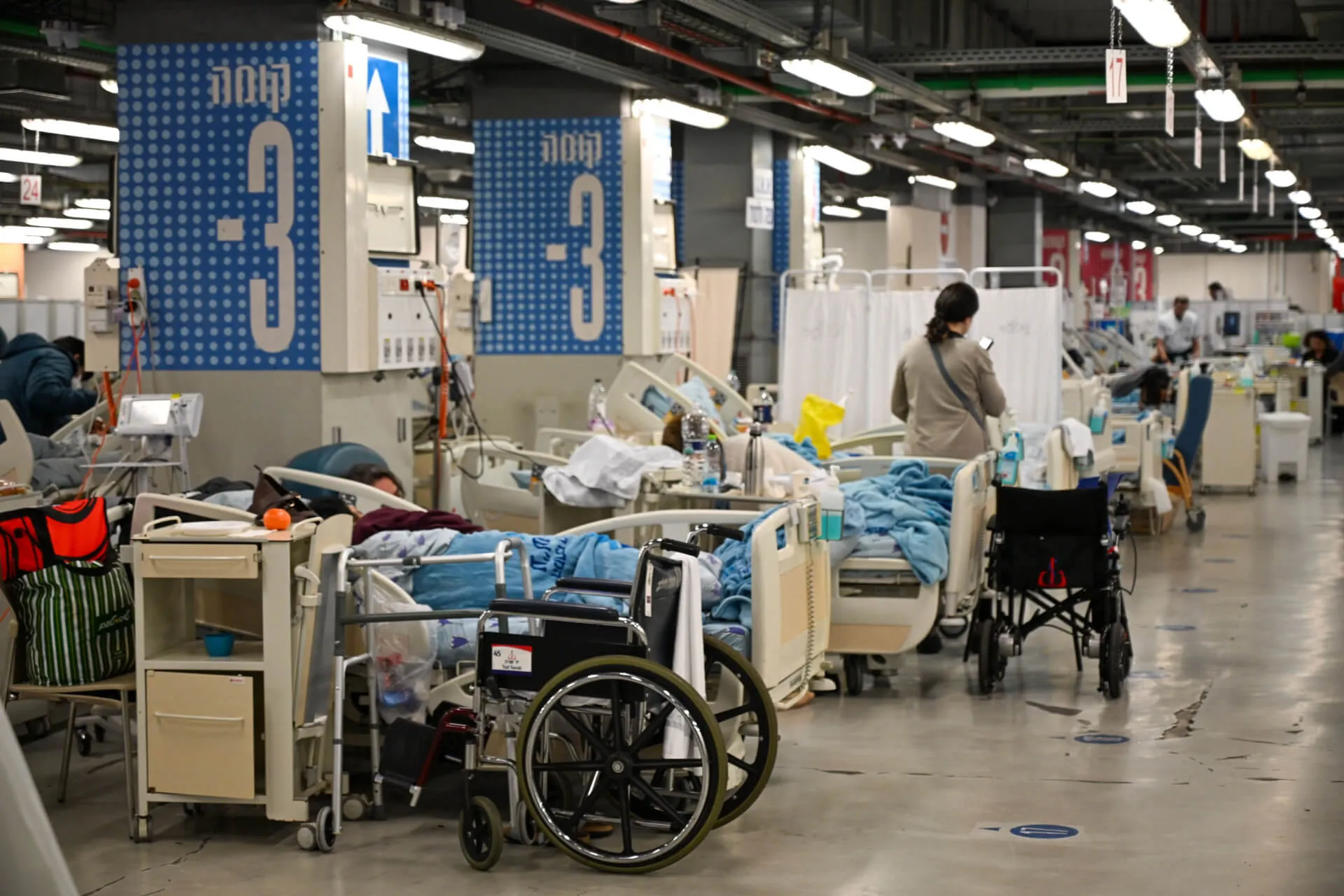
Hospital beds in the underground parking lot at Ichilov Hospital. Subjects not related to the story. Photo: Reuters

Chen Shalita
March 26, 2026

Summary


Listen to a Dynamic Summary of the Article
Created using NotebookLM AI tool
The underground car parks that were converted into hospital wards looked amazing when the television cameras came to document preparations for the war. While hospital administrators are rightly proud of the logistical success, the grinding daily routine, so visible in the eyes of patients and medical teams alike, is far more complex. Prof. Ido Wolf, head of the Oncology Division at Tel Aviv’s Ichilov Hospital, took to social media in March, writing “The phrase ‘war in deluxe conditions’ is disconnected and obtuse. Go to Internal Medicine A, Floor -4, bed 26, and tell that to the elderly person lying there, exposed to infections, in substandard conditions, without dignity. And tell that to the doctor who, three times a night, runs with her young children to the shelter, but still comes to work every morning at seven. With tears in her eyes, but she comes.”
Indeed, the fact that beds have been crammed so densely together – in some sections even with no curtain between them – has increased the incidence of healthcare-associated infections and antibiotic-resistant bacteria. Patient privacy is all but nonexistent and elderly patients often found themselves having their diapers changed in full view of passersby. Even patients who were fully functional often wore diapers because, as the mother of one patient told Shomrim, “on our floor there are only five toilets and two showers. Just think how many people they are supposed to serve.” Added to this are the incessant noise and life without natural daylight, which can lead to confusion and losing all sense of time. Beyond all this, there is the concern over a mass outbreak of infections and diseases – mainly measles, which is airborne – since it could take several days in the parking lot for patients to be diagnosed.
“None of the hospital administrators will give you data about the increase in the number of infections during the war,” says one senior physician from a hospital in the center of the country. “Partly because the documentation isn’t ready yet, but also because no one wants to be seen as a hospital where people get infections – despite the fact that they all have the same problem. The Ministry of Health is aware of the problem and, after the Twelve-Day War in June, issued instructions on how to deal with infections. But it’s hard to implement them when everything is very crowded.”
How crowded is it?
“You know that friction with other cars, when your vehicle is stuck in the back row of a parking lot? That is exactly what it is like now with the beds placed in the parking spaces. Apart from the lack of privacy, simply touching the curtains between the beds can lead to infection. And even if you’re very conscientious about washing your hands, there isn’t a sink next to every patient like there is on the wards. The floor in the parking lot is not the kind that can be cleaned properly and, before the war, there were bats and pigeons living in the ceiling. These are not conditions that a Western hospital in 2026 can accept. These are conditions you’d expect to find in a hospital during World War One.”
If you were to ask AI, it would tell you beyond a shadow of a doubt that the chances of a child with a weak immune system being hit by an Iranian ballistic missile are a lot lower than the chances that the child will catch an infection – but it’s hard to explain that to a parent whose child is undergoing chemotherapy."
How does this impact the infections?
“Our daily monitoring reveals more frequent outbreaks of antibiotic-resistant bacteria than normal. In one hospital, five staff members who had been vaccinated contracted measles, which could have spread like wildfire because even people who have been vaccinated have a five percent chance of being unable to produce the antibodies. Not to mention people who have received organ transplants and have suppressed immune systems, who were also taken down to the parking lots.”
Has it led to any fatalities?
“Not yet, but we are very concerned, because we cannot provide the conditions for people who, under normal circumstances, we would not even consider keeping in a corridor. We would hospitalize them in single rooms. The parking lot is like one massive corridor.”


Concern over infections and outbreaks of disease |
‘This war is being waged during the largest outbreak of measles Israel has ever seen’
The longer the war goes on, the greater the concern. A young boy hospitalized at Sheba Medical Center’s Oncology Department – which was relocated to the underground parking lot – was discovered to have measles only four days after he was admitted, when he broke out in a rash. “The hospital executed the preventative plan admirably,” says one physician who was involved in the process. “The Ministry of Health and the hospital investigated and a lot of people were given preventative care that has a success rate of between 80 and 100 percent. In the meantime, there has been no spread.”
Would it not be better for most of the children being treated in the Oncology Department to remain above ground and for their parents to take them to a protected area when the siren sounds?
“The longer the war goes on, the more you wonder what’s better. If you were to ask AI, it would tell you beyond a shadow of a doubt that the chances of a child with a weak immune system being hit by an Iranian ballistic missile are a lot lower than the chances that the child will be infected – but it’s hard to explain that to a parent whose child is undergoing chemotherapy. Parents will always choose the safety of the underground parking lot, even though that’s not the statistically rational choice.”

Another physician, from a hospital which primarily serves the ultra-Orthodox community, adds: “People get infected in public shelters and then come here. Even in normal times, all it takes is for a large air filtration system to spread measles – even more so when you’ve got a large space with hundreds of patients. At our hospital, some of the organ transplant patients are underground, as is the respiratory rehabilitation department – which represents a major risk for these two groups in particular. The medical team is extremely cautious when it comes to hygiene, but the high levels of exhaustion and the crazy nights at home with the kids and the sirens can lead to mishaps.”
Prof. Tal Brosh, head of the Infectious Disease Unit at Assuta Hospital in Ashdod, is a relatively new employee and his department is located entirely in a missile-proof area. Nonetheless, he is well aware of the dilemmas. “The priorities of the department obligate hospitals to make compromises when it comes to preventing infections. Patients who, under normal circumstances, would be in isolation – like patients with antibiotic-resistant bacteria – are still being isolated but the conditions are not as good. They are kept in a particular section of the underground wards, with curtains surrounding them, and the staff will do everything it can to minimize the risks – but it's not the same as keeping them in specially designed rooms in specific departments.”
What is the biggest challenge in terms of healthcare-associated infections and the war?
“Dealing with airborne diseases like measles and tuberculosis. This war is being waged during the largest outbreak of measles Israel has ever seen. And it’s a real problem when a children’s ward has to go underground, because if we discover a single child with measles, then there is a high chance that the infants who have not reached the age for a measles vaccine, which is 12 months, and those children whose parents refuse to vaccinate them, will get infected.”
“None of the hospital administrators will give you data about the increase in the number of infections during the war. Partly because the documentation isn’t ready yet, but also because no one wants to be seen as a hospital where people get infections – despite the fact that they all have the same problem."
What do you do in normal circumstances?
“A lot of hospitals have airborne infection isolation rooms, which help prevent the spread of these diseases. Here at Assuta Hospital in Ashdod, those rooms are reinforced, but for many other hospitals this is not the case. Sometimes, the solution is to move the patients to a different hospital, which can treat them safely. The longer the war goes on, the greater the chances of encountering such cross-infections.”
The Ministry of Health is aware of the complexity of the situation. “Every morning at 7:30 we have a discussion about the issue of infectious diseases in the underground parking lots,” says one senior ministry official. “We analyze the findings from tours we conducted of the hospitals the previous day, we examine how patients are categorized at each hospital and we send the hospitals a report with recommendations tailored for each hospital. The situation is far from ideal, and we are continuing to work on solutions such as reinforced spaces for certain kinds of patients.”
Noise, crowded conditions and no privacy |
‘It reminded my father of the days when he evacuated wounded soldiers to field hospitals during the Yom Kippur War’
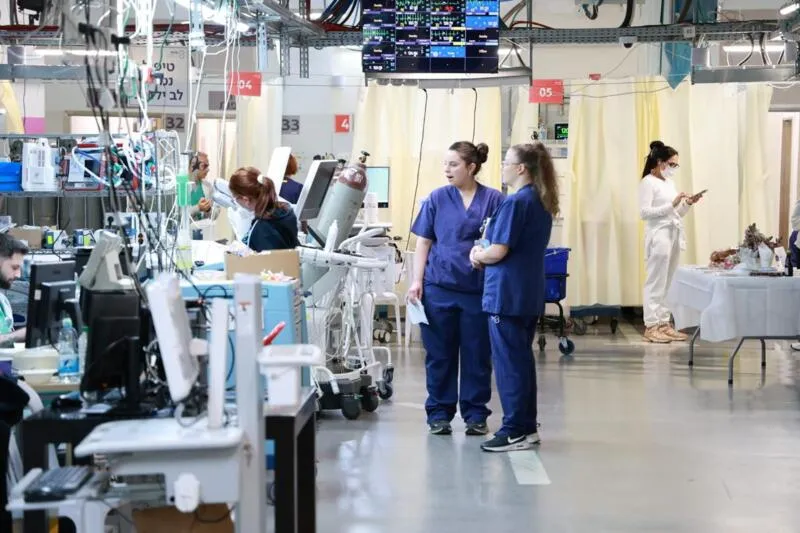
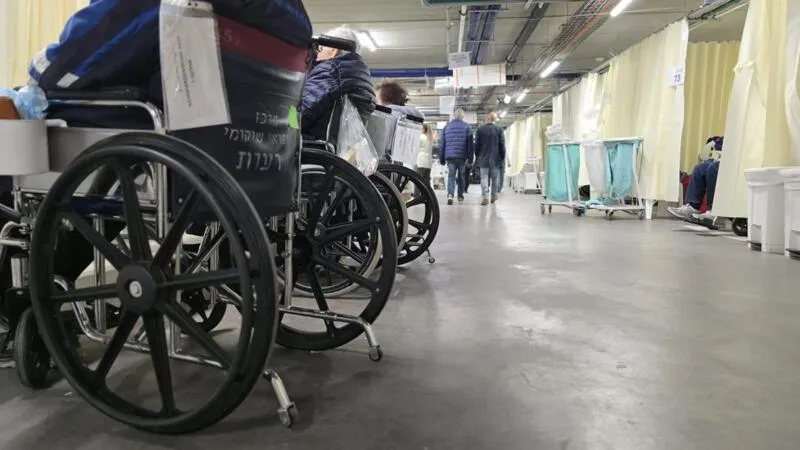
The crowded conditions and the lack of privacy create highly challenging conditions. Under normal circumstances, the bodies of deceased patients are taken from the hospital via the service elevator and, in any case, most of the other patients in the room cannot see what is happening behind the curtains. When the whole department has been relocated underground, however, staff have no choice but to carry out bodies between rows upon rows of beds. Families also find themselves saying their goodbyes to loved ones in crowded, makeshift departments.
This apocalyptic atmosphere is summed up well by H., a young woman who underwent surgery at Ichilov Hospital. “When they wheeled my bed from the recovery room to the parking lot, I didn’t really understand what was going on,” she tells Shomrim. “But I could see the expression on my father’s face as he walked alongside me. It reminded my father of the days when he evacuated wounded soldiers to field hospitals during the Yom Kippur War – a massive room with a lot of beds and everyone shouting. It’s a traumatic experience for everyone – patients and visitors alike – even though the staff were dedicated and did all they could. They really are doing holy work.”
So why was there shouting and what was so traumatic?
“Because you can’t push a button to call a nurse. In the parking lot, there’s no other option but to shout for attention. There were a lot of surreal moments. For example, there was a daily announcement saying what day it is and what time it is, because there are no windows and you’re living under fluorescent lighting which dim slightly between 11 P.M. and 7 A.M. You completely lose your sense of time.”
And your privacy.
“The lovely dividers that they designed at the Shenkar College of Engineering, Design and Art give you some privacy from the beds either side of you, but you are totally exposed to the bed opposite you, because that part remains uncovered. When the doctors came to examine me, they brought a divider that shielded me from the patient opposite. If they didn’t have a divider, two interns would stand holding a sheet. They really tried their best, but I still got glimpses of my neighbor’s behind every so often and I could still hear the conversations that were taking place around me.”
How do visitors respond?
“Let’s start with the fact that, when visitors arrive, they give the ID number of the patients and are told where to find them according to the color and number of the parking spot – which is pretty amusing. The visits themselves are short, because people are in a hurry to leave. Some patients do their business in pots that they keep next to their beds, because there is a limited number of toilets and not everyone can wait. It’s not like in the department, where there is a toilet in every room.”
Patients from every hospital face similar problems. Some of them are fully functional people who are forced to use a diaper during their underground hospitalization due to postoperative mobility difficulties. Older patients, often less able to object, face an additional difficulty. “Everyone sees when they have their diapers changed, because the beds are packed in like sardines,” says the daughter of one elderly patient. “It’s heartbreaking to see my mother like this. This whole situation has led to a massive cognitive decline.”
.webp)
“I need help getting to the bathroom, which is on a different floor,” says one non-ambulatory patient in the underground parking lot at Sheba. “There are only two elevators that go from the seventh basement level to the ground floor, and they are always extremely busy. Sometimes, you can wait up to 10 minutes for an elevator with space – and that’s after waiting for auxiliary staff to come and get me, having shouted out across the parking lot that I need the toilet.”
The hospital staff are not trying to hide any of these problems. “It’s true that it takes time to get up and down and I am not jealous of anyone who doesn’t get to see sunlight for days and weeks on end,” says one doctor who works in an underground department every day. “Unfortunately, we cannot take the risk of taking them upstairs to breathe fresh air even for a minute. After all, how would we get them back down – with their beds and all their equipment – if there were to be a siren? The people who remain in hospital during a war are people who are too sick to be sent home as outpatients. They are not in a good way. We are doing everything we can for them in impossible conditions, but their privacy has been undermined. On the other hand, I encounter people who are perfectly happy in the parking lot. They feel safer and don’t need to worry whether they will make it to the bomb shelter in time. There are also visitors who prefer to remain here because they don’t have easy access to a shelter at home and here they are not only protected, they are helping the patients.”
“It’s heartbreaking to see my mother like this. This whole situation has led to a massive cognitive decline.” says the daughter of one elderly patient.

Long-term hospitalization in an underground department has additional costs. “The acoustics are terrible and there is constant noise,” says one patient. “At night, I sleep with earplugs and an eye mask, otherwise I wouldn’t be able to sleep. During the day, you are simply exposed to incessant noise, staff briefings, visitors coming to see your neighbors and the constant beeping of medical equipment.”
Prof. Nadav Davidovitch, an epidemiologist and public health expert who serves as head of the Health Policy Program at the Taub Center for Social Policy Studies in Israel, spent the war visiting hospitals across the country. The Israel National Institute for Health Policy and Health Services Research recently issued a call for research into the effects of relocating patients to protected spaces during wartime – and Davidovitch is among the experts who took on the challenge. He believes that noise “is a type of pollution that is not talked about enough. It affects the stress hormones, sleep and the patients’ levels of anxiety and depression. And it also affects medical staff. Combined with a lack of daylight, the biological clock and the mood are certainly impacted. Even during normal circumstances, there is a lot of beeping on a hospital ward, but the exposed concrete of the parking lot amplifies them. There are solutions to this problem – such as mobile acoustic paneling or silent alerts for staff using vibrating bracelets or phone alerts. It’s not being implemented here enough – and that’s a shame.”
Procedures without anesthetic, recovery without protected spaces |
‘The dilemmas will only get sharper the longer the war goes on, because we won’t be able to postpone procedures for non-ambulatory patients any longer’
“Israeli hospitals prepared for missile attacks by Hamas and Hezbollah,” one senior Ministry of Health official says. “The massive missiles from Iran – especially after Soroka Hospital was so badly hit during the Twelve-Day War last June – and the new Home Front Command demands for protected spaces have reduced spaces where hospitals had previously provided treatment during wartime, forcing us to conduct a new risk assessment.”
.webp)
It may be hard to believe but, during that Twelve-Day War, there were discussions about what doctors should do if a siren sounds during an operation in a surgery room that is not fortified. Should the team remain by the anesthetized patient’s side or should they find a protected space – assuming that the surgery is at a stage which permits them to do so. Patients on ventilators, whom it took several days to successfully move down to the parking lots with all their accompanying equipment, raised a similar dilemma.
In the end, the instruction was to remain by the patient’s side but, when Shomrim asked how it is even possible to consider the option of leaving an unconscious patient alone, one department head said: “It’s like the emergency instructions on a plane. Parents are told to put their own oxygen masks on because they are trying to help others.”
But the medical team relocates to a different area. There is no continued treatment.
“So, what good does it do if the medical team is killed along with the patient? True, it does create a very tough ethical dilemma for us. In most of the cases I am aware of, the team stayed with the patient.”
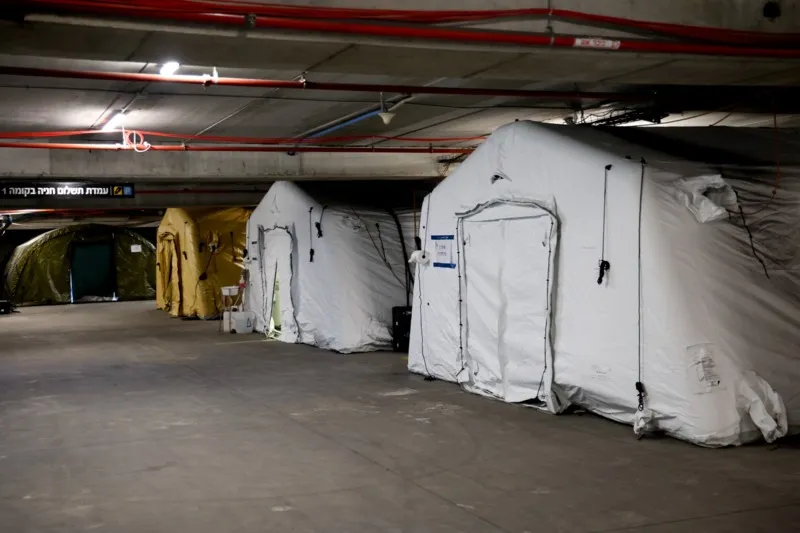
One source in the Ministry of Health told Shomrim: “We learned the lessons from previous campaigns and the instructions now ensure that no long procedures that entail anesthesia or sedation will be carried out in non-reinforced areas. The solution that we found was for private hospitals that were not active due to the war to allow public hospitals to make use of their dormant reinforced operating rooms. The medical team arrives there with the patients and, when the operation is over, they return to their original hospital. There will be no more war-time surgeries in operating rooms that have not been reinforced – other than in emergency situations.”
Although private hospitals do provide reinforced operating rooms, the same cannot be said for recovery rooms. According to the relative of one patient, “the catheterization was conducted in a protected space, but two minutes after it was over and the patient was in the recovery room – there was a siren and he was forced to run to a bomb shelter with the infusion still in his arm.”
A source in the Ministry of Health told Shomrim: “We learned the lessons from previous campaigns and the instructions now ensure that no long procedures that entail anesthesia or sedation will be carried out in non-reinforced areas."
Sheba Medical Center is currently offering colonoscopies – a procedure that usually takes place in a non-reinforced space – without sedation, so that people can get up mid-exam and run to a bomb shelter if the sirens sound. The goal is to reduce the backlog of hundreds of such procedures that have built up because of the war and, of course, to continue to identify problems in a timely manner. The main conflict, however, centers around imaging, especially MRIs. The head of the radiology department at Meir Medical Center, Dr. Rotem Sivan, in response to a question on Instagram, said that “more than half of the imaging machines in Israel are not reinforced so, when we put a patient inside an MRI machine we have no way of fully protecting them. All we can do is hope that we get the five-minute warning before the missile alerts go off, so that we can get the patient out of the machine and run with them to the shelter. Everything else is down to luck.”
Speaking to Shomrim, Sivan adds that, “there was a lively discussion just last week on a WhatsApp group for the directors of radiology departments in Israel about whether we should resume our use of non-reinforced spaces. During the first week of the war, it wasn’t worth risking people’s lives, so we only dealt with life-and-death cases, and, when we were asked to carry out tests, the first question we asked was whether the patient was ambulatory. But, as time has gone on, most of the department directors are finding it harder to postpone tests and treatments for oncology patients. In many cases, people have waited months for their MRI appointments. When the patient is ambulatory, it’s possible to get them out of the machine quickly, but not all patients are.”
In one of the responses to your Instagram post, someone wrote that the medical staff left her mother in the machine and went to the bomb shelter.
“And we will only face more and more such dilemmas the longer the war goes on, because we will no longer be able to postpone treatment for non-ambulatory patients.”
Why is a piece of equipment as expensive as an MRI machine stored in a non-reinforced space to begin with?
“That’s a very legitimate question and it is part of the problem that hospitals face when it comes to non-reinforced spaces. The State Comptroller warned, in a report published in January, that there is a problem with reinforced spaces in Israeli hospitals. In the report, he cites all of the previous reports that warned about exactly this problem. Hospital administrators improve as much as they can, but, in the end, they need funding.”
Senior Ministry of Health officials respond: “It is unfortunate that a patient was left in an MRI machine. We do not expect medical staff to behave in this way. The instructions are clear and only allow for procedures in non-reinforced spaces if the staff is able to halt the procedure midway through and safely get the patient to a reinforced space. Hospitals and HMOs conduct simulations to ascertain whether they are able to do so.”
%20(1).webp)
The gap between Ichilov and Sheba – and all the rest |
‘Not everyone has a high-quality air filtration system and it can get very cold in some of the underground departments’
Despite the agreement with several private hospitals, elective procedures at the country’s public hospitals have been dramatically reduced and as many patients have been released as possible. “The war gave a massive push to home hospitalization – which is a welcome trend,” according to Prof. Davidovitch. “But even when the patient’s condition allows for it, not every family can deal with home hospitalization in terms of the emotional and financial resources it demands.”
Prof. Wolf, head of oncology at Ichilov, has this to say about war-time surgery at his hospital: “There is a committee of surgeons which meets every day, headed by the deputy director of the hospital, to decide which operation will be conducted the next day, what is urgent and what is not. Oncology operations continue and our rapid diagnosis unit is actually seeing more patients than usual since the war means that no one is traveling overseas for conferences and no one is on vacation. Everyone is here.”
How do oncology patients deal with hospitalization in an underground parking lot? I understand that you are in a better state than internal medicine departments, but are you not worried about infections?
“We have a very nice corner of the parking lot with curtains surrounding every patient’s bed. It’s only a piece of cloth, but it makes a huge difference compared to the situation in the first few hours, before we put them up.
“I am not worried about infections. The air circulation is good. The hematology department is in the protected space above us. We did not bring people with compromised immune systems down to the parking lot. Both we and the internal medicine departments have reduced our patient quotas, so while we are treating fewer people, we are working very efficiently and with a great deal of advance planning. The goal is to create high turnover and manage as many potential patients as possible. Right now, you won’t hear us telling patients, ‘Stay on the ward for another night – just to be safe.’ People also prefer to transition to home hospitalization and come in only when necessary. We are trying to look after the staff as much as possible and we are mentally prepared for several weeks ahead.”
One senior physician from a smaller hospital is jealous of Wolf’s optimism. “You can’t compare Ichilov and Sheba to the rest of the hospitals in the country, which do not have their resources and space. Not everyone has a high-quality air filtration system, and in some of the underground areas, it gets very cold. It is not easy to heat an underground parking garage and many patients complain about the cold. Despite all this, the hospitals are doing unbelievable things given the conditions. One could say that, considering the circumstances, what is happening here is amazing.”