


The War Routine: How Israelis Normalize the Abnormal
Between running to the bomb shelters and debating which missile is better, Israeli society is learning to find methods within a mad reality – through rationalization, repression and a search for control. While resilience metrics remain high, tension, attrition and deep gaps are building up beneath the surface – reshaping not only the psyche but also public and political conduct. Who benefits from this?
Between running to the bomb shelters and debating which missile is better, Israeli society is learning to find methods within a mad reality – through rationalization, repression and a search for control. While resilience metrics remain high, tension, attrition and deep gaps are building up beneath the surface – reshaping not only the psyche but also public and political conduct. Who benefits from this?
Between running to the bomb shelters and debating which missile is better, Israeli society is learning to find methods within a mad reality – through rationalization, repression and a search for control. While resilience metrics remain high, tension, attrition and deep gaps are building up beneath the surface – reshaping not only the psyche but also public and political conduct. Who benefits from this?
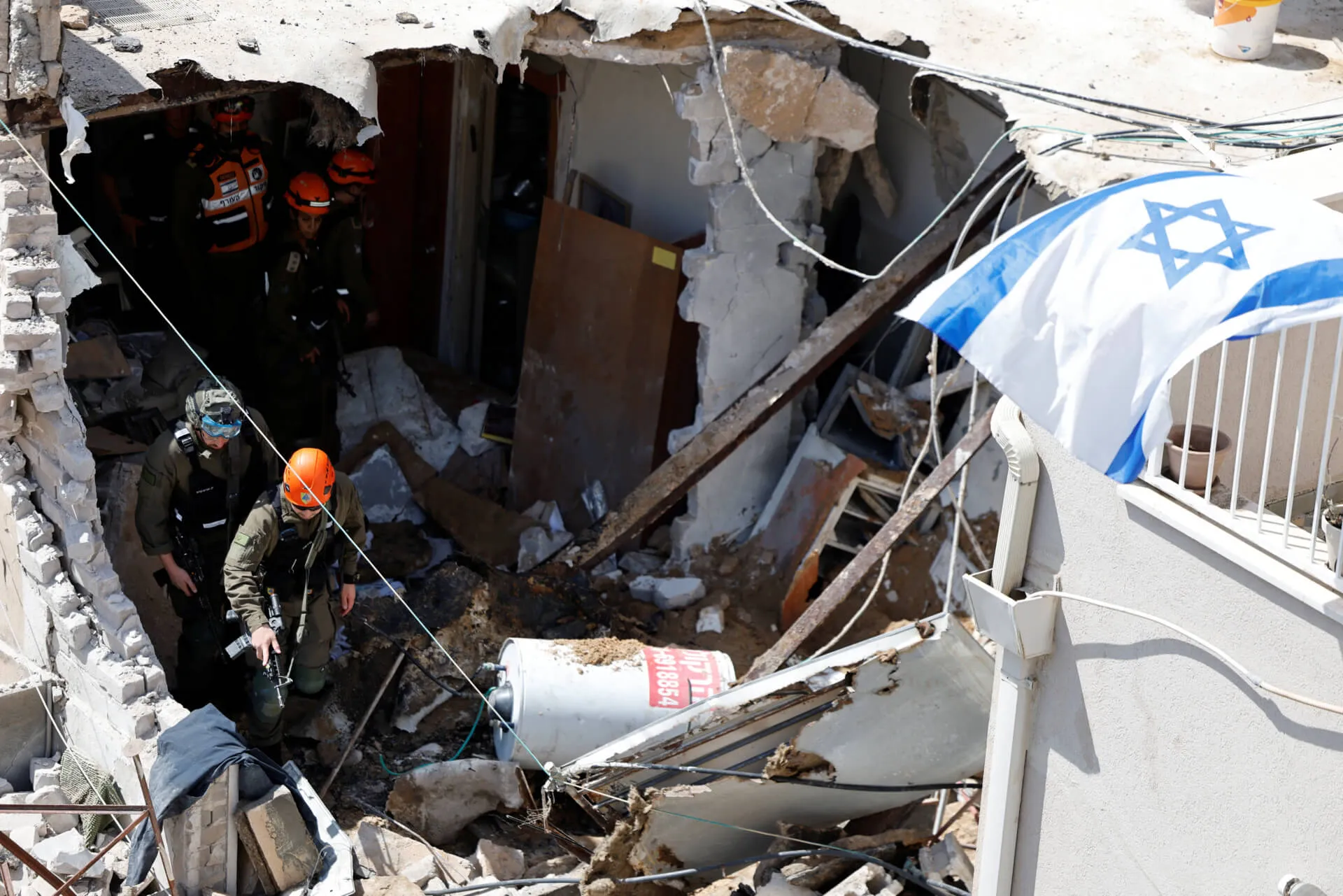
A missile impact site in Tel Aviv, this week. Photo: Reuters

Chen Shalita
March 25, 2026

Summary


Listen to a Dynamic Summary of the Article
Created using NotebookLM AI tool
Ever since October 7, Israelis have been living with the routine of war. Does anyone even remember that, until Operation Protective Edge in 2014, it was considered rare for missiles to be fired at Tel Aviv? Or that the Likud’s 1984 election campaign focused on the fact that residents of Kiryat Shmona were forced to run every day to their bomb shelters to flee incoming missiles from Lebanon. “People ask me whether we will also have to live by the sword,” Prime Minister Benjamin Netanyahu was quoted as saying more than a decade ago. When he answered this question in the affirmative, there was outrage in the media. Since then, the Israeli public has become accustomed to living like a frog in a pot of water who doesn’t realize that the temperature is slowly being raised.
“When you have people discussing what’s better – a missile with a 500-kilogram payload or a missile with cluster munitions – that’s excellent proof that Israelis have normalized the insane situation they find themselves in,” says Prof. Moran Bodas, director of the department of Emergency and Disaster Management at Tel Aviv University. “They are looking for some method in the madness. Israelis developed what is known as the Victimization Model.”
Bodas goes on to explain: “People who are frequently and continuously exposed to a threat no longer think ‘What’s happening here is very serious and could happen to me, too, so I’d better do something about it.’ Instead, they develop a sense that they know best how to act, even if it goes against the instructions. That’s why you’ll see people refusing to enter the protected spaces, who will remain in the street filming missile interceptions. Or people who leave the bomb shelter whenever their logic tells them it’s safe to do so.”

Is that because they want to impose some kind of control on the situation – or is it an act of rebellion against the authorities who keep them running to the bomb shelter?
“A little bit of both. People need rationalization. In the reality in which we are currently living, there is everything apart from logic. Take the rescue flights, for example, which are bringing people back into a war zone and not away from one. That’s part of the psychosis. One of the ways that people maintain their sanity is to create a logic that works for them. The Victimization Model divides people into two main groups. Those whose mental resilience is greater, are able to adapt or become less sensitive. They process the situation and tell themselves: ‘It’ll be okay. I don’t have the strength to worry, so I’ll do the best that I can and whatever happens – happens.’ These are the people who stay and who cope. In contrast, people with less mental resilience – people who become tense or anxious at the very mention of the war – look for ways to locate themselves in areas where the war is less felt, in order to reduce their exposure to the threat.”

Even people who distance themselves from a war zone are forced to come back, though – whether that’s for work or because it’s expensive and/or inconvenient not to live at home.
“It’s similar to the normalization of terrorism that happened here during the first and second intifadas. Buses were blown up and dozens were killed or injured – and yet there was no drop in the use of public transport and people didn’t stop going to cafes. Instead, a doctrine developed whereby everyone got back to routine as quickly as possible: clean up the blood and, just like that, it’s like nothing happened. If somebody senses that they are in existential danger and they can’t live with it, they won’t ride the bus no matter what. Even the stock exchange did not react to these incidents during the second intifada.”
Does the government like this normalization?
“It’s complicated. A government needs credit from the public in order to run the war. If there is a mass-casualty event, the credit that the public gives the government will be depleted – so authorities need the public to obey instructions and not to become complacent because they have normalized the situation. It usually does so with a patronizing and condescending attitude, which is why it creates frustration for many people.”
What price are we paying by living with so much stress?
“People can’t live feeling like every step they take – like driving a car – could be their last. It’s just too much. In a war, those thoughts of death tend to bubble up from the subconscious to the surface more often, like when a siren goes off while you’re out and you have to scramble for cover. But as soon as it’s over, you just stop thinking about it.”
And is this back-and-forth exactly what we’re seeing in Israeli society right now?
“People are repeatedly entering and exiting a state of heightened awareness of death. It isn’t normal, and for some, it could lead to psychopathology long after the war ends because they lived under sustained tension. If this stress isn’t addressed, it can develop into post-traumatic stress disorder or other mental health conditions. For others, it also manifests as physiological illnesses – heart attacks, strokes, inflammatory bowel diseases and the worsening of existing conditions.”
How do you explain the phenomenon whereby Israelis residing overseas are also experiencing increased stress levels?
“They are experiencing a kind of FOMO – fear of missing out – because, as far as they are concerned, ‘If I am not there and not experiencing it, I am in the wrong place because I am not part of the collective.’ One of the defense mechanisms that we use to ward off the terror of death is belonging to a collective. Israelis overseas do not have that belonging, so they develop the terror of death. In Israel, people tend to downplay this – which is wrong.”

"In the reality in which we are currently living, there is everything apart from logic. Take the rescue flights, for example, which are bringing people back into a war zone and not away from one."
Supporters of the government suffer less
“Israeli society has undergone a massive change under Netanyahu,” says psychologist Prof. Shaul Kimhi, head of the Resilience and Stress Research Center at Tel-Hai College. In addition to being an internationally renowned expert in resilience, Kimhi also published a detailed psychological profile of Netanyahu back in 1999 and has been updating it periodically ever since.
“Supporters of Benjamin Netanyahu have cult-like characteristics, so many of the questions you’re asking are irrelevant for them. Even if they were to turn up on Election Day after months of running to the bomb shelter and a war that drags on and on, they will say: ‘How lucky we are that Netanyahu is prime minister during this period. God help us if someone else had been at the helm. Only Bibi can save us’.”
Researchers are also attempting to support these claims through studies that measure resilience against support for the government. Prof. Kimhi and Prof. Bruria Adini, the head of the Department of Emergency Management and Disaster Medicine at Tel Aviv University, are part of a team that has been conducting surveys to examine public resilience metrics since October 7, in line with the developments of the war. Rather than ask respondents who they voted for in the last election, researchers asked whether they support the government, oppose it or are neutral. “In every metric – coping, resilience, morale, hope, despair and stress symptoms – government supporters, who make up about 30 percent of the sample, are in a more positive place and experience much less distress than government opponents,” Kimhi says. “The result has repeated itself since October 7.”
That leaves 70 percent who are not happy with the situation.
“When people are under threat – even when they are frustrated – they tend to behave like disciplined subjects. Netanyahu is always buying time. He successfully sold us the idea that total victory [in Gaza] is just a moment away – and now he’s trying to make similar promises.”
According to Prof. Adini, “the national and personal level of resilience is currently high. In fact, if you look at the figures themselves – with the context of the war removed – you’d think that everything was rosy here.”
“Based on past experience from previous wars, I suspect that in another month or two we will see more disillusionment and a decline in positive resilience metrics"

You make it sound like a positive thing – but it’s insane to live that way.
“I agree. No nation is meant to live for a prolonged period of time with such a constant threat of danger and with such a high level of uncertainty. But, after two and a half years of war, we have become accustomed to the emergency situation. People are less afraid and tell themselves that there’s little chance they will be hurt.”
Even now, people believe that this will lead to a better future, to a new Middle East.
“Based on past experience from previous wars, I suspect that in another month or two we will see more disillusionment and a decline in positive resilience metrics. When the threat is critical, there is a rallying around the flag – and most of the public is still there. However, opponents of the government are much more troubled by political polarization and violence in Israeli society than by the Iranian threat. In most cases, those who defined themselves as neutral are similar to opponents in their attitudes toward the war and questions of resilience. It will be interesting to see where this leads next. Right now, we are still normalizing the abnormal, which has become our new routine.”