



How a Private Nonprofit is Operating as an Israeli Military Unit
A Shomrim investigation: Yatar, a private nonprofit that raises millions of dollars abroad, operates an ATV unit embedded in IDF reserve operations. The investigation also reveals how the organization takes donors on tours near the Gaza Strip and the northern border. The IDF in response: ‘We are not involved in and cannot comment on the private activities of a civilian NGO’. The story was also published in Calalist

A Shomrim investigation: Yatar, a private nonprofit that raises millions of dollars abroad, operates an ATV unit embedded in IDF reserve operations. The investigation also reveals how the organization takes donors on tours near the Gaza Strip and the northern border. The IDF in response: ‘We are not involved in and cannot comment on the private activities of a civilian NGO’. The story was also published in Calalist
A Shomrim investigation: Yatar, a private nonprofit that raises millions of dollars abroad, operates an ATV unit embedded in IDF reserve operations. The investigation also reveals how the organization takes donors on tours near the Gaza Strip and the northern border. The IDF in response: ‘We are not involved in and cannot comment on the private activities of a civilian NGO’. The story was also published in Calalist
Yatar commander Tzuriel Raviv (left, screenshot from his Facebook page) and one of the nonprofit's ATVs (Photo: IDF Spokesperson's Unit).

Roni Singer
June 29, 2026

Summary


Listen to a Dynamic Summary of the Article
Created using NotebookLM AI tool
Yatar is an all-terrain vehicle (ATV) unit that operates alongside the Israeli military. It operates on active battlefields and accompanies Israeli troops. But despite appearances, Yatar is not an official military unit. It is a private nonprofit that raises millions of dollars from donors around the world.
Its website, however, leaves little room for doubt. Beneath the unit's emblemת flanked by the parachute wings typically associated with elite Israeli military units, it describes Yatar as "a fully authorized division of the Israeli Defense Force." It goes on to state: "Our volunteers come from the elite ranks of the IDF, after having undergone extensive and specialized training. As Israel's only compact ATV unit, Yatar is the first line of defense against both internal and external threats against Israel and its citizens.
Indeed, the unit’s activities, its volunteers and the number of vehicles it has at its disposal – according to the website, it has 42 advanced ATVs – are all very impressive. There’s just one issue hovering above Yatar: it is not a regular IDF unit. Rather,it’s a non-governmental organization established around a decade ago, with paid officials and fundraising apparatus – most of which takes place overseas. It is an NGO which, over the past three years - and especially since the outbreak of the war, after Hamas' October 7, 2023 attack – has been behaving as if it were a unit of the IDF.
"I simply can't understand how the army allows something like this to exist," an official familiar with Yatar's operations told Shomrim. "The organization's founder and commander raises millions of dollars, brings donors for tours, offers people paid reserve military service and can pull a vehicle from anyone who doesn't give him what he wants. It's absurd, but everyone goes along with it because we need the 'cool vehicles' he provides. That's the whole story."


The founder in question is Tzuriel Raviv, who finished his mandatory military service as a staff sergeant yet now wears reserve captain ranks. According to the IDF, this is an honorary rank. We will return to Raviv and his field trip for donors in detail, but first, it should be noted that when this abovementioned official complains that “everyone goes along with it,” he is not referring to low-ranking officers in the field, or even to battalion and brigade commanders. Just last month, Prime Minister Benjamin Netanyahu visited the Jordan Valley to inspect Yatar’s ATVs. He sat inside one of them, with his former military secretary and now Mossad Chief Roman Gofman sitting behind him, and Defense Minister Israel Katz by his side. When Netanyahu was asked, “Prime Minister, how is the vehicle?”, he replied, “It’s not the vehicles, it’s the people.” In another video from that visit, Katz stands in front of the camera and declares that “the wheel is in safe hands.”
The State of Israel’s defense budget for 2026 is roughly 142.36 billion shekels ($47.42 Billion). Around half of that sum is earmarked for procurement. This raises a very simple question: Why are these vehicles being purchased using private funding from donations, rather than using a tiny fraction of the defense establishment’s massive budget?
Donations have shot up since October 7
To fully understand the story, we need to go back to how Yatar was founded as an NGO in 2016 by Tzuriel Raviv.Raviv was the main force behind the establishment of Yatar, along with businessman Geoffrey Rochwarger and others. From the very beginning, fundraising efforts by the pair and their associates focused on raising money to purchase ATVs – a fleet that now includes more expensive Maverick and Can-Am vehicles costing up to $90,000. Donations during the first few years of operation were not high. A Shomrim investigation reveals that in 2016, donations stood at about $66,700 and have grown slowly since then, hovering at around $333,000 to 666,700 between 2018 and 2022. But then the war broke out and Yatar ended 2023 with donations totaling $2,500,000. In 2024, the last year for which reporting is currently available, the non-profit’s annual turnover had reached about $3,267,000.
“For years, Raviv was looking for an official cooperation for his organization,” says one official familiar with Yatar’s operations. “To begin with, he contacted the Border Police, which he very much wanted to become part of.” Indeed, in several PR articles published between 2019 and 2021 on the Hebrew-language “4X4” all-terrain vehicle website, Yatar was described as the Border Police’s ATV unit. For example, an article from 2019 – which was published in collaboration with Ofer Avnir, the official importers of Can-Am ATVs to Israel – details how the company instructed Raviv and his volunteers in off-road driving. A year later, a similar article covers training on driving a Maverick ATV on the Golan Heights and in the Negev and another in 2021 covered what was described as “training for nighttime driving for the Border Police’s ATVs.”
The person responsible for bringing Raviv under the wings of the Border Police was Kobi Shabtai, who served as head of the Border Police and later as Israel’s police chief. Talking now to Shomrim, Shabtai says that working with Yatar was “Just like volunteers who arrive with their own vehicles, or like the mounted police who bring horses from home. They had vehicles and they came as an organized body like a rapid response team, and I thought that as long as they are a non-profit organization, it was perfectly fine to work with them.”
However, police operations at the time with Yatar were eventually halted. “They were put on hold because of an issue with their permits,” Shabtai confirms. “They suspended them, but later reinstated their authorization.”
.webp)
‘The army doesn’t know – or pretends it doesn’t know’
Yatar made its great leap forward inside the IDF. During the course of 2023, even before the outbreak of the war in Gaza, following Hamas’ October 7 attack, it began operations in the West Bank in a voluntary capacity with the Border Police. “We in the army recognized them as providing us with unique ATVs that mainly helped us capture illegal Palestinian workers. I don’t remember anything more than that,” says one former senior IDF officer in conversation with Shomrim.
A former volunteer who worked with the police tells Shomrim that “after the Israel Police stopped working with Yatar, it turned most of its effort to the IDF. And then, just a few months before October 7, the unit was officially integrated into active service as part of the Judea and Samaria Division – and Yatar became the Judea and Samaria Division’s mobility unit. They gave the non-profit a military unit number. Suddenly, all the drivers in the unit had to be assigned to the Judea and Samaria Division for military reserve duty and some were even pulled from other units by major general’s order. They held a nice ceremony at the division, with lots of decorations, and made it mandatory for everyone to attend.”
“Every company commander and every officer wants to get his hands on these vehicles, so everyone becomes [Raviv’s] friend,” says another source familiar with the details. And so, with the IDF’s support, fundraising efforts were intensified and Yatar became attractive for donors.
For example, Shomrim has discovered that, just a few days before the October 7 massacre, reservists from Yatar were told to come to the Gaza envelope to take donors on a tour. “Participating in one of these tours as a volunteer is usually done in exchange for paid military reserve duty. So, most people say yes and turn up.” One person who participated in the tour described it to Shomrim, saying there were “about 40 to 50 family members – all of them Americans – including children. Everyone got onto the Mavericks and took a trip along the perimeter fence. Then they met with the local security chiefs, some of whom were killed a few days later. The deputy brigade commander also came and gave a nice lecture next to the water tower.”
Donor tours continued even after the outbreak of the war. Shomrim is aware of at least four such tours that Yatar conducted on the Gaza and Syrian borders in 2024 and 2025 – all of them using vehicles belonging to the unit. According to the information available, the donors are mainly Americans, who don helmets and are taken on tours of highly sensitive war zones: “The IDF does not know that there are civilians on the ATVs – or pretends that it doesn’t know,” says one source familiar with these tours.
It’s entirely possible, of course, that the IDF turns a blind eye to these military-sponsored tours because the officers in the field simply need Raviv’s ATVs. “You should see it in the field,” the source tells Shomrim. “Yatar is the coolest thing there is. When its ATVs are out in the field, everyone comes to talk to you: the Shin Bet, the General Staff, top officers. Everyone wants to use the Can-Ams, so Raviv became a figure that everyone chased after.”
Shomrim has obtained the transcript of WhatsApp conversations which highlight the problematic nature of these tours in terms of the chain of command. It happened when one of the volunteers in the group chat posted a link to an article which reported on an IDF anti-smuggling operation on the Jordan border. The volunteer complained that the article “didn’t mention Yatar.” In response, Raviv told the group: “Today was the very last time that they will work with our vehicles – and I mean that totally seriously.”
In the end Yatar’s ATVs did work again with the IDF in that area, but sources who were involved in command meetings say that Raviv would attend them and would be part of the approval chain for operations. He and his people were exposed to military intelligence and the use of the ATVs has always required his approval. “I remember hearing one IDF officer wondering out loud how it’s possible that the Israeli military is dependent on an external person,” a source told Shomrim.
Former police chief Shabtai does not deny that there is something problematic about the fact that the ATVs are privately owned, but, at the same time, insists that “Tzuri’s vehicles have saved lives and done very important work.”

A National Rescue Unit – and a ‘governance’ tour
Who are the donors supporting Yatar? Raviv, Rochwarger and other fundraisers who work with Yatar have connections with Jewish communities in North and South America, as well as Australia. According to information obtained by Shomrim, in 2024 the largest donor to Yatar was an organization called Friends of Mishteret Israel, which donated around $2,200,000. A year before that, the organization donated a little over $333,0000. An organization named Diffusion Fabrica donated another $1 million, alongside Keren Hayesod, an organization called United with Israel. United with Israel also donated money the previous year, as did the International Christian Embassy Jerusalem (ICEJ) and the Belz Torah Center in New York. In the past, Yatar also received donations via the Central Fund of Israel (CFI), which is known for funneling donations to Israeli NGOs, many of them identified as right-wing organizations.
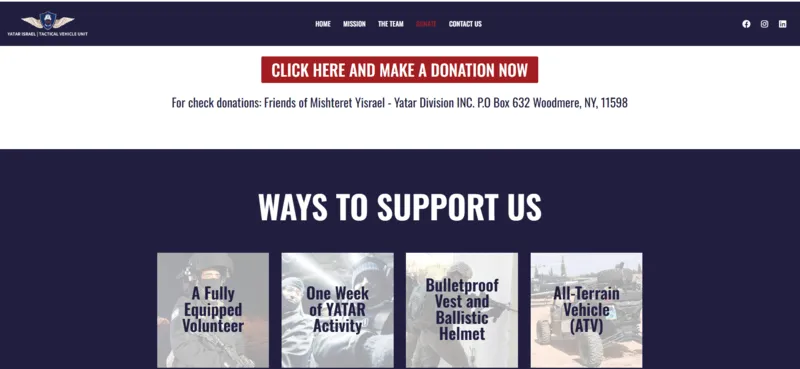
Information obtained by Shomrim reveals that until 2024, Raviv was the highest earner in the organization. In 2018, his annual salary stood at about $92,000, and by 2022, it had increased to nearly $200,000. In the years that followed, there was a drop in his salary; the reason, presumably, is that he was called up as a reservist, meaning his salary is paid by the IDF.
This is also one of the issues that everybody interviewed for this article brings up – the question of paid military reserve duty that volunteers with the organization report. The IDF pays the salary of its reservists and it was recently revealed that Yatar has been given permission by the army for another two months of reserve service. People involved in the matter say that “somebody in the army has recently woken up” to the issue of the large number of reserve duty days reported by Yatar volunteers.
It’s likely that one wake-up call for the army was the report last month by Carmella Menashe, the veteran military affairs correspondent for public broadcaster Kan 11, under the headline: “Without approval: Soldiers and military vehicles used in tours for groups of VIPs from abroad.” According to the article, a group organized by a private production company was taken to an IDF base in the Jordan Valley where Yatar equipment is stored, was given a briefing by commanders and even toured open areas accompanied by IDF forces. In response, the army stated that the tour had not been approved through the accepted channels and that the incident would be investigated.
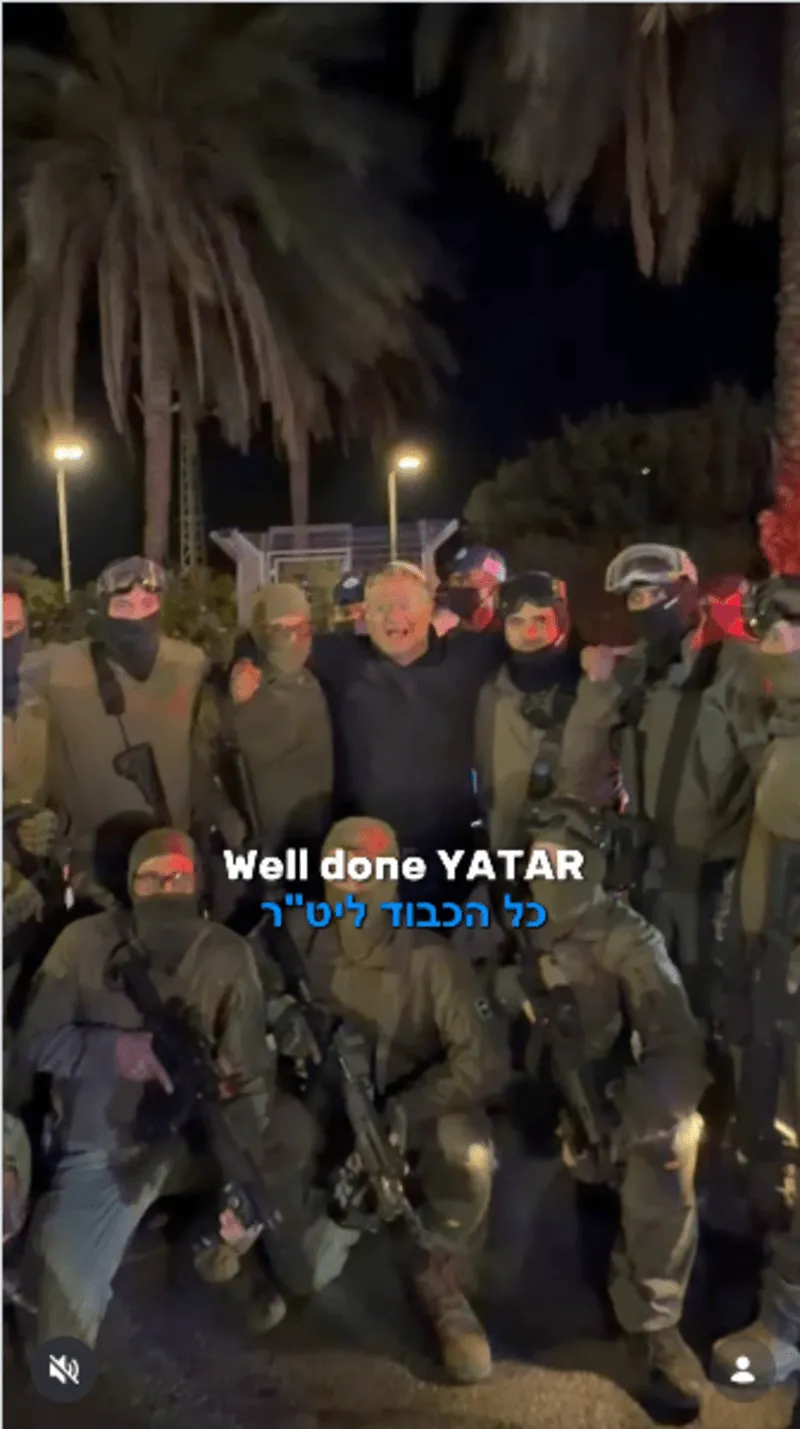
Rather than prompting a rethink of the donation model, Yatar’s increasingly integrated relationship with the military actually reinforced it. This past February, it even received recognition that will likely help with fundraising when National Security Minister Itamar Ben-Gvir declared Yatar a national rescue unit. According to testimony obtained by Shomrim, Raviv also attended the highly publicized birthday party that Ben-Gvir celebrated this past May as a guest of the minister. The official response did not address a question on the matter.
For his part, Ben-Gvir also went for a highly publicized ride on the unit’s ATVs during a tour he conducted a few weeks ago in Tuba-Zangariyye, a Bedouin town in northern Israel. Ben-Gvir posted the video of the tour online and Raviv shared it, adding the word “governance.” While Ben-Gvir’s declaration does not carry much operational significance, donors do not necessarily know that.

Shomrim asked Raviv, the commander of the Yatar unit, for his response. He referred us to the IDF response.
The IDF Spokesperson’s Unit said: “Yatar is part of Mobility Battalion 7085 and since October 7 has been operating on the front lines across various areas – risking lives in Gaza, Lebanon, Syria and Judea and Samaria – to transport forces deep into the field and evacuate the wounded using its specialized vehicles. Its personnel are called up to the IDF as combatants on active reserve duty. The unit has distinct operational advantages and operates in accordance with the requirements for IDF operations.
Using its vehicles, the unit operates in combat zones and forward positions.
To carry out its missions, vehicles are mobilized for the unit according to standard procedure.
We emphasize that the commander of Yatar is on active reserve duty and holds an honorary rank, approved and coordinated by the relevant IDF bodies.
The IDF is not involved in and cannot comment on the private activities of the civilian Yatar non-profit.
Regarding claims about transporting civilians within Israel for non-operational purposes, we are aware of one incident that breached orders, and it is being handled.
Regarding the claims about bringing civilians into combat zones, we have no record of these events; if the reporter provides specific details, they will be thoroughly checked.”