



When Religious Authority Becomes a Tool of Control: Domestic Abuse in ultra-Orthodox Community
In Israel’s ultra-Orthodox communities, some women struggle to recognize controlling behavior as abuse when it is framed as religious obligation or marital duty. Even those who leave may face pressure from their families, schools and religious courts. Now, women and activists within the community are working to challenge these patterns.
In Israel’s ultra-Orthodox communities, some women struggle to recognize controlling behavior as abuse when it is framed as religious obligation or marital duty. Even those who leave may face pressure from their families, schools and religious courts. Now, women and activists within the community are working to challenge these patterns.
In Israel’s ultra-Orthodox communities, some women struggle to recognize controlling behavior as abuse when it is framed as religious obligation or marital duty. Even those who leave may face pressure from their families, schools and religious courts. Now, women and activists within the community are working to challenge these patterns.
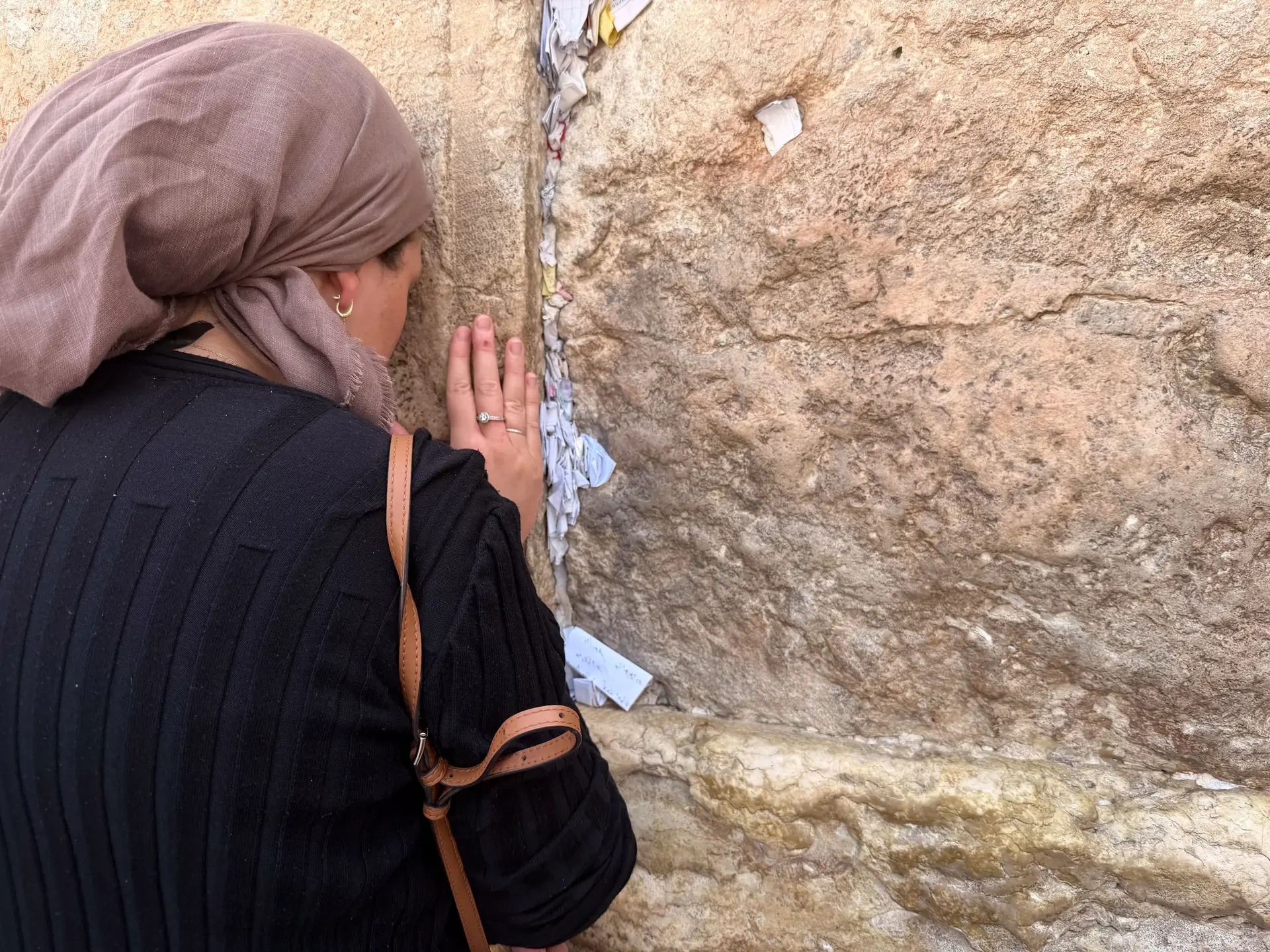
The woman pictured is not connected to the story. Photo: Shutterstock.

Lir Spiriton
November 1, 2026

Summary


Listen to a Dynamic Summary of the Article
Created using NotebookLM AI tool
Yehudit, 27, was in a violent relationship for around five years that involved control, isolation and humiliation, but she never defined it as violence. Only when things turned physical, first with slammed doors and thrown objects and later with slaps and blows, did she allow herself to think, as she put it to Shomrim, that “maybe it’s worth checking if something is wrong.”
Yehudit grew up in a large ultra-Orthodox family in Jerusalem. “My parents’ relationship was one of admiration and respect; whatever my father said was sacred,” she tells Shomrim. When she got married at the age of 19, she adds, she was looking for exactly the same kind of relationship. “I wanted somebody who would be the spiritual figure in the home, who would be the rabbi of the household. That’s what I was raised to want, so at first, I explained everything away on that basis.” When her husband forced her to distance herself from her friends and family, or when he coerced her into sexual relations, she believed it was part of his role. “I saw myself as a good, observant woman who was doing what her husband demanded,” she says. “In a way, I was proud of my suffering. On the other hand, something inside of me broke.”
Yehudit’s story is part of a familiar pattern: violence and coercive control — including isolation, emotional manipulation, reproductive pressure are not unique to the ultra-Orthodox, but it is in that corner of Israeli society that it can be concealed in concepts such as authority, domestic harmony, modesty, family and community. When the boundary between acceptable norms and damaging abuse becomes blurred in a relationship, it is harder to identify violence, harder to call it by its name – and sometimes even harder to get out of.
When control is seen as part of marriage
Fainy Sukenik, one of the founders of the Ba’asher Telchi (Wherever You Go) association, which provides counseling for women going through a divorce, tells Shomrim that many young Haredi women get married without any previous experience. “Even if they sense that something is not right, they are not always capable of saying anything because they simply don’t have the words and they don’t have any experiences with which to compare.” According to Sukenik, preparing a young woman for marriage focuses on halakha and obligations and issues such as identifying an abusive relationship are very rarely touched upon.

This problem is even more pronounced in relationships that follow the hierarchical structure that is standard in Haredi society. Sukenik is at pains to stress that not every relationship that adheres to this structure is necessarily violent, but the boundary between authority and coercive control can become blurred. “It is interpreted as a conservative relationship, but when you add in the elements of violence, obsessive behavior and belittling, many women will still believe that this is how a marriage should be.” According to Sukenik, even when their intuition tells them that something is wrong, it takes time to formulate the language to define it.
In Haredi and religious societies, there can also be an element of spiritual violence – the use of halakha and authority to impose control. Sukenik cites cases in which modesty requirements were tightened after the wedding, social ties were restricted and personal whims were presented as halakhic obligations, including in intimate matters. “All of these kinds of acts are, in fact, just levels of control; sometimes it can be control through finances and sometimes it can be control of someone’s life by controlling their social media... And in Haredi society, it’s also possible to control a woman through religion.”
Rivka – not her real name – is another ultra-Orthodox woman who spoke to Shomrim about the relationship she was in for several years, in which the coercive control behavior was below the surface. There was no physical violence, she says, but she was gradually transformed from an energetic and contented woman into an “extinguished soul” after the wedding. “Not for a moment did I connect it to my relationship,” she says. “I was sure that I was just being extremely sensitive and, later on, that I was the problematic and sick one.”
Rivka’s husband knew how to play on her genuine vulnerabilities and sore spots to shift the blame back onto her. Today, she knows that his behavior was manipulative and that he was gaslighting her, but, at the time, it felt like proof that something was wrong with her. Asked to characterize the relationship, she says simply: “It’s control. I mean, there’s no room for what I want.”

Control also extended to Rivka’s decisions about her own body: when she refused to get pregnant again, her husband exerted emotional pressure, threatened to divorce her if she didn’t stop taking birth control and argued that “no rabbi would ever approve something like that.” She did not dare to look into the matter for herself. “I didn’t have the courage to go and ask the rabbi a question like that,” she says.
When Rivka did seek help – much later in the marriage – her husband set stringent conditions. “If you want counseling for yourself, you can go – but you will not talk about me,” he insisted. In retrospect, she says, even his agreeing to therapy served him as proof that he was a supportive partner, while the therapy itself remained focused on her and her depression, not on what was happening at home.
It was a psychiatrist who, after hearing the details of the relationship, first suggested that Rivka give what was happening a different name. “I was shocked that it’s called violence,” Rivka tells Shomrim. I said: ‘Violence? What violence?’ If anything, he’s the poor one here.” Following that conversation, Rivka started reading about gaslighting and nonphysical violence. “These were things that I was genuinely unaware of,” she says. “I simply had no idea.”
The absence of physical violence did not make the abuse any less dangerous. After another pregnancy that she was coerced into, Rivka’s emotional state deteriorated and she even attempted suicide. “In ultra-Orthodox society, divorce is sometimes simply outside people’s consciousness,” she explains. “And when I reached rock bottom, instead of thinking about the option of divorce, I chose the death option.” Only afterward, once she realized she wanted to live, did leaving begin to seem like a real possibility.
Identifying violence does not mean there’s an easy way out
Even when a woman recognizes that the relationship she is in is not merely “challenging” or “not working,” but far more than that, the path to leaving doesn’t open up right away. According to Sukenik, even before pressure comes from society, from family and from rabbis, there is often an internal mechanism that holds the woman back. “The woman holds herself back, before others can do it,” she says. In Haredi society, she says, marriage is not perceived solely as a relationship between two people, but first and foremost as the foundation on which a family is built. New couples have children soon after marriage and, before they have had a chance to build a relationship, the woman becomes responsible for managing the whole household.
This responsibility is wide-ranging, at least according to what is taught in most Haredi seminaries. Sukenik cites maxims such as “A woman builds, a woman destroys” and “Shalom bayit [a Jewish religious ideal emphasizing peace and harmony within the home LS] is down to you,” which lead a woman to see the breakup of the home as a personal failure rather than a response to the harm she has suffered. The price waiting on the other side of the decision is known in advance: the children, the educational institutions, standing in the community and future shidduchim [the matchmaking process through which many ultra-Orthodox marriages are arranged]. Some women who tell of harsh situations hear from those around them, “We don’t get divorced,” or are sent off for yet another attempt at shalom bayit. In other cases, they hear messages such as “He doesn’t mean it,” “Try therapy” or “Don’t provoke him.”
Sari Meir of the Bat Melech association, which helps Haredi women suffering abuse, knows this route well. Haredi women, she says, reach a shelter only after countless attempts to solve the situation from within. “She’ll try to turn to sources of help and make shalom bayit, and she’ll come to us when she’s run out of options.”

Sometimes the turning point comes when the abuse is directed at the children. “Many times, that’s the point where the woman says: Enough,” Meir explains. That is what happened to Yehudit. Despite her fear of breaking up the family, the moment she saw her husband shouting at their three-year-old son changed the equation. “Sometimes I thought maybe I had to keep suffering for their sake,” she says. “But when it happened, I suddenly realized I’d rather live in a dump with no support than leave the children, and eventually myself too, in the same house as my husband.”
The reaction of those around her was mixed. Her sister encouraged her to leave and helped her throughout, but others tried to persuade her to keep trying for shalom bayit. Her husband’s family, she says, warned of the possible consequences for how she and the children would be treated in the community and the schools. “It was obvious to me there would be very significant repercussions,” she says. “I was afraid for the children’s schooling, and later for their shidduchim, because children of divorced parents are not exactly a catch.”
According to Meir, a community can pull in two opposite directions: it can support and empower the woman, or turn against her, especially in closed societies where a dispute becomes a communal affair and each side can rally its own supporters. “If she does get a supportive response, it’s very empowering,” Meir says.
Figures of authority in the community also wield unusual power over how a woman interprets her situation and what she does next. Meir says many women turn to local figures before they approach the welfare authorities, including rabbis, who have, as she puts it, become “half social workers,” because such cases reach them again and again. The same rabbi may be the one who recommends trying shalom bayit once more, but he can also be the one who gives the woman what Meir calls “a blessing for the road”: the go-ahead to leave, approach the welfare services or go to a shelter.
Hairdressers, Wig Stylists and Rabbis: Fighting Abuse From Within the Community
This gap is one reason organizations working in the field try not to bypass the community’s own mechanisms, but to work through them. The aim is to reach not only the woman herself but also the people she is most likely to turn to first. From there begins an effort to change the language in which Haredi society talks about relationships, boundaries and violence. Part of the difficulty lies in the very ability to call violence by its name, and in recent years there have been attempts within Haredi society to act even before the stage of leaving. The goal is to change the language and to teach the people around a couple to recognize early warning signs.
Sara Liba Haenfling, a Haredi filmmaker and lecturer whose films and talks address nonphysical violence as well, made a film in which a woman suffering from abuse pours out her heart to her sheitel [the wig worn by many married ultra-Orthodox Jewish women] maker, who directs her to appropriate help. Haenfling believes that one of the most important arenas is far from the therapy room. “Women who meet a lot of women – that can be a hairdresser, a beautician, bride instructors, rebbetzins and teachers,” she says. “They play a huge role, because they hear so many stories.” The response of the person who happens to be there at the moment something is revealed can be critical. That woman, she says, can be the one who “saves a life if she says the right thing,” but with the wrong response she can also become “one more nail in the coffin.”
This approach underlies the Gvul Nakhon (“Right Boundary”) forum of the Kavim Adumim (“Red Lines”) initiative. Sukenik, one of the forum’s founders, defines its aim as “awareness and prevention,” through enlisting community agents of change. In Bnei Brak, for example, sheitel stylists and beauticians have been trained to recognize signs of abuse: “They’re a first line. They hear everything there.”

The forum also targets the institutional junctions of Haredi society: bride and groom instructors, rabbis and dayanim (rabbinical court judges). “The goal is to give them tools to understand what violence in a relationship is, to recognize it and to know how to act,” Sukenik explains. Accordingly, dayanim have been trained to distinguish between a fraught but ordinary divorce dispute and a clear-cut case of violence.
Alongside the training sessions, the forum has produced dedicated materials for rabbis and bride and groom instructors. These illustrate well the change the forum is seeking. Within an unmistakably Haredi framing, with the title “Establishing Faithful Homes in Israel,” rabbinic sources and references to rabbis, the booklet speaks the language of privacy, boundaries, joint decisions and personal identity. “A couple’s relationship is built not on superiority but on partnership,” it states. “Even if there is a difference between their worlds, each side is required to respect, listen and consider the other.”
The booklet translates the concepts into everyday examples: a groom who demands to know whom his fiancée spoke to or where she is, or who decides which friends she may meet, patterns that can be disguised as closeness or “transparency.” “There is a profound difference between love and domination,” the booklet says. Elsewhere it warns against recurring patterns of control, disrespect or “erasure of personal identity,” and presents the engagement period, which sometimes includes meetings between the bride and groom, as a window in which these patterns can sometimes be spotted before the wedding.
The booklet sets out clearly the limits of the instructor’s role: “Your job is not to diagnose but to notice.” Instructors should listen, identify worrying patterns and refer the couple to a professional familiar with Haredi society and, where necessary, to a rabbi who knows the field of domestic violence, rather than simply any rabbi who happens to be a figure of Torah authority. It amounts to introducing concepts like partnership, choice and privacy into a cautious, insular language. But these messages collide with an education system that preserves gender hierarchy, creating a contradiction that is hard to get around.
“If you grow up with the idea that there’s a hierarchy, how do you know where the boundary is?” Sukenik asks. “What within the hierarchy is normal, in quotation marks, and what within the hierarchy is already violence?” She stresses that not every relationship with clear gender roles is violent, but the very legitimacy of hierarchy makes it hard to mark the boundary. When a woman grows up with the image of “he’s the head and you’re the neck,” she says, there can be ambiguity over what a husband is permitted to do in the name of that hierarchy and what already constitutes control.
According to Sukenik, education in the seminaries focuses on establishing a family, and bridal instruction deals with the laws of marital relations, purity laws surrounding menstruation and the religious outlook of a Jewish home, but “they don’t talk enough about red lines.” This is why the initiative set out to teach young women to recognize self-erasure and the suppression of personal will, without necessarily challenging the entire structure within which they were raised. The forum tries to draw clear boundaries. That is also the main complexity of the whole undertaking: distinguishing between a conservative relationship and an abusive one.
How successful these efforts are is harder to determine. The materials and interviews provided to Shomrim point to activity on several fronts, including training, written materials and meetings with various officeholders, but they contain no systematic data on how many people have been exposed to these initiatives, nor measures that would allow checking whether they have led to better early identification, more referrals for treatment or less violence. A shift in the language and tools offered to the community is discernible; it is less clear how far the change has seeped into everyday life.
Reliable data on the prevalence of domestic abuse in Israel’s ultra-Orthodox community remain limited. A 2024 nationwide survey found that one in ten Israelis had experienced intimate partner violence, but a separate survey targeting the Haredi population failed to produce a statistically representative sample. As a result, there is no reliable basis for determining whether domestic abuse is more prevalent in the ultra-Orthodox The Gvul Nakhon booklet notes trends that emerged from the survey, chiefly gender gaps and harm around marital relations, which were especially marked among Haredi women, along with a reservation against generalizing them to the whole population. There is currently no basis for determining whether the phenomenon is more common in Haredi society.
Sukenik warns against the simplistic view that the entire sector is in denial: “It looks as though in Haredi society everyone says, ‘We don’t have violence,’ but that’s not accurate.” Welfare professionals and Israeli authorities, she says, are familiar with the phenomenon and deal with it. But even in her view, there is still a long way to go: “There’s still a lot of work to be done in this field.”
Even After Leaving, Ultra-Orthodox Women Face Barriers to Safety and Recovery
There is a further problem once a woman reaches a protected shelter. Haredi families are large, and fitting all the children in is a logistical challenge of its own. According to Bat Melech, an organization that operates shelters for ultra-Orthodox women experiencing domestic abuse, its shelters house an average of 2.5 times as many children as shelters serving the general population.
According to Meir, “Women arrive with seven children or eight children,” she says. One family may need two or three rooms, so taking in one woman with a large family sometimes comes at the expense of space that could have been offered to other women.
The gap also shows in funding, which is not adjusted to family size. “The shelter’s funding is the same as for a woman with two children,” Meir says, explaining that the therapeutic care each child requires is not adequately covered. The association currently runs three shelters, and Meir says its hotline received about 1,600 calls over the past year.
But a safe place solves only one problem. Almost immediately, the question arises of where the children will go to school. Children in a shelter can usually be placed in a state school. But in ultra-Orthodox society, the label “Haredi school” is not enough. Attorney Nechama Isaac, who represents women in shelters on behalf of Bat Melech, points to a patchwork of institutions: “They come from all kinds of Hasidic groups, and it matters which one. If they’re Lithuanian, it matters which Lithuanian community.” The goal, she says, is to place the child in a framework similar to the one the child came from, and disputes between the parents can sometimes delay registration for months.
According to Isaac, the foot-dragging is not unique to the rabbinical courts. The civil courts, too, take months to issue approvals for registering children in schools. In the meantime, the children remain in a temporary framework at the shelter. “They get an educational response from us, but it’s still not a school, not at all the same.” The children’s presence in the shelter throughout the day also holds back the mother’s rehabilitation: in a family with five or more children, an entire family’s life is put on hold in a temporary setting. “When there’s no solution that can advance the woman’s treatment,” Isaac says, “everything gets delayed.”
Above all, there is the legal process, in which a deep gap opens between the pace at which the system demands a coherent, complete account from a woman and the pace at which a woman who has left a violent home can even understand and relate what she went through. “Women often arrive at shelters truly shell-shocked,” she says. “Sometimes they can’t speak, can’t tell what they went through.”
The gap widens when a woman from a closed community is required to expose her intimate life to strangers: a panel of three dayanim, a court clerk, her husband and his representatives. “That doesn’t fit at all with the background she came from and her ability to share,” Isaac explains. When she has difficulty revealing the abuse even to the social worker, laying it out in a rabbinical court becomes an almost impossible task.
But the legal system does not wait: accounts are recorded immediately, and whatever isn’t said at the start may come back as a challenge to her credibility. Isaac notes the gap between the first meeting and the woman who appears months later, after gaining a sense of security and treatment and beginning to process the trauma: “What I hear at the first meeting is nothing like what she’s able to tell later.”
And then, just as the picture becomes clearer, she meets with distrust: “How come you didn’t say this at the start? Why aren’t you telling the truth?” According to Isaac, both the civil courts and the rabbinical courts struggle to understand the mental state of an abuse victim when she first leaves, a difficulty compounded in Haredi society, where sharing intimate matters before a panel of unfamiliar men meets a deep psychological barrier.
Yehudit experienced this gap firsthand: at the start of her divorce, she didn’t even know how to define what she had been through. “I was ashamed to talk about the intimate violence, I didn’t know what to call it and I felt I was being judged,” she recalls. Overwhelmed by her husband’s financial and legal claims, she found help through her sister, who connected her with a lawyer from an aid organization: “I don’t know what I would have done without her.” Today Yehudit lives with her children and is trying to build an independent life. Looking back, she still struggles with anger at herself for not recognizing the abuse sooner, amid the flow of life with early marriage and children, but she is looking ahead: “I’ll raise my children differently, to be independent and skeptical. I don’t want them to end up in a situation where someone exploits them and hurts them, in any way.”
Will the system manage to educate the next generation differently? Sukenik notes that real change is measured not only by identifying existing violence, but by education for relationships, by defining power dynamics, and by regarding a woman’s will as independent and of equal weight. Training and early detection will not be enough on their own. Deep change will require touching on the root issues of Haredi society, including gender hierarchy and the status of women’s autonomy. These are values in inherent tension with the principles of equality, and they may make it harder to recognize dangerous control when it is wrapped in the language and values of religion, tradition, marital roles or shalom bayit. The question is whether it is possible to change attitudes toward violence in Haredi society at all without challenging the power relations that sustain it.