


As the West Bank Economy Struggles, Some Israelis Help Keep Palestinian Livelihoods Alive
Since the October 7, 2023, Hamas attack and the outbreak of war, tens of thousands of West Bank Palestinians have lost access to jobs in Israel, while movement restrictions and settler violence have disrupted agricultural livelihoods. In response, a grassroots network of Israeli volunteers and nonprofits is helping Palestinian families sell olive oil, honey, handicrafts and home-cooked meals – preserving economic and human ties at a time of deepening division.
Since the October 7, 2023, Hamas attack and the outbreak of war, tens of thousands of West Bank Palestinians have lost access to jobs in Israel, while movement restrictions and settler violence have disrupted agricultural livelihoods. In response, a grassroots network of Israeli volunteers and nonprofits is helping Palestinian families sell olive oil, honey, handicrafts and home-cooked meals – preserving economic and human ties at a time of deepening division.
Since the October 7, 2023, Hamas attack and the outbreak of war, tens of thousands of West Bank Palestinians have lost access to jobs in Israel, while movement restrictions and settler violence have disrupted agricultural livelihoods. In response, a grassroots network of Israeli volunteers and nonprofits is helping Palestinian families sell olive oil, honey, handicrafts and home-cooked meals – preserving economic and human ties at a time of deepening division.
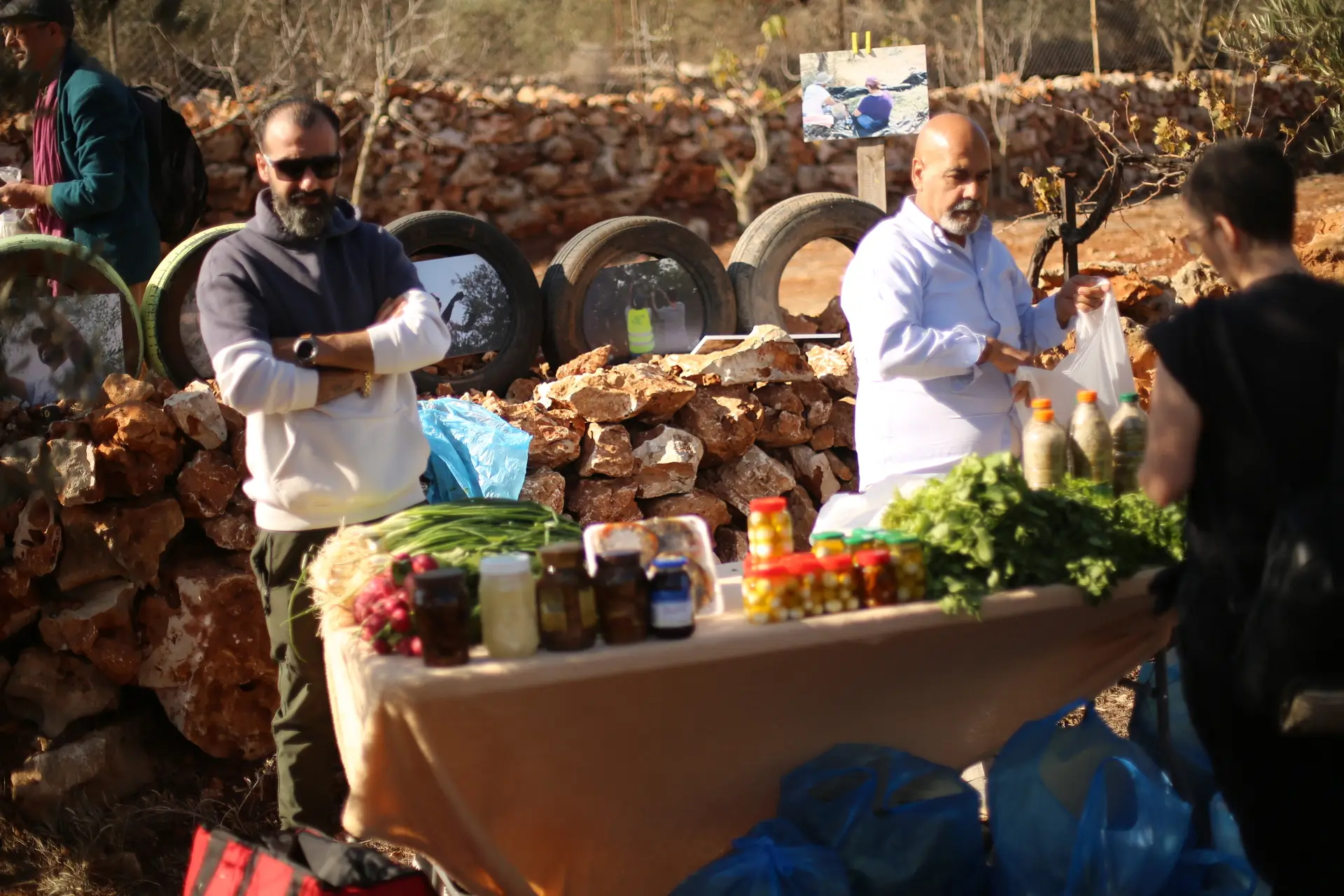
Local Palestinian market. Photo: Rabbis for Human Rights
Hadar Kane, Shomrim
November 24, 2026

Summary


Listen to a Dynamic Summary of the Article
Created using NotebookLM AI tool
When Yael Moav, an Israeli tour guide and activist, ordered lunch for a group of hikers, she turned to Fatima, a Palestinian woman who runs a small restaurant out of her home in a Bedouin community in the West Bank. The meal – maqluba, a traditional Palestinian rice dish, stuffed vegetables and other homemade dishes – cost about $300. For Fatima’s family, whose members lost their permits to work in Israel after October 7, 2023, the order meant much more than a day's business. “That’s the family’s entire income for the near future,” Moav said. “It’s this or nothing.”
Moav is part of an informal network of Israeli volunteers who are helping Palestinian families find new sources of income amid a deepening economic crisis in the West Bank. Through personal connections, WhatsApp groups and community markets, they help Palestinian farmers, artisans and small business owners sell their products to Israeli customers.
The initiatives are modest in scale, but for the families involved, they can mean the difference between earning a living and depending on charity. They are also helping preserve economic and personal ties between Israelis and Palestinians at a time when those connections are increasingly difficult to maintain.

Rachel Beit Arie, an activist, buys olive oil from a Palestinian family she has known for years and distributes it to friends by word of mouth. All of the money is passed on to the family. “It’s good-quality produce, and it’s a wonderful way to support the local economy in the face of obstacles that shouldn’t exist,” she said. Avishai, a left-wing activist who helps Palestinian farmers, asked to be identified by a pseudonym and requested that the groups he works with not be named, fearing harassment and the possible shutdown of their activities. He runs a WhatsApp group with dozens of buyers, purchasing olive oil and other agricultural products from Palestinian farmers in the West Bank and selling them to customers in Israel without taking a profit.
Alongside the individual initiatives, there are more organized efforts. Since the start of the war, Rabbis for Human Rights, an Israeli human rights NGO, has held a baladi (“local”) market a few times a year, where Palestinian farmers sell their produce to Israelis. The next one will be held on November 27. Sindyanna of Galilee, a nonprofit run jointly by Arab and Jewish women, buys olive oil from West Bank villages and markets it in Israel and abroad.
An Economy in Crisis
For years, employment in Israel and Israeli settlements provided a major source of income for West Bank Palestinian households, with workers typically earning substantially more than they could in the Palestinian economy. Following the Hamas-led attack on Israel on October 7, 2023, Israeli authorities sharply restricted Palestinian workers’ access to jobs in Israel, citing security concerns.
Before October 2023, approximately 172,000 West Bank Palestinians worked in Israel and Israeli settlements. By the second quarter of 2026, that number had fallen to around 53,000 – a decline of nearly 70%, according to the Palestinian Central Bureau of Statistics. Unemployment in the West Bank stood at approximately 28%.
Avishai said that although the defense establishment and construction-industry employers have pressed to bring the Palestinian workers back, almost none have returned. He also pointed to explicit statements that the goal is to make life so hard for Palestinians that they emigrate. That is his view, he said, and one shared by other activists.
The crisis goes beyond the loss of jobs in Israel. Clearance revenues – the customs duties and purchase taxes Israel collects on behalf of the Palestinian Authority on goods imported into its territory – make up about 65 percent of the PA’s revenue, according to the World Bank. For about a year now, Finance Minister Bezalel Smotrich has been freezing most of the transfers. According to an April report, of 740 million shekels (approximately $225 million), about 590 million (approximately $178 million) was deducted to pay debts to the Israel Electric Corporation and water utilities, and funds the PA had earmarked for Palestinian prisoners and their families. The rest of the money was frozen.
The government justifies the move by citing fears that the funds will reach terrorism, as well as the PA’s legal actions against Israel. Smotrich declared that funds intended for terrorism would be deducted, and data presented to the security cabinet showed that in 2025 the PA transferred about half a billion shekels to prisoners and to the families of terrorists.
The Palestinian economy minister estimated in December 2025 that about $4.5 billion is being held by Israel. Officials in Israel and around the world have warned of the PA’s collapse, and six members of the U.S. House of Representatives, from both parties, have called for the money to be released, along with the creation of mechanisms to keep it from being diverted to terrorism. The PA has not collapsed: according to the Institute for National Security Studies, in July 2026, thanks to increased aid from the European Union and the World Bank, it continues to function but pays partial salaries. World Bank data show that in 2025, the PA paid only 50 percent to 70 percent of salaries, and teachers and nurses are getting partial pay.

Sayel Jabarin of Combatants for Peace, an Israeli–Palestinian NGO, said he has been getting only half his salary for three years now, and sometimes no pay at all. The damage is evident in the education system too, he said, which operates only three days a week. “Imagine a child who started first grade and is now in third grade – he’s gotten only 50 percent of the education he should have received,” he said. The strain shows at home as well. “I work two jobs, and my wife works too, to pay for private school for our three children, because the public one operates only partly. The tuition is more than my salary.”
Avishai said that since October 7, families that lost their entry permits have had trouble making a living. “A guy I know worked as a laborer inside Israel and earned 6,000 shekels ($1,800) a month. For him that was a decent living. Since Israel barred him from entering, he’s dependent on charity to feed his family. And let’s say they’re barely holding on most of the time, but it all falls apart when a big expense comes up, like surgery, or when a kid finishes high school and wants to go to university. They have no way to come up with the money.”
Jabarin, who lives in Kafr Sa’ir, told Shomrim about the plight of those who lost their jobs in Israel. “Contractors who used to earn 20,000 shekels ($6,000) a month are sitting at home with no food for their families,” he said. The hardship, he said, is already felt in every area of life. “We never had children from our community selling at intersections or asking for money. Today you see it at every intersection.” In an Arab Barometer survey from October 2025, 92 percent of West Bank residents rated their economic situation as bad or very bad.
A Grassroots Network of Solidarity
Against this backdrop, small-scale initiatives linking Palestinian producers with Israeli consumers have taken on a new significance. Yael Moav began working with the villagers more than eight years ago, during the campaign against the eviction of Khan al-Ahmar - a Palestinian Bedouin community in the West Bank that has faced the threat of demolition and displacement. That led to the formation of Friends of the Jahalin, a group of about 10 volunteers, including residents of a nearby settlement. She said the eviction was averted because of European pressure. “But we were there, ready,” she said.
After October 7, when the village residents were barred from entering Israel, Moav approached the head of the community to ask how she could help. He asked her to find a way to give them both a livelihood and some joy. After a post she wrote, an artist brought the village simple patterns for dolls that could be embroidered and sold in Israel to tourists and supporters. “The older women knew how to embroider, the younger ones less so,” Moav said. The older women sat with the younger ones and helped them learn the craft, and the project led many women to return to embroidery. Each doll sells for 50 shekels ($17), of which 40 ($13) goes to the embroiderer. Thousands of dolls have been sold so far, channeling tens of thousands of shekels to the village.

The collaboration also includes extracting honey and selling it in Israel through a WhatsApp group of several hundred buyers. Moav also spoke of hikes in the wadi led by a Bedouin guide. On Saturday, eight people joined a 16-kilometer (10-mile) hike, and each paid 150 shekels ($50), all of which went to the guide – more than 1,000 shekels ($300) in a single day. Two mothers also teach Arabic lessons by video for 70 shekels ($23) an hour, earning 1,000 to 2,000 shekels ($300-$600) a month.
And then there’s Fatima, who hosts up to 50 diners in her home and serves vegan meals of stuffed vegetables and maqluba for about 60 shekels ($18) a person. She also prepares takeout meals and finds other ways to earn a living. “Fatima is a very beloved woman,” Moav said. “At least she has this. Others don’t even have that. She works for her living, she doesn’t take handouts.” Moav said the community where Fatima lives also faces settler violence, and that settler-run farms operate in the area. In that reality, she said, being able to host and sell food is an especially important source of income.
From Palestinian Olive Groves to Israeli Markets
The olive industry is a main source of income in the West Bank, supporting more than 100,000 families, according to the Civil Administration, the military body responsible for administering civilian affairs in parts of the West Bank. But since October 2023, Palestinian farmers’ access to their groves and land has been restricted. Movement restrictions, a prior-coordination procedure that human rights groups say keeps farmers away from their orchards, and growing violence in volatile areas make it hard for them to reach their land and work it. The organizations say some of the crop is stolen or left to rot in the field, threatening the livelihoods of entire communities.
Because it’s so hard to sell the produce, a network of solidarity buying groups has sprung up. They operate on social media and by word of mouth, and Israeli activists are behind them. The network gets around the barriers to movement and trade and lets farmers sell their produce in Israel. The route is fairly simple, as long as you’re Israeli: show up, load your trunk with produce, agree on a price and drive back to Israel. For Palestinians, by contrast, the way into Israel is blocked and fraught with obstacles.

Avishai said he began helping an olive grower even before the war. The farmer’s income from those sales is about 20,000 shekels ($6,000) a year – not a lot of money. Before the war, the sales supplemented the farmer’s income, but since work permits in Israel were revoked, those 20,000 shekels are his entire livelihood.
The Civil Administration expects an olive oil yield of 22,000 tons in 2026, at a price of about 35 shekels ($10) a kilogram, compared with 45 shekels ($13) two years ago. But the reality on the ground is more complicated. Rabbis for Human Rights says the actual yield is significantly lower because of theft, lack of enforcement and denial of access to the groves. In a letter to the Coordinator of Government Activities in the Territories (COGAT), the organization wrote of a procedure under which soldiers drive away, and at times detain or arrest, farmers who come to private groves in Area C, the portion of the West Bank under full Israeli civil and security control under the Oslo Accords, on the grounds that prior coordination is required. The procedure’s legal status, the group said, is unclear. It documented eight such incidents between October 11 and November 7 and has received no response.
Jabarin said 70 percent of his village’s residents make a living from farming, but since October 7 they have been denied access to their land, and anyone who tries to reach it risks being shot at. He said settlers even uprooted olive trees in his father-in-law’s grove, land the father-in-law inherited from his father. According to Yesh Din, an Israeli human rights organization that monitors violations of Palestinian rights in the West Bank, 937 incidents of settler violence were documented over 39 days, 436 of them related to the olive harvest. Soldiers were present in about 23 percent of the incidents. The figures are based on the organization’s own documentation, and the same incident is sometimes counted in several categories.
Sales in Israel are possible thanks to small, discreet activity that is easy to disrupt, Avishai said. He said he sometimes runs into inspections at checkpoints. For that reason, this article does not detail routes, groups or methods. Avishai makes no money from the activity himself and does it all as a volunteer. In a world of activism where people pay a price, he said, it is a “net positive” – emotional satisfaction in place of financial reward.
Beit Arie buys a liter of olive oil for 50 shekels ($15) and sells it for the same price. The money goes to the family she bought the produce from. “It started by word of mouth in the neighborhood and on Facebook, long before October 7, because the oil is excellent,” she said. “At first I made deliveries for family and friends. After October 7 I bought a bit more. When I wanted to buy for myself I asked friends whether they wanted some, and posted a little on Facebook. There are lots of families that want to sell, and everything runs through personal connections. I bought a quantity and distributed it. They would have been happy if I’d managed much more, but in recent months I stopped, for reasons unrelated to them.”
According to Beit Arie, there is demand for Palestinian produce, which is fresh, high quality and cheaper. “The normal thing would be for them to sell to boutique shops and farmers markets. The only reason they can’t is the occupation. It’s twisted that it has to be done this way.” She pointed to the gap in freedom of movement: Israelis can enter the West Bank freely, while for Palestinians crossing checkpoints is nearly impossible. “Buying is a way to get a local economy moving and stand up to obstacles that shouldn’t exist in a decent country,” she said.
In addition, checkpoints have been added since the start of the war, and getting to villages means taking roundabout roads. According to the United Nations Office for the Coordination of Humanitarian Affairs, there are 925 movement obstacles in the West Bank, at least 459 of which block or restrict access to main roads.

Anton Goodman, acting director of Rabbis for Human Rights, said the Palestinian economy is collapsing. Tens of thousands of Palestinians have lost the ability to work in Israel, he said, and they support entire clans. Teachers, too, are getting less than half their salaries. This year is a “catastrophe,” he said: settlers are stealing olives, and the settlers’ olive presses are full while the Palestinian ones stand empty. “Better than aid is letting people make a living with dignity, and that’s what they want,” he said.
During the harvest, the organization’s volunteers come to help farmers who have trouble reaching their groves, and pick olives with them. At the end of the harvest, a baladi market is held. This year it is planned for November 27, and the organization hopes to draw 500 visitors. Six or seven farmers, each representing several families, will take part, along with home producers, makers of olive-wood carvings and utensils, and a dabke dance troupe. Pickled olives, olive oil soap, oil, honey, candles and ceramics will be sold. The goal is sales of 30,000 to 50,000 shekels ($9,000-$15,000) in a single day.
According to Goodman, the army once warned farmers not to host the organization. In another case, orders were issued restricting the arrival of buses, on suspicion of a breach of public order. In response, the organization set up market days in Jerusalem and Tel Aviv.
“It’s a drop in the ocean compared with the economic collapse of two million people,” Goodman said, but he stressed that the income is meaningful for the participating families and businesses. Cooperation with the farmers, he said, is better than ever. They are willing to work together to protect their livelihoods and rights because they have no choice, and they see a shared future. What isn’t working is getting the Israeli establishment to cooperate. “The army has cut off contact,” he said, adding that in the past the army and the Shin Bet security service had an interest in the Palestinians having an economy. He spoke enthusiastically of Palestinian oil: thick as honey, “something you drink, a spiritual experience.”
Keeping Human Connections Alive
Alongside the small initiatives, attempts are being made to sell the produce through regulated commercial channels. Sindyanna of Galilee operates as a fair-trade social enterprise connecting Arab and Jewish women, who together produce award-winning olive oil. The oil comes from local groves in the Galilee, and the nonprofit also works with Palestinian agricultural cooperatives, mainly in the northern West Bank.
Sindyanna has bought organic olive oil from Kafr Qaddum for the third year, channeling tens of thousands of shekels a year into the village, including for infrastructure upgrades. But regulated trade runs into difficulties too: transferring money from Israel to the West Bank is a problem in itself, and the roads are blocked as well. Hanan Manadreh Zoabi, the co-manager of Sindyanna of Galilee’s Visitors Center, told Shomrim about a soap maker who has worked with the nonprofit for 30 years. He leaves for his factory at 4 or 5 A.M. and sometimes arrives only at noon, though the drive should take half an hour. About 80 percent of the nonprofit’s sales are for export, but since October 7 they have plunged 50 percent, which Zoabi attributed to campaigns by the boycott, divestment and sanctions movement, known as BDS.
These initiatives are far too small to reverse the West Bank’s economic crisis. But for the families involved, they provide meaningful income while helping preserve economic and human connections between Israelis and Palestinians. “I doubt we’re talking about huge amounts,” Beit Arie said.
When there is no work, no pay and no access to the groves, even 1,000 shekels ($300) can make a difference. “There’s no comparison between what’s needed and what we’re able to do,” Avishai said. The biggest beneficiary may be the solidarity among Palestinians themselves: those who have more to look after families in especially difficult straits. “And it’s unclear how long this can last,” he said.
The activity carries risk as well: Moav said she was beaten by rioters, and that a week before our meeting, volunteers were evacuated by ambulance. “Sometimes it’s dangerous” she said “but I feel I have to be there. I’m already part of the community.”