


Breaking a Decades-Long Boycott, More Palestinians in East Jerusalem Vote in Israeli Election
More than 10,000 Palestinian citizens of Israel living in East Jerusalem voted in last month’s parliamentary election - the highest number since 1967. For some, voting offers a way to challenge discriminatory policies and improve daily life without abandoning their Palestinian identity. Others see participation as legitimizing Israeli control over East Jerusalem. The next test could come in the city’s 2028 municipal election.
More than 10,000 Palestinian citizens of Israel living in East Jerusalem voted in last month’s parliamentary election - the highest number since 1967. For some, voting offers a way to challenge discriminatory policies and improve daily life without abandoning their Palestinian identity. Others see participation as legitimizing Israeli control over East Jerusalem. The next test could come in the city’s 2028 municipal election.
More than 10,000 Palestinian citizens of Israel living in East Jerusalem voted in last month’s parliamentary election - the highest number since 1967. For some, voting offers a way to challenge discriminatory policies and improve daily life without abandoning their Palestinian identity. Others see participation as legitimizing Israeli control over East Jerusalem. The next test could come in the city’s 2028 municipal election.
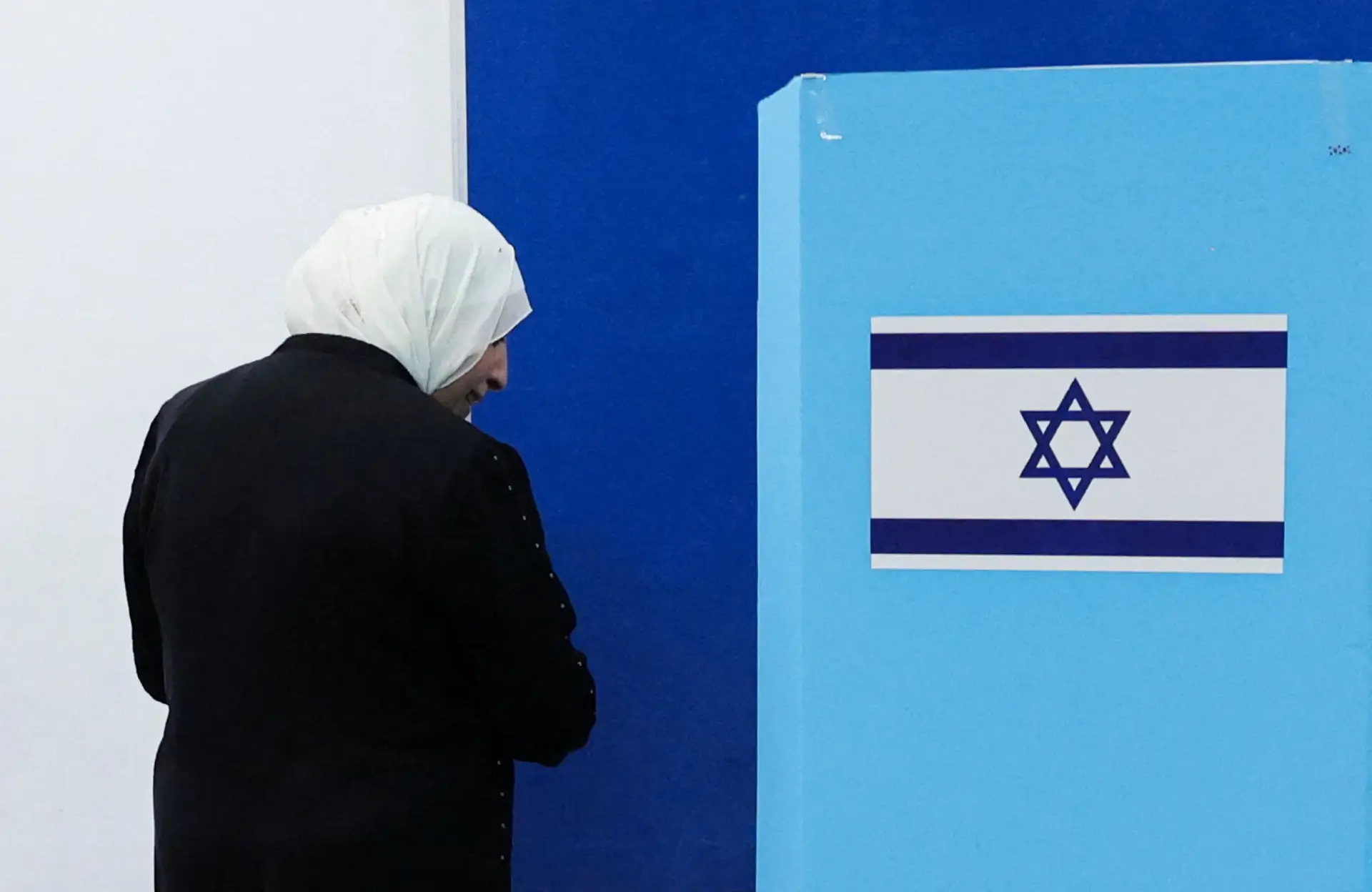
2026 Israeli elections. The woman pictured is not connected to the story. Photo: Reuters

Rahma Ali, Wasla
November 4, 2026

Summary


Listen to a Dynamic Summary of the Article
Created using NotebookLM AI tool
When Amal Jabarin, a 42-year-old resident of the Shoafat refugee camp, arrived at the voting station that had been opened in Jerusalem’s Sheikh Jarrah neighborhood on Election Day, he was taken aback by the number of people who had turned out to vote. “People waited in line for up to two hours to vote,” he told Shomrim. “There were also [Israeli] settlers trying to provoke us into an argument, but we tried our hardest not to be dragged into it.”
For Jabarin, casting a vote in an Israeli Knesset election was not something to be taken for granted. He had not intended to vote on October 27, even though he had participated in a previous election – when the Joint List first ran for parliament. This time around, friends convinced him to vote and he turned up at the polling station, accompanied by his wife and son. This time, he voted for the United Arab List-Ta’al.
“The situation in Jerusalem is dire; we have to do something about it,” Jabarin explained when asked what motivated him to go to the polling station with his family this time around. For the first time in years, he explained, he felt that society in general was supportive of East Jerusalem residents voting in the Knesset election. “Maybe that way we can atone for the mistake we made when we accepted Israeli citizenship,” he says.

Jabarin was far from the only Arab citizen to exercise his democratic right. Rather, he was part of a wave that has transformed political participation among the Arab residents of East Jerusalem. In last month’s election, the turnout was higher there than in any election since 1967, with more than 10,000 Palestinians with Israeli citizenship in East Jerusalem casting a ballot. In the neighborhood of Sur Baher, for example, the voter turnout was 56 percent, compared to just 16 percent in the 2022 election. At the polling station opened at the Abdullah bin Hussein high school in Sheikh Jarrah where Jabarin voted, the turnout jumped from 16 percent four years ago to 53 percent last month. More than 80 percent of the votes were for UAL-Ta’al.

Most of the Palestinians in East Jerusalem have permanent resident status, which does not give them the right to vote in Israeli elections. According to a report by the State Comptroller in 2019, around 22,000 East Jerusalem Palestinians have Israeli citizenship. However, the report does not specify how many of them have the right to vote and have reached 18. The turnout represents a major shift in the political landscape of East Jerusalem where, for years, voting in Israeli elections was strictly taboo.
Ending a historical boycott versus blocking the far right
Since 1967, Palestinians with the right to vote in Israeli Knesset elections – as well as municipal elections in the capital, in which all residents are entitled to vote – have maintained a steadfast and blanket boycott of the democratic process in Israel. Participating in Israeli elections is seen by the Palestinian public as de facto recognition of the State of Israel’s sovereignty over East Jerusalem. Over the years, Palestinian political movements have called time and time again for a boycott of all Israeli elections and anyone choosing to ignore these calls was subjected to harsh criticism and often paid a heavy social price. In last month’s election, it seems that part of that paradigm started to shift.
Jabarin decided to vote mainly with the goal of keeping the far-right parties out of power. “Because of the rising hatred of Arabs, the policies being enacted by Ben-Gvir and Smotrich and what is happening to the Palestinians in the West Bank, I felt that I had to do something.”
What do you expect the Arab Knesset members to do for residents of East Jerusalem?
“First of all, they should change the way that the police treat us.”
Jabarin expects the new Arab lawmakers to act against police harassment and arrests, as well as to prevent Jewish prayer services on the Temple Mount. He works for the Kulna Jerusalem organization and voted for the United Arab List-Ta’al partly because, he says, Mansour Abbas’ experience in the coalition gives the party an edge in dealing with the Jewish parties and getting results.
S., a program coordinator from Shoafat, is another first-time voter. She got her Israeli citizenship some four years ago and decided that she would vote for the United Arab List-Ta’al. “I think that they represent us and our problems. Also, they talk to us in a language that we understand – both in terms of the messaging and the language itself. I see them as my voice in the Knesset.”
For S., the significance of voting goes far beyond the boundaries of Jerusalem itself. She also sees voting as an opportunity to have an impact on the fate of the Palestinians in the occupied territories. “I hope that the Arab lawmakers will manage to reduce the pressure on Palestinian prisoners in Israeli jails and to shine a light on the conditions they are being subjected to. There are families who have been waiting for years to find out what became of their sons and they have no idea what conditions are like inside Israeli prisons. I also hope that they will work to secure the return of Palestinian laborers to Israel. They are in dire straits,” she says.
The national dilemma
Daoud Alian, an attorney from Beit Safafa, is a long-time voter. He has been participating in Israeli elections for years. This time, too, he voted for the United Arab List-Ta’al but says that he has no delusions about Arab MKs’ ability to make any fundamental changes to the situation in the city. “I vote because I don’t have an alternative. I don’t want to see Ben-Gvir demolish Palestinian homes, like he has in Silwan,” he says. According to Alian, restrictions on muezzins in East Jerusalem also played a part in his decision. He voted for the United Arab List-Ta’al because he wants results, not just speeches. “Joint List lawmakers talk about our rights and quote [Palestinian national poet] Mahmoud Darwish,” he says, “but what good does that do people? It’s time to try a different path. [Ahmad] Tibi has been in the Knesset for the past 27 years; it’s time for him to let others step in.”
Alian worked for many years in the Jerusalem healthcare system, including for more than one HMO, and he says that he was exposed to the impact of the budgets allocated to the Arab community when the United Arab List-Ta’al was part of the coalition. “I saw it’s possible to achieve when you’re working within the government. I want politics to have an impact on people’s lives, instead of just offering them slogans.
“I expect Arab MKs to deal with issues that preoccupy us on a daily basis: construction plans, budgets, crime and the need to keep proving that Jerusalem is their center of life. People live in fear that they will lose their residency permits. I don’t expect Arab lawmakers to solve all of these issues – but they should at least try to improve things for us,” he says. Jabarin also expects representatives of the Arab population to focus on their constituents’ daily concerns: education, parks, antidrug activities and building permits. “Jerusalem is more than al-Aqsa,” he says.

The issue of whether or not to vote is not just one of material or political considerations for East Jerusalem residents: it touches deeply on their national identity and the symbolic and ideological significance of taking part in the institutions of the Israeli state. Yahya a-Sayeed, 31, was born in the Muslim Quarter of the Old City and now lives in Abu Ghosh. He views voting as a way of engaging with reality. “I am a Palestinian and the fact that I vote in Knesset elections does not alter my identity and does not mean that I accept the current political situation. In the end, Knesset decisions have a direct impact on our lives, on construction, on the services we are provided and on our rights. Why shouldn’t we use the tools at our disposal to try and make a difference?”
A-Sayeed also understands why some people decided to boycott the election. “I respect their decision and the reasons for it. But I believe that voting is one of the ways that we can make our voices heard, without giving up on our nationalist positions.” Alian, for his part, is worried that participating in Israeli elections will undermine the Palestinian identity; he still believes that there is currently no other way to safeguard the rights of Israel’s Arab citizens. He says that the Muslim religious leaders in Jerusalem are also split on the issue. “I know clerics who believe it’s a sin not to vote and others who say that participating in the election is forbidden by Islamic law.”
B.L., who lives in the Old City and is vehemently opposed to participating in the Israeli democratic process, has never voted in a parliamentary election. “The Knesset cannot represent us or our national ambitions. They make false promises about what we stand to gain if we vote – but we could end up paying a heavy price in the future,” he says.
He is highly critical of the Arab lawmakers, whom he accuses of neglecting the problems of East Jerusalem Palestinians for years. His main objection to voting in Israeli elections, however, is not a question of effectiveness but is purely ideological. “When we participate in Israel’s elections, we are helping Israel to portray itself to the rest of the world as a democratic country – at a time when it is committing genocide. I do not want to be party to that.”
The municipal test: Will the change filter down to the city council?
The dramatic changes in voting patterns and the increase in turnout in last month’s Knesset election raise a key question when it comes to potential ramifications for the next Jerusalem municipal election. There is a fundamental difference between municipal and parliamentary elections: unlike Knesset elections, in which only people with Israeli citizenship can vote, Palestinians with permanent resident status are legally entitled to vote in municipal elections.
In purely numerical terms, the potential is massive: In 2024, the number of Palestinians with permanent residency status in Jerusalem was estimated to be around 250,000 – around 36 percent of the total number of eligible voters in the capital’s municipal elections. Despite their significant electoral strength, the turnout for municipal elections among Arab residents is particularly low. In the last election, for example, it was less than 2 percent.
A-Sayeed believes that the higher turnout for the Knesset election will also lead to an increase in participation in municipal elections. He says that the impact of the boycott is evident in the current state of the city. The lack of Palestinian representation on the city council, he says, is especially felt in the ongoing neglect of infrastructure and services in neighborhoods like Kafr Aqab, Shoafat and Qalandiyah. A-Sayeed expects some movement among the local population, adding that, “more and more Jerusalemites will reconsider voting in municipal elections, especially since you don’t need Israeli citizenship to vote. People understand how important it is to be represented in decision-making processes – and that does not mean they are giving up on their Palestinian identity.”

The neglect is evident. The East Jerusalem neighborhood of Kafr Aqab.
In contrast, B.L. does not believe that there is necessarily any connection between voting in a Knesset election and participating in a municipal election. “I believe that people who voted in the Knesset election wanted to prove two things,” he says. “First of all, they wanted to prove to the State of Israel that they are citizens who exercise their rights just like they perform their duties. It is as if they are telling the government: ‘We finally got citizenship and we want to show that we’re like every other Israeli citizen.’ The second thing that they want to do is convince the Arab public that they are fulfilling an important national role by casting their votes for parties that will help oust Prime Minister Benjamin Netanyahu and his partners from power. It may well be that someone who votes in the Knesset election will also vote in a municipal election; there may be more voters or fewer.”