


Three U.S. court filings reveal how money raised through online crowdfunding campaigns allegedly reached Hamas and Palestinian Islamic Jihad. Drawing on court filings, cryptocurrency transactions and social media records, a Shomrim investigation examines how gaps in regulatory oversight allow funds to move from donation platforms and on to payment processors and crypto exchanges, with almost no visibility into their ultimate destination.
The Crowdfunding Blind Spot: How Hamas and Islamic Jihad Use Innocent Donors to Fund Terror
Three U.S. court filings reveal how money raised through online crowdfunding campaigns allegedly reached Hamas and Palestinian Islamic Jihad. Drawing on court filings, cryptocurrency transactions and social media records, a Shomrim investigation examines how gaps in regulatory oversight allow funds to move from donation platforms and on to payment processors and crypto exchanges, with almost no visibility into their ultimate destination.
Three U.S. court filings reveal how money raised through online crowdfunding campaigns allegedly reached Hamas and Palestinian Islamic Jihad. Drawing on court filings, cryptocurrency transactions and social media records, a Shomrim investigation examines how gaps in regulatory oversight allow funds to move from donation platforms and on to payment processors and crypto exchanges, with almost no visibility into their ultimate destination.
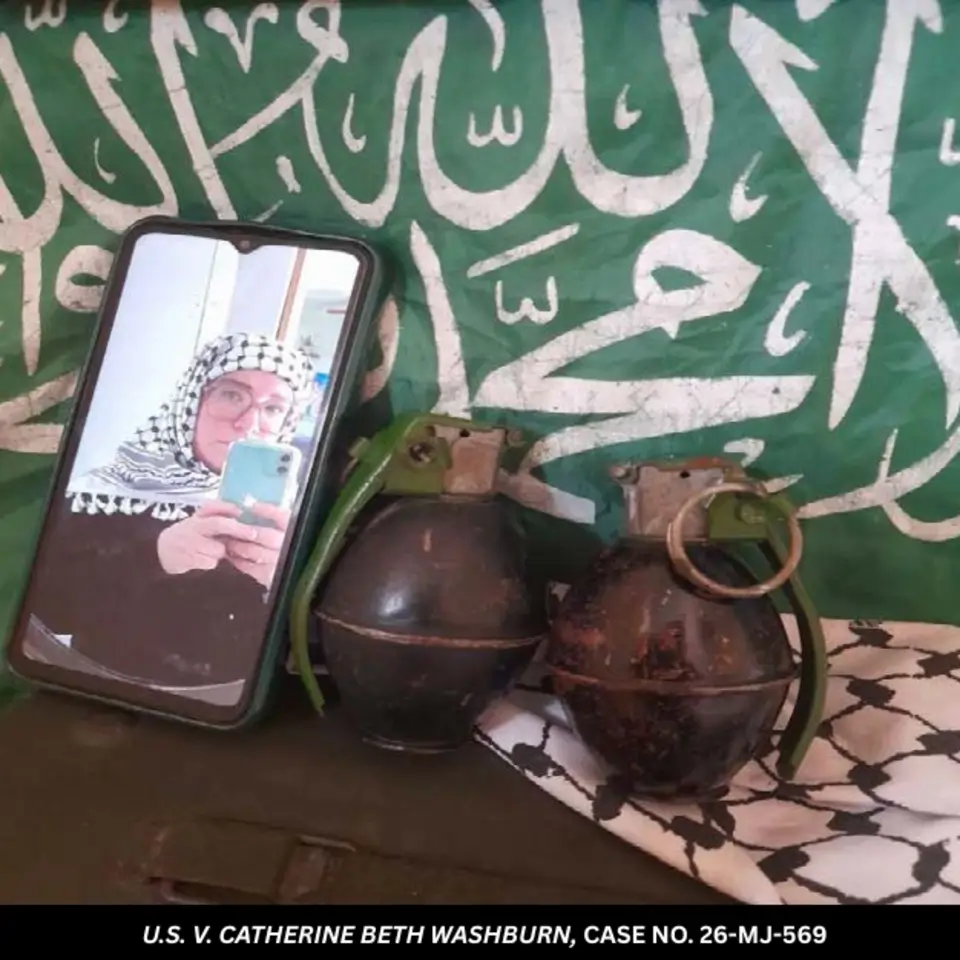
Catherine Washburn with grenades and a Hamas flag. Photo: U.S. Department of Justice website
Theia Chatelle
November 12, 2026

Summary


Listen to a Dynamic Summary of the Article
Created using NotebookLM AI tool
“I wish every day were October 7th,” Catherine Washburn, a 37-year-old American and a leader of the Direct Action Movement for Palestinian Liberation (DAMPL), wrote in February 2025 to a man in the Gaza Strip who had just told her he was a fighter in Palestinian Islamic Jihad. Their full correspondence, obtained by the FBI through a search warrant for Washburn’s personal iCloud account shows, prosecutors allege, that she raised money for the operative under the guise of humanitarian aid — and kept doing so even after he told her he belonged to a terror group.
Washburn, according to the criminal complaint, had been working since November 2024 to raise money for the operative, who is identified in court filings only by the initials H.H. In all, she sent him more than $30,000 in cryptocurrency. She was later arrested and charged in federal court with attempting to provide material support to Islamic Jihad, which the United States designates as a foreign terrorist organization.
The complaint against Washburn raises another issue which reaches far beyond the allegations against Washburn. The main platform used to raise the money, according to the complaint, was the Australian crowdfunding site Chuffed, which has grown popular with the left for its strong stances on social issues. Australian law does not currently require crowdfunding platforms to comply with anti-money-laundering regulations, and similar loopholes exist in most other countries. For terror groups in Gaza these gaps in regulatory oversight are a way to raise money, now that other channels have been closed off by the authorities.
Repeated requests by Shomrim for comment from Chuffed’s management went unanswered.
Regulatory blindness: The puzzle no one can put together
Hans-Jakob Schindler is a senior director at the Counter Extremism Project (CEP) and a former coordinator of the UN Security Council’s monitoring team on ISIS, Al-Qaida and the Taliban. According to Schindler, Canada is the only country to have explicitly brought crowdfunding platforms under anti-money-laundering regulations comparable to those governing financial service providers.

Schindler notes that the regulatory loophole allows terror groups to obscure the final destination of donated funds long before the money is routed to their accounts. “In the strictest sense it’s not money laundering, but of course it’s obfuscation,” he says. From the outside, he explains, all the crowdfunders can see is that a campaign has been set up and that people are donating to it, not who is really behind it or where the money goes. “I don’t think any terrorist or extremist organization is stupid enough to say, ‘This is for Hamas weapons in Gaza,’” he says, calling the use of the crowdfunding sites, “really the perfect loophole.”
The crowdfunding platforms defend their business model on the grounds that they are not financial institutions – a line of defense similar to arguments that social media companies like Instagram and Facebook have made to avoid stricter regulation. They say they merely provide a website where people can meet and donate, while the actual transfer of funds is carried out by outside payment processors such as PayPal and Stripe. In practice, this leads to a situation in which each link in the chain – the host site, the payment processor, the bank that receives the money, and the crypto exchange – has only a fraction of the information about the funds. “You basically have everything you need to know, but since you can’t put the pieces of the puzzle together, you know nothing” Schindler adds.
Blockchain footprints: The transfers that slipped under the law’s radar
The case against Catherine Washburn is one of at least three filed this year in U.S. federal courts in which prosecutors allege that money raised through crowdfunding sites – where many campaigns raise funds for Gaza – was routed to Hamas or Islamic Jihad. A Shomrim analysis of court filings, cryptocurrency blockchain records and tens of thousands of social media posts by fundraisers illustrates just how easy it is to raise and move money with almost no official body checking the transfer chain.
This activity is part of a larger ecosystem. In November 2025, as part of a project by the International Consortium of Investigative Journalists (ICIJ), Shomrim revealed that crypto wallets Israel had officially designated as belonging to Hamas and Iran’s Revolutionary Guard Corps were still making regular transfers through major crypto exchanges, led by Binance. Binance pleaded guilty in the U.S. to violating anti-money laundering regulations.
Shomrim’s analysis of blockchain data found that the crypto wallet the complaint identified received about $49,000 from Coinbase between September 2025 and May 2026, nearly $20,000 more than the amount in transfers Washburn is accused of making.
Shomrim’s analysis found that 79 of the 80 transfers were made to a specific address on the Bybit crypto exchange. Transfers continued for months without interruption, even after the FBI issued and executed search warrants for Washburn’s iCloud account.
Washburn’s attorney and the U.S. Attorney’s Office for the Western District of New York did not respond to requests for comment. Neither did Coinbase or Bybit.
International Hamas fundraising networks: New York, France and San Diego
The case against Washburn is one of several filed this year that offer a glimpse into how terror groups have pivoted to more creative fundraising methods. Another is an indictment filed against Saleem Alzaq in New York in September. Prosecutors allege that Alzaq is a longtime Hamas member and deputy media officer in the group’s military wing.
According to the indictment, Alzaq, together with an associate operating from France, raised approximately $1.75 million, including about $600,000 in the United States, through campaigns presented as humanitarian assistance to Gaza, however the funds were ultimately transferred to Hamas. When sanctions and anti-money laundering regulations PayPal’s oversight of the transfers, Alzaq allegedly instructed his partner to move the money to crypto exchanges subject to lighter regulation.
Ryan Wohl, a research associate at the Foundation for Defense of Democracies (FDD), says the money “moved through everyday channels, not hidden ones. Each time a platform pushed back, the network moved to another one instead of stopping.”
Another example is that of a man named Reda Sabassi, a San Diego resident who ran a nonprofit called Ikram. The criminal complaint alleges that he launched fundraising campaigns that brought in a total of $600,000. Of the money raised, $116,000 was sent, under the guise of humanitarian aid, to a Hamas member operating from Turkey, according to the complaint.
Crowdfunding platforms are moving substantial sums of money into Gaza, and some of those funds may ultimately end up in the hands of terrorist organizations, even indirectly through fees and intermediaries involved in transferring the money - Al Jazeera reported last year, that GoFundMe has raised more than $300 million on its platform alone since October 7 for humanitarian causes in the Gaza Strip.
The majority of crowdfunding campaigns for Gaza are not implicated in the criminal cases examined by Shomrim. Humanitarian fundraising for Palestinians is not inherently suspect, but rather the concern lies in how campaigns may be exploited to conceal who ultimately receives the money.
The Australian crowdfunding site Chuffed, where Washburn raised her money, has a dedicated “Palestine” tab, with hundreds of active fundraisers. Some of the public descriptions include inverted red triangles, which have become a symbol associated with Hamas and its military wing. Others state openly that donations will be converted directly into crypto and sent to Gaza

Chuffed did not respond to Shomrim’s questions about whether it was aware of Washburn’s case, or how, or even whether it verifies the identities of campaign organizers and their intended recipients. According to the procedures outlined on the website’s help pages, credit card donations are transferred directly to campaign organizers’ bank accounts through the payment processor Stripe. Stripe also declined to respond to questions about the oversight mechanisms it applies to transactions originating from crowdfunding campaigns.